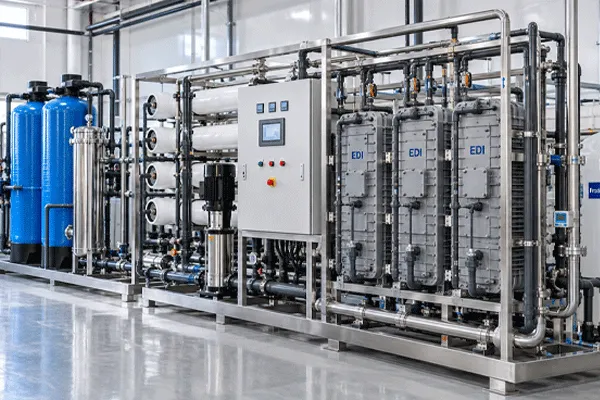
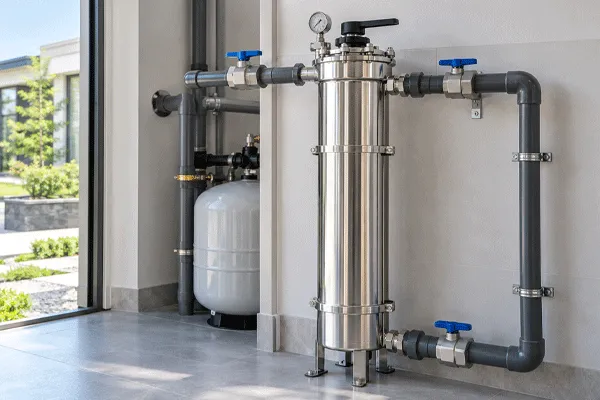
Dirty sediment, microorganisms, unpleasant taste, and uncertain water quality can affect water from every faucet in a building. Treating only the kitchen tap leaves the rest untouched. A properly designed whole house ultrafiltration system provides one central filtration solution before water moves throughout the property.
A whole house ultrafiltration system uses an ultrafiltration membrane to remove fine particles, suspended solids, many bacteria, parasites, and other impurities from the main water supply. Installed as a point-of-entry filter system, it can provide filtered water to bathrooms, kitchens, appliances, and other outlets while usually keeping useful dissolved minerals in the water.
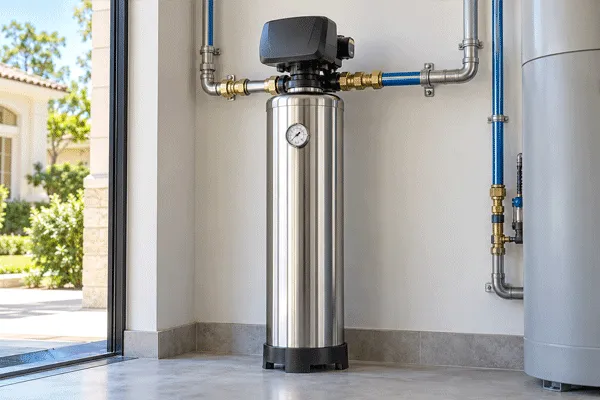
Whole House Ultrafiltration Systems: How a Whole House Water Filter System Delivers Cleaner Water
Article Outline
- What is a whole house ultrafiltration system?
- How does ultrafiltration work?
- What contaminants can a whole house filter remove?
- What are the main filtration stages?
- How does UF compare with carbon, RO, UV, and water softeners?
- Can ultrafiltration treat city water and well water?
- How should a whole house water filter system be sized?
- What maintenance and filter replacement are required?
- How should engineers design a complete filtration system?
- How do you choose the best whole house filtration solution?
- Frequently asked questions.
What Is a Whole House Ultrafiltration System?
A whole house water filtration system is installed at the point where the main water supply enters a home, commercial property, hotel, farm, or other facility. Instead of treating only one drinking water faucet, the system treats the water throughout your home or building before it reaches different outlets.
A standard cartridge filter may mainly remove visible sediment. An ultrafiltration system goes further. It uses a special membrane with extremely small pores to separate fine suspended particles and microorganisms from water. The CDC notes that ultrafiltration membranes typically have pore sizes around 0.01 micron, although actual pore sizes vary by filter design. Ultrafiltration can remove parasites and bacteria and may provide some virus reduction, but it should not be treated as a universal chemical-removal technology.
This difference is important. A good whole house filter is not simply a larger version of a kitchen water purifier. Engineers must consider the incoming water source, peak flow, pressure, contaminant profile, pretreatment, membrane area, cleaning method, and required water quality.
From our engineering perspective, we normally start with the water itself—not the equipment catalog.
Good filtration begins with understanding what is actually present in the water.
How Does Ultrafiltration Work in a Whole House Water Filter System?
Ultrafiltration is a pressure-driven filtration process. Water moves across or through a hollow fiber membrane containing microscopic pores. Water and many small dissolved substances pass through, while larger particles remain on the membrane side.
A simplified process looks like this:
Raw Water → Sediment Pretreatment → Optional Carbon Filter → UF Membrane → Treated Water → Distribution
Inside a hollow fiber ultrafiltration module, thousands of tiny membrane fibers provide a large filtration area in a compact space. Depending on the system design, water may pass from the inside of the fiber outward or from the outside inward.
The membrane acts as a physical barrier. Instead of relying only on adsorption or chemical treatment, the separation depends largely on particle size.
According to the CDC, ultrafiltration is commonly associated with a pore size of roughly 0.01 micron. By comparison, microfiltration is generally coarser, while reverse osmosis uses an even tighter membrane barrier.
This makes UF useful when the treatment goal includes:
- Turbidity reduction
- Fine particle removal
- Suspended sediment control
- Bacteria reduction
- Parasite reduction
- Protection of downstream equipment
- Improved clarity
- Pretreatment before RO
- Water reuse or process water pretreatment
Unlike many RO systems, UF normally allows dissolved minerals and salts to remain in the filtered water. This can be useful when the goal is particle and microbial filtration rather than desalination.
What Can Whole House Ultrafiltration Remove?
No single filter removes every contaminant. This is one of the most important points when choosing water filters.
A UF membrane performs very well against many particles and microorganisms, but it is not designed to remove every dissolved chemical.
| Water Issue |
Typical UF Performance |
Additional Treatment May Be Needed |
| Sand and sediment |
Very good |
Usually no |
| Suspended solids |
Very good |
Usually no |
| Turbidity |
Very good |
Usually no |
| Many bacteria |
Very good |
UV may provide added protection |
| Parasites |
Very good |
Usually no |
| Some viruses |
Limited to good depending on membrane |
UV, NF, or RO may be preferred |
| Chlorine |
Limited |
Carbon filter |
| Taste and odor |
Limited |
Activated carbon |
| Hardness |
Does not remove effectively |
Water softener |
| Dissolved salts |
Does not remove |
Reverse osmosis |
| Lead and other dissolved heavy metals |
Not reliably removed by UF alone |
Specialized media or RO |
| Arsenic |
Not reliably removed |
Specialized treatment or RO |
The CDC specifically advises users to select treatment according to the harmful germs or chemicals actually found in their water. A water filter that removes microorganisms may not remove dissolved chemicals, and vice versa.
This is why we often recommend comprehensive filtration instead of simply installing one membrane module.
For example, if local water contains both suspended solids and noticeable chlorine, a combination such as:
Sediment Filter → Catalytic Carbon Filter → Ultrafiltration
may make more sense than UF alone.
If the water also has high hardness, the system may require a water softener. If high dissolved salt, nitrate, arsenic, or other dissolved contaminants are present, a properly designed RO system may be more suitable.
What Filtration Stages Are Used in a Whole House System?
A practical whole house system may contain two, three, or more filtration stages. The correct configuration depends on the incoming water conditions.
A common 3-stage whole house design can include:
Stage 1: Sediment Filter
The first filter protects downstream equipment from larger particles.
A 5 micron sediment filter is common in many cartridge-based systems, although the required rating should depend on source water and downstream membrane requirements.
It can reduce:
- Sand
- Rust
- Pipe scale
- Dirt
- Visible particulate matter
For water with high sediment loading, washable screens, multimedia filters, automatic backwashing units, or larger pretreatment systems may be better than small disposable filter cartridges.
Stage 2: Carbon Water Filter
An activated carbon or catalytic carbon filter may help reduce chlorine, unpleasant taste, odor, and selected organic compounds.
A carbon water filter is especially useful for treated municipal city water, where chlorine or chloramine may affect taste and membrane operation.
However, removing residual disinfectant from whole-house water requires careful system design. The CDC notes that removing chlorine from all household water may increase the possibility of microbial growth inside plumbing if the system is not properly maintained.
Stage 3: Ultrafiltration Membrane
The UF filter provides the fine physical barrier.
This final filtration step can produce clean, low-turbidity water while maintaining much of the original dissolved mineral content.
For more demanding treatment needs, designers can add:
- UV disinfection
- Water softener
- Iron and manganese removal
- Specialty adsorption media
- Reverse osmosis
- Automatic dosing equipment
- Storage tanks
- Booster pumps
- PLC controls
The result becomes a complete water treatment system rather than a simple cartridge assembly.
Ultrafiltration vs. Carbon Filter vs. Reverse Osmosis: Which Is Better?
There is no universal best whole house treatment technology. Each technology solves different problems.
Consider the treatment goal first.
| Technology |
Main Purpose |
Removes Dissolved Salts? |
Typical Whole House Use |
| Sediment filter |
Sand, rust, particles |
No |
Pretreatment |
| Carbon filter |
Chlorine, taste, odor, some organics |
No |
City water polishing |
| Ultrafiltration |
Fine solids and microorganisms |
No |
Main membrane filtration |
| Water softener |
Calcium and magnesium hardness |
Partly through ion exchange |
Hard water control |
| UV |
Microbial inactivation |
No |
Final disinfection |
| Reverse osmosis |
Dissolved salts and many contaminants |
Yes |
High-purity water |
| EDI |
Ion removal/polishing |
Yes |
Ultrapure industrial water |
A UF filter system typically operates at lower pressure than RO and does not intentionally remove most dissolved minerals. This often allows a strong water flow with less concentrate generation.
Reverse osmosis goes much further. The CDC describes RO membranes as having an approximate pore scale around 0.0001 micron and notes that RO can reduce various dissolved substances, including sodium, chloride, copper, chromium, and lead, depending on the system.
So, if your goal is mainly clear household water with strong particulate and microbial filtration, UF can be attractive.
If your goal is very low TDS or pure water, use RO.
If the main problem is hard water, choose a softener.
If the main concern is chlorine taste, use carbon.
Often, the best answer is not “UF or carbon” but UF plus carbon, designed around the actual feed water.
Can Whole House Filtration Treat City Water and Well Water?
Yes, but city water and well water normally require different treatment strategies.
Municipal tap water has usually already passed through a treatment plant. It may still contain sediment from distribution pipes, chlorine or chloramine, hardness minerals, and other substances that affect taste or household equipment.
A common configuration for municipal water may be:
Sediment → Carbon → UF → Optional UV
This design can improve clarity and taste while adding a membrane barrier before water is distributed throughout the house.
Well water can be more complicated.
Depending on geology and local conditions, it may contain:
- Sand
- Clay
- Iron
- Manganese
- Hardness
- Microorganisms
- Hydrogen sulfide
- Organic material
- High turbidity
- Nitrate
- Other dissolved contaminants
Placing a fine UF filter directly onto difficult well water can cause rapid fouling.
Instead, the system may require:
Raw Well Water → Oxidation → Multimedia/Sediment Filtration → Iron Removal → Softening if Needed → UF → UV
This is why water testing matters.
The CDC recommends testing the water source and selecting treatment according to the actual contaminants present rather than assuming one technology will solve every water problem.
Why Is Hollow Fiber Ultrafiltration Useful for Whole House Filtration?
Hollow fiber UF membranes provide a large membrane surface inside a relatively compact filter housing or module.
This design can support higher treatment capacity without taking up excessive installation space. For homes, villas, apartment buildings, hotels, farms, commercial facilities, and other decentralized applications, compact equipment can be a major advantage.
The main benefits include:
- Fine physical filtration
- High membrane surface area
- Compact system footprint
- Good turbidity control
- Strong removal of suspended material
- Ability to operate without high RO pressure
- Modular capacity expansion
- Relatively high water recovery
- Automatic flushing options
- Compatibility with skid-mounted systems
As a manufacturer of hollow fiber UF membranes and complete treatment equipment, we look beyond the membrane itself.
A membrane that works well in a laboratory can still perform poorly in the field if pretreatment, operating flux, cross-flow conditions, backwash logic, pressure control, or cleaning procedures are wrong.
The actual filtration efficiency of a system therefore depends on both membrane quality and engineering design.
A Simple Engineering Example
Consider an illustrative property with several bathrooms, a kitchen, laundry equipment, and outdoor water demand.
If peak household demand reaches 40 L/min, choosing a membrane rated for only 40 L/min under ideal laboratory conditions leaves almost no operating margin.
A better design evaluates:
- Normal flow
- Peak flow
- Feed pressure
- Temperature
- Turbidity
- Membrane fouling risk
- Backwash flow
- Future capacity demand
The final membrane capacity should support real-world water usage, not just a nominal catalog number.
Whole House Ultrafiltration Systems: How a Whole House Water Filter System Delivers Cleaner Water
How Do Flow Rate, Water Pressure, and Micron Rating Affect Filter Selection?
Many buyers focus only on the micron rating. That is not enough.
A smaller pore size improves particle separation, but it can also increase resistance. When membrane area is too small for the required flow, pressure loss increases and performance can decline.
Three factors should be checked together:
1. Peak Flow Demand
Calculate how much household water may be used at the same time.
A system serving one bathroom needs far less capacity than a villa, apartment block, hotel, or farm.
2. Available Water Pressure
The UF membrane requires pressure to move water through the membrane surface.
If incoming water pressure is low, engineers may need a booster pump.
3. Feed Water Quality
Dirty water increases membrane loading.
More sediment often means:
- More pretreatment
- More frequent backwashing
- Lower design flux
- Larger membrane area
- More frequent cleaning
A well-designed water filter system balances all three.
Installing an oversized system may waste money. Installing an undersized filter system can create poor flow, frequent maintenance, and an unhappy end user.
How Often Does a Whole House Filter Need Maintenance?
Every filtration system requires maintenance.
Claims such as “maintenance-free water purification” should be treated carefully. Even automatic membrane systems require periodic inspection and cleaning.
Maintenance depends on water quality and system configuration.
| Component |
Typical Maintenance Requirement |
| Sediment cartridge |
Inspect and replace according to pressure drop and water condition |
| Carbon filter |
Media replacement based on capacity and chlorine loading |
| UF membrane |
Automatic flushing/backwash plus periodic chemical cleaning |
| UV lamp |
Periodic lamp replacement and quartz sleeve cleaning |
| Water softener |
Salt replenishment and resin maintenance |
| Pumps and valves |
Inspection according to operating hours |
Filter replacement intervals should never be based only on a generic calendar.
A sediment cartridge treating clean municipal water may last much longer than the same cartridge treating turbid well water.
For commercial or engineered whole house filtration systems, useful monitoring parameters include:
- Inlet pressure
- Outlet pressure
- Transmembrane pressure
- Flow rate
- Turbidity
- Backwash frequency
- Chlorine concentration where relevant
- Operating hours
Automatic PLC control can manage flushing and alarm functions.
For larger projects, we may integrate membrane skids with pumps, valves, instruments, control panels, and PLC or SCADA communication. This approach makes operation easier for EPC contractors and facility managers.
How Should an Engineering-Grade Whole House Water Filtration System Be Designed?
A high-quality whole house water filter system should begin with water analysis.
The CDC and other public-health guidance consistently emphasize matching treatment technology to the actual contamination problem. Different water filters remove different substances.
Our usual engineering workflow is:
- Analyze feed water
- Turbidity
- TDS
- Hardness
- Iron
- Manganese
- Chlorine
- Microbial concerns
- Organic load
- Other target contaminants
- Confirm treatment objective
- General clean water
- Potable water pretreatment
- Process water
- RO pretreatment
- Reuse
- Commercial water supply
- Calculate flow demand
- Average flow
- Peak flow
- Daily consumption
- Select pretreatment
- Sediment filter
- Multimedia filter
- Carbon
- Softening
- Chemical dosing
- Size the UF membrane
- Membrane area
- Design flux
- Recovery
- Cleaning strategy
- Design automation
- Pressure protection
- Automatic flushing
- Backwash
- Alarms
- PLC controls
- Plan long-term service
- Spare membrane modules
- Replacement components
- Technical documentation
- Commissioning support
This engineering approach is especially useful for distributors, system integrators, hotels, farms, commercial buildings, and EPC companies that need more than an off-the-shelf water purifier.
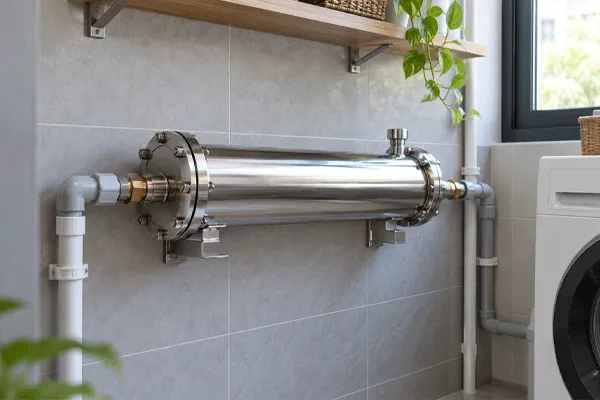
Whole House Ultrafiltration Systems: How a Whole House Water Filter System Delivers Cleaner Water
How Do You Choose the Best Whole House Filtration System?
The best system is the one that matches your local water.
Do not begin by asking, “Which filter has the smallest pore size?”
Instead, ask:
- What is in my water?
- Which contaminant must be removed?
- How much water do I need?
- What peak flow is required?
- Is the source municipal or well water?
- Do I have hardness problems?
- Do I need chlorine removal?
- Do I need drinking water quality at every outlet?
- Is RO required?
- How much maintenance can the operator manage?
For simple municipal applications, a compact UF system may be enough.
For chlorine, taste, and odor, add carbon.
For hard water, combine it with a water softener.
For microbial risk, consider UF plus UV.
For high dissolved salts or certain dissolved heavy metals, add reverse osmosis or specific treatment media.
The objective is not simply clean water from every tap. The objective is stable water quality without unnecessary complexity.
NSF also recommends checking independently verified performance claims. Standards such as NSF/ANSI 42 relate to aesthetic effects such as chlorine taste and odor, while NSF/ANSI 53 covers certain contaminants with health effects.
If certification is important for your market, confirm exactly which standard and contaminant reduction claim applies to the selected equipment.
Whole House UF Systems for Commercial and Engineering Projects
The term whole house is usually associated with residential filtration, but the same point-of-entry idea can scale to larger projects.
Hollow fiber UF membrane systems can also serve:
- Villas
- Apartment buildings
- Hotels
- Schools
- Farms
- Restaurants
- Worker camps
- Commercial buildings
- Small communities
- Industrial facilities
- RO pretreatment projects
- Reuse projects
A small property may use a simple manual unit. A commercial installation may need multiple UF membrane modules, automatic valves, tanks, pumps, dosing systems, online instruments, and PLC control.
This is where factory-engineered filtration systems offer an advantage.
As a water and wastewater treatment equipment manufacturer, we can integrate UF with:
- Hollow fiber membrane modules
- Multimedia pretreatment
- Carbon filtration
- Reverse osmosis
- EDI
- Chemical dosing
- UV
- Storage tanks
- Pumps
- PLC / SCADA controls
- Containerized equipment
- Skid-mounted equipment
This makes the technology suitable not only for home water, but also for distributors, EPC contractors, engineering companies, and commercial project developers looking for customized water treatment packages.
Frequently Asked Questions About Whole House Ultrafiltration Systems
Is ultrafiltration water safe to drink?
UF can significantly improve microbiological and particulate water quality by removing sediment, parasites, and many bacteria. However, whether the final drinking water is safe depends on the original water and contaminants present.
UF does not reliably remove every dissolved chemical. Test the water first and add carbon, UV, RO, or other treatment when required.
Does a whole house UF filter remove chlorine?
Not effectively by itself.
If chlorine reduction is required, an activated carbon or catalytic carbon stage is commonly added. The system should still be designed carefully because removing disinfectant from the incoming main water can affect microbial conditions in downstream plumbing.
Does ultrafiltration remove hard water?
No.
Hardness comes mainly from dissolved calcium and magnesium. These ions are small enough to pass through an ultrafiltration membrane.
Install a water softener if hardness reduction is required.
Is ultrafiltration better than reverse osmosis?
Neither technology is always better.
UF is suitable for removing suspended solids and many microorganisms while retaining most dissolved minerals. RO provides much stronger removal of dissolved salts and many dissolved contaminants.
UF is often selected for general filtration or RO pretreatment, while reverse osmosis is preferred when low-TDS or high-purity water is required.
Can UF be used for well water?
Yes, but pretreatment is often essential.
A well water source with high sediment, iron, manganese, hardness, or organic matter can foul the membrane quickly. Water analysis should determine whether multimedia filtration, oxidation, iron removal, softening, carbon, or other stages are necessary before UF.
Every filter creates some pressure loss.
A properly sized system should keep this within an acceptable range. Large pressure losses usually indicate insufficient membrane area, dirty pretreatment, membrane fouling, low incoming pressure, or an undersized system.
For larger installations, engineers may include booster pumps and automatic pressure monitoring.
Final Thoughts: Building the Right Whole House Filtration System
A whole house ultrafiltration system can be an effective way to improve the quality of water entering an entire property. The membrane provides a strong physical barrier against sediment, turbidity, parasites, bacteria, and other suspended impurities while generally allowing dissolved minerals to remain.
But the membrane is only one part of the solution.
Good results depend on understanding the raw water, choosing suitable pretreatment, sizing the membrane correctly, protecting water flow, and planning long-term maintenance.
As a manufacturer and engineering-oriented supplier of hollow fiber UF membranes, MBR membranes, RO membranes, EDI modules, pure water plants, wastewater treatment plants, and integrated membrane filtration systems, we approach each project as a complete water treatment problem rather than simply selling a filter.
For distributors, EPC companies, hotels, farms, commercial facilities, industrial users, and engineering contractors, we can develop customized membrane systems according to feed water analysis, capacity, installation space, automation requirements, and final water quality targets.
Key Things to Remember
- Whole house filtration treats water at the point of entry, so water can be filtered before reaching multiple faucets and appliances.
- Ultrafiltration commonly uses a membrane around the 0.01-micron scale.
- UF is highly effective for sediment, turbidity, parasites, and many bacteria.
- UF does not replace RO when dissolved salt removal is required.
- A UF filter does not function as a water softener.
- Use carbon when chlorine, taste, or odor reduction is required.
- Well water often needs more pretreatment than municipal water.
- The correct membrane size depends on peak flow, feed pressure, temperature, and water quality.
- Automatic flushing and proper maintenance help maintain stable membrane performance.
- Water testing should come before equipment selection.
- For demanding projects, combine UF with carbon, UV, softening, RO, or other processes.
- The best solution is not the filter with the most stages—it is the treatment system designed around your actual water conditions.
Reference Sources
Technical guidance in this article is aligned with current information from the U.S. Centers for Disease Control and Prevention, the U.S. Environmental Protection Agency, and NSF regarding household water treatment, ultrafiltration, reverse osmosis, point-of-entry filtration, and treatment-system certification.












 09:30