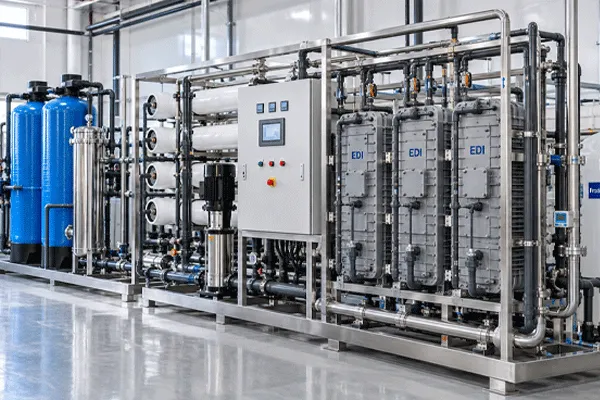
Producing high-purity water can become expensive when a plant depends on frequent chemical regeneration, unstable ion exchange performance, or complex operator work. An EDI skid solves much of this problem by combining membrane separation, ion exchange resin, and electricity in one continuous polishing system.
An EDI skid is a preassembled electrodeionization water treatment system used mainly after reverse osmosis. It continuously removes ionizable impurities from RO permeate by combining ion exchange resin, selective membranes, and a DC electric field. Unlike conventional deionizers, EDI normally does not require routine acid-and-caustic chemical regeneration, making it well suited to continuous high-purity and ultrapure water production.
What Is an EDI Skid? How Electrodeionization Water Treatment Systems Work
Article Outline
- What is an EDI skid?
- How does the electrodeionization process work?
- What components make up an EDI water treatment system?
- Why is reverse osmosis normally installed before EDI?
- How does EDI compare with traditional ion exchange?
- What water quality can an EDI system produce?
- What feed-water conditions does an EDI unit need?
- Where is EDI used in industrial applications?
- What are the main advantages and limits of EDI?
- How should an electro-deionized water treatment skid be designed?
- How is an EDI system operated and maintained?
- How should EPC contractors select an EDI system supplier?
- Frequently asked questions
- Key points to remember
What Is an EDI Skid in a Water Treatment System?
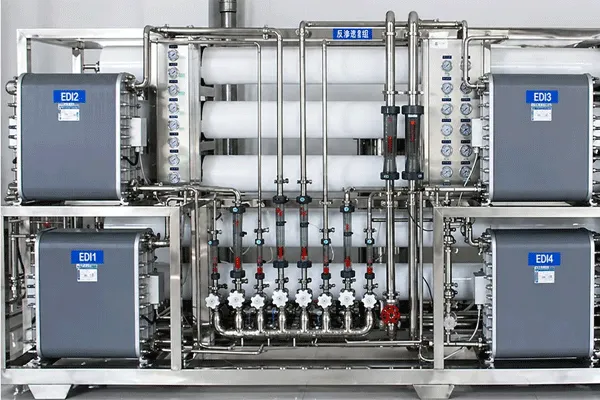
EDI stands for electrodeionization. An EDI skid is a factory-assembled water purification package that contains one or more EDI modules together with the equipment needed to operate, monitor, and control them.
The skid normally receives highly purified feed water from a reverse osmosis system. It then removes many of the remaining dissolved ionic impurities to make deionized water or high-purity process water.
A simplified treatment train looks like this:
Raw Water
    ↓
Pretreatment
    ↓
Reverse Osmosis
    ↓
RO Permeate
    ↓
EDI Skid
    ↓
High-Purity Water
The word “skid” refers to the physical package. Pumps, valves, EDI modules, instruments, piping, electrical components, and controls are mounted on a structural frame so the system can be manufactured and tested before shipment.
This is useful for EPC projects because much of the piping and electrical integration takes place in the factory rather than at the project site.
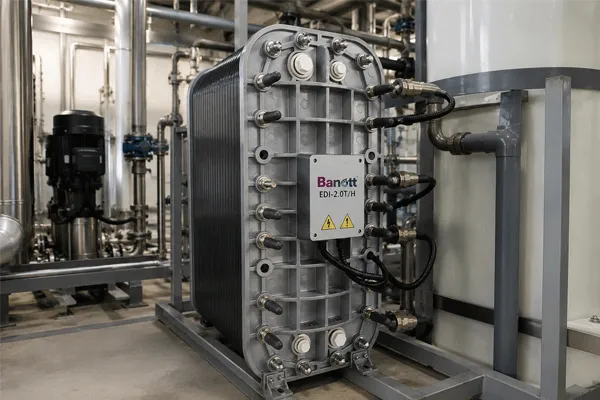
An EDI module, by contrast, is only the core separation device. An EDI system or skid integrates the module into an operating water treatment package.
How Does the Electrodeionization Process Work?
The EDI process combines three technologies:
- Ion exchange resin
- Ion exchange membranes
- Direct electrical current
The resin captures dissolved ions from the water. The applied electric field then causes those ions to migrate through selective membranes and into concentrate channels.
Positively charged ions, called cations, include substances such as:
- Sodium
- Calcium
- Magnesium
- Ammonium
Negatively charged ions, called anions, include:
- Chloride
- Sulfate
- Nitrate
- Bicarbonate
- Silicate species under suitable conditions
The EDI stack contains alternating ion-selective membranes. Cation-exchange membranes favor the movement of positively charged ions, while anion-exchange membranes favor negatively charged ions.
A simplified view is:
                    DC Electric Field
              (+) -------------------- (-)

Feed Water
    ↓
┌─────────────────────────────────────────┐
│ Resin-Filled Diluting Chamber           │
│                                         │
│   Cations ──────► Cation Membrane       │
│   Anions  ◄────── Anion Membrane        │
│                                         │
│    Purified Water Continues Forward     │
└─────────────────────────────────────────┘
       ↓                         ↓
 Product Water              Concentrate
As ions migrate away from the product stream, the product water becomes progressively more deionized.
A key feature is the behavior of the resin. In conventional ion exchange, exhausted resin normally requires acid or caustic regeneration. In EDI, electrical conditions inside the module promote water splitting into hydrogen and hydroxide ions. These help continuously regenerate the resin during operation.
That is why electrodeionization is often described as a continuous process. Veolia describes continuous EDI as using resin, membranes, and electricity to continuously polish RO permeate without routine chemical regeneration.
What Is an EDI Skid? How Electrodeionization Water Treatment Systems Work
What Components Make Up an EDI Water Treatment System?
An industrial EDI water treatment system contains much more than the EDI module itself.
A typical skid can include:
| Component |
Function |
| EDI module |
Removes remaining ionizable impurities |
| Feed isolation valve |
Controls incoming RO permeate |
| Pressure regulator |
Maintains suitable operating pressure |
| Flow meters |
Measure product and concentrate flow |
| Pressure gauges/transmitters |
Monitor hydraulic conditions |
| Conductivity/resistivity meter |
Checks product water quality |
| DC power supply |
Provides the electric field |
| Control panel |
Operates and protects the system |
| PLC/HMI |
Automation and process monitoring |
| Piping and valves |
Direct feed, product, and concentrate streams |
| Sample points |
Allow water-quality testing |
| Frame/skid |
Supports the complete package |
Larger systems may use several EDI devices in parallel to achieve the required water production capacity.
The system also needs interlocks. For example, the DC power should not operate without correct water flow. Low flow, excessive pressure, poor inlet quality, or another abnormal condition may trigger an alarm or shutdown.
For EPC contractors, we usually recommend considering the EDI skid as part of the entire water treatment system, not as a separate box. RO quality, degassing, pumping, storage, recirculation, instrumentation, and downstream hygiene all affect final performance.
Why Is Reverse Osmosis Normally Installed Before EDI?
EDI is a polishing technology. It is generally not designed to accept untreated raw water.
Reverse osmosis therefore performs most of the bulk desalination first.
A common system arrangement is:
Raw Water
   ↓
Pretreatment
   ↓
RO
   │
   ├── Removes Most Dissolved Salt
   ↓
EDI
   │
   └── Polishes Remaining Ions
   ↓
High Purity Water
Veolia’s commercial RO-CEDI systems combine reverse osmosis and continuous electrodeionization on one skid specifically to produce demineralized, high-grade water.
This arrangement has an important economic benefit.
If an EDI unit had to process water with very high ionic loading, it would need to move far more ions through its selective membranes. That creates greater electrical demand, scaling risk, and performance problems.
RO lowers this burden first.
The reverse osmosis system also reduces:
- Hardness
- Sodium
- Chloride
- Sulfate
- Many dissolved contaminants
- Silica to varying degrees
- Organic contamination to varying degrees
EDI then handles the much smaller ionic load remaining in the RO permeate.
For high-purity systems, a membrane degasser may also be installed before EDI to control carbon dioxide. CO₂ is important because it is not strongly rejected as an ion in its dissolved molecular form and can add to the ionic load after entering the EDI environment.
DuPont’s EDI technical guidance specifically notes that excessive CO₂ and alkalinity can significantly reduce product-water quality.
How Does EDI Compare With Traditional Ion Exchange?
Both EDI and traditional ion exchange can produce demineralized water. The big difference is how the ion exchange resin is regenerated.
In a conventional mixed-bed or two-bed deionization system, resin eventually becomes exhausted. Operators normally use acids and caustic chemicals to restore its exchange capacity.
EDI uses electricity to keep the resin active during operation.
| Factor |
EDI |
Traditional Ion Exchange |
| Ion removal |
Continuous |
Batch/cyclic |
| Resin |
Yes |
Yes |
| Selective membrane |
Yes |
Usually no |
| Electrical field |
Yes |
No |
| Routine acid/caustic regeneration |
Normally not required |
Required |
| Feed requirement |
High-quality pretreated water |
Can accept broader conditions depending on design |
| Water quality stability |
Continuous when operated correctly |
Can change through service/regeneration cycle |
| Automation |
High |
Can be automated but regeneration remains necessary |
| Chemical storage |
Lower for regeneration |
Acid/caustic normally required |
This is one reason EDI has become attractive for facilities that want to reduce the routine handling of hazardous chemicals.
However, “chemical-free” should not be taken too literally.
EDI eliminates routine chemical regeneration of the resin during normal production, but an industrial plant may still require chemicals elsewhere for:
- RO pretreatment
- pH control
- Membrane cleaning
- Sanitization
- CIP operations
- Scale control
The real advantage is the removal of the recurring acid-and-caustic regeneration cycle that characterizes many traditional ion exchange systems.
What Water Quality Can an EDI System Produce?
EDI is used when ordinary RO permeate is not pure enough.
Under suitable feed-water and operating conditions, commercial electrodeionization systems can produce water with resistivity approaching 18 MΩ·cm. Veolia states that some integrated RO-CEDI systems are designed to produce deionized water up to approximately 18 MΩ·cm.
Higher resistivity generally indicates lower ionic contamination.
A simplified comparison is:
| Water stage |
Typical relative ionic purity |
| Raw water |
Low |
| Softened water |
Similar total ions, lower hardness |
| RO permeate |
High |
| RO + EDI product |
Very high |
| RO + EDI + final polishing |
Suitable for demanding ultrapure applications when properly engineered |
Actual performance must be defined by the specific project.
Do not select an EDI system only because a brochure states “18 MΩ·cm.” Product-water quality depends on:
- Feed conductivity
- CO₂
- Silica
- Temperature
- Feed hardness
- EDI module loading
- Recovery
- Flow rate
- Electrical current
- System condition
In addition, industries often control more than conductivity or resistivity.
They may also specify:
- Silica
- Sodium
- Total organic carbon
- Bacteria
- Particles
- Dissolved oxygen
- Boron
- Chloride
For semiconductor, pharmaceutical, and other ultrapure water projects, EDI may be one stage in a much larger purification train.
What Feed-Water Conditions Does an EDI Unit Need?
Good EDI performance starts with good pretreated water.
Hardness is especially important. Calcium and magnesium can form scale inside the EDI concentrate zones because local pH conditions may favor precipitation.
For example, DuPont’s current EDI-310 technical manual specifies maximum hardness of 0.5 mg/L as CaCO₃ at 90% recovery and 0.1 mg/L at 95% recovery for that particular module. These figures illustrate how low EDI feed hardness may need to be; the correct limit must always come from the selected module manufacturer.
Other important feed-water parameters include:
- Conductivity
- Hardness
- CO₂
- Alkalinity
- Silica
- Iron
- Manganese
- Organic contamination
- Chlorine or other oxidants
- Temperature
- pH
Why does silica matter?
Silica can cause difficult deposits under unsuitable water conditions. DuPont warns that excessive influent silica can reduce EDI performance and may contribute to irreversible scaling in concentrate chambers.
Why does CO₂ matter?
Carbon dioxide can pass through RO relatively easily compared with ionic salts. Once it enters an EDI unit, reactions involving bicarbonate and carbonate add ionic load.
For water with significant CO₂, engineers may use:
- pH adjustment
- Membrane degassing
- Decarbonation
- Improved RO configuration
The exact solution depends on the complete feed analysis.
Where Is EDI Used in Industrial Applications?
The industrial applications of EDI are concentrated in processes that need continuous, reliable, low-conductivity water.
Power generation
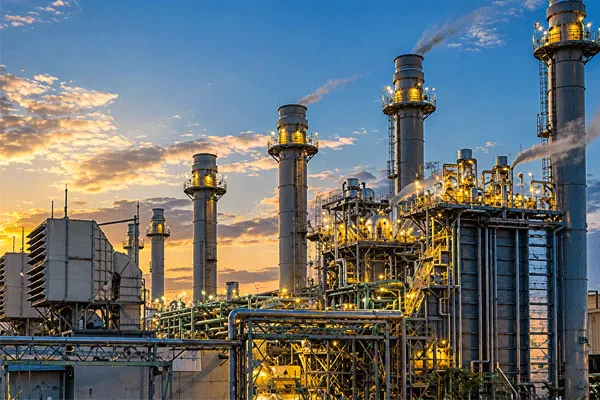
EDI is widely associated with power generation, including production of demineralized water for boiler feed and turbine-related applications.
Veolia specifically lists boiler feed and turbine injection among the applications for integrated RO-CEDI plants.
Low ionic contamination helps reduce:
- Boiler deposits
- Corrosion risk
- Steam contamination
- Turbine deposition
Pharmaceutical production
Pharmaceutical facilities use purified water systems with tightly controlled microbiological and chemical quality.
EDI can form part of the purification train after RO, although using an EDI module does not by itself guarantee compliance with a pharmacopeial standard. The entire sanitary design, storage, distribution, monitoring, validation, and operating procedure must meet the applicable requirement.
Semiconductor and electronics manufacturing
Electronics plants need extremely low contamination levels for processes such as:
- Wafer rinsing
- Component cleaning
- Surface preparation
- Chemical blending
RO + EDI is often followed by additional polishing for full ultrapure water production.
Food and beverage facilities
EDI can provide high-quality process water where mineral content must be tightly controlled.
Laboratories and general manufacturing
Labs, coatings, specialty chemical processes, data centers, and many other facilities may use EDI where consistent high purity water is required. Veolia lists power, food and beverage, microelectronics, metals, general manufacturing, and data centers among applications for its RO-CEDI systems.
What Is an EDI Skid? How Electrodeionization Water Treatment Systems Work
What Are the Main Advantages and Limitations of EDI?
The main attraction of electrodeionization is continuous demineralization without routine acid-and-caustic resin regeneration.
Main advantages
- Continuous water production
- Stable product quality
- No routine resin chemical regeneration
- Lower chemical storage requirements
- Compact footprint
- High automation potential
- Easy integration after RO
- Suitable for skid-mounted systems
- Reduced operator intervention
- Useful for high-purity industrial water
Continuous operation also removes the service/regeneration quality cycling found in some conventional deionization systems.
Important limitations
EDI is not suitable for every feed stream.
Its limits include:
- Need for good pretreatment
- Sensitivity to hardness
- Sensitivity to excessive CO₂
- Scaling risk from silica and minerals
- Electrical power requirement
- Need for correct hydraulic flow
- Limited tolerance of major upstream treatment failures
- Higher engineering demands than a basic cartridge filtration system
In other words:
EDI is an excellent polishing technology, but a poor substitute for proper pretreatment.
An EDI module cannot repair a badly designed RO system.
How Should Electro-Deionized Water Treatment Skids Be Designed?
Good electro-deionized water treatment skids begin with a process specification rather than a module model.
Before sizing the equipment, engineers need to know:
- RO permeate flow
- RO permeate conductivity
- Hardness
- CO₂
- Silica
- Temperature
- Required product resistivity
- Product silica requirement
- Daily operating hours
- Required redundancy
- Available footprint
- Power supply
- Automation requirements
Typical engineering workflow
Feed Water Analysis
        ↓
RO System Design
        ↓
RO Permeate Analysis / Projection
        ↓
EDI Load Calculation
        ↓
EDI Module Selection
        ↓
Hydraulic Design
        ↓
Power Supply Selection
        ↓
Instrumentation
        ↓
PLC / HMI Programming
        ↓
Skid Fabrication
        ↓
Factory Testing
        ↓
Shipping & Commissioning
For large systems, several modules can operate in parallel.
For example:
               ┌── EDI Module 1 ──┐
RO Permeate ───┼── EDI Module 2 ──┼──► Product Water
               ├── EDI Module 3 ──┤
               └── EDI Module 4 ──┘
This modular structure also allows engineers to provide redundancy. A project may use an N+1 configuration when uptime is critical.
Skid-based designs are especially useful for containerized plants and EPC projects because the equipment can be assembled, wired, inspected, and partly commissioned before arriving on site.
Commercial plug-and-play RO-CEDI systems are also offered for container transport and fast installation, demonstrating the practicality of this approach.
How Is an EDI System Operated and Maintained?
EDI requires less routine regeneration work than conventional deionizers, but it is not maintenance-free.
Operators should monitor:
- Feed conductivity
- Product conductivity
- Product resistivity
- Feed pressure
- Product pressure
- Concentrate pressure
- Feed flow
- Product flow
- Concentrate flow
- Module voltage
- Module current
- Temperature
Stable trending is often more useful than one isolated measurement.
Typical warning signs
| Observation |
Possible cause |
| Product resistivity falls |
Feed quality change, CO₂, module loading |
| Pressure drop increases |
Fouling or obstruction |
| Electrical current changes sharply |
Feed ionic load or operating problem |
| Product flow drops |
Hydraulic restriction |
| Silica rises |
Upstream or EDI performance issue |
| Hardness appears in feed |
RO or pretreatment upset |
The upstream RO system should also be monitored closely.
If RO rejection suddenly deteriorates, the ionic load entering the EDI system can rise sharply. Continuing to run the EDI skid without correction may lead to scaling or poor product water quality.
Good PLC programming can therefore include alarms for:
- High feed conductivity
- Low flow
- High pressure
- Poor product resistivity
- Power-supply fault
- Tank level
- Pump fault
This is one reason automation matters in an integrated water treatment plant.
How Does an EDI Skid Fit Into a Complete Pure Water Treatment Plant?
For most industrial projects, EDI is not a stand-alone treatment technology.
A complete system might look like this:
Raw Water
    ↓
Multimedia / UF Pretreatment
    ↓
Activated Carbon or Dechlorination
    ↓
Cartridge Filter
    ↓
Reverse Osmosis
    ↓
CO₂ Control if Required
    ↓
EDI
    ↓
UV / Final Polishing if Required
    ↓
Pure Water Tank
    ↓
Distribution Loop
A more demanding electronics system might use:
Pretreatment
     ↓
RO
     ↓
Second-Pass RO
     ↓
EDI
     ↓
UV
     ↓
TOC Polishing
     ↓
Final UF
     ↓
Ultrapure Water
Wastewater-reuse projects may begin much earlier:
Industrial Wastewater
       ↓
Biological Treatment
       ↓
MBR
       ↓
RO
       ↓
EDI
       ↓
High-Quality Reuse Water
This integrated approach is central to our work as a manufacturer and engineering-oriented provider of water and wastewater treatment systems in China.
We manufacture and integrate:
- Hollow fiber MBR membranes
- Hollow fiber UF membranes
- Flat sheet MBR membranes
- RO membranes
- EDI modules
- Small RO machines
- Pure water treatment plants
- Wastewater treatment plants
- Containerized systems
- Skid-mounted treatment equipment
For an EPC project, that means the MBR, UF, RO, EDI, pumps, instrumentation, tanks, PLC/SCADA controls, and technical documents can be considered as one engineered process rather than a collection of unrelated components.
What Should EPC Contractors Look for in an EDI Equipment Supplier?
For an industrial buyer, an inexpensive EDI module does not necessarily create an inexpensive water plant.
A poor design can lead to:
- Low product resistivity
- Frequent alarms
- Scaling
- Reduced module life
- High reject flow
- Unstable capacity
- Commissioning delays
Before buying EDI equipment, ask the supplier to confirm:
| Requirement |
What you should receive |
| Feed-water specification |
Clear limits |
| Product-water target |
Resistivity/conductivity and other parameters |
| Flow rate |
Nominal and operating capacity |
| Recovery |
Design value |
| Module model |
Datasheet and quantity |
| Electrical design |
Voltage/current/power supply |
| P&ID |
Complete process layout |
| Instrumentation |
Brand, range, signal |
| Control philosophy |
PLC/HMI logic |
| Materials |
Piping, frame, wetted components |
| Testing |
FAT plan |
| Documentation |
Manuals and drawings |
| Spare parts |
Recommended list |
| Commissioning |
Remote or on-site support |
We also recommend sending your supplier the real feed-water analysis rather than asking only:
“How much is a 10 m³/h EDI skid?”
Two plants with the same flow may need different designs because their RO permeate contains different levels of CO₂, hardness, silica, and other ionizable species.
For EPC contractors, municipal and industrial engineering companies, pharmaceutical plants, semiconductor manufacturers, food and beverage factories, and international distributors, the better purchasing sequence is:
water analysis → product-water requirement → process design → equipment selection → commercial quotation.
That reduces risk for everyone.
Frequently Asked Questions
What does EDI mean in water treatment?
EDI means electrodeionization. It combines ion exchange resin, selective membranes, and direct electrical current to continuously remove dissolved ionic impurities from highly pretreated water.
What is the difference between an EDI module and an EDI skid?
An EDI module is the core deionization device. An EDI skid includes the module plus piping, valves, electrical power supplies, instrumentation, controls, and a structural frame needed to operate it as a complete system.
Does EDI need reverse osmosis before it?
In most industrial high-purity applications, yes. RO removes most of the dissolved salt first, allowing EDI to polish the remaining ions efficiently. EDI should normally receive high-quality, low-hardness pretreated water.
Can EDI replace a mixed-bed ion exchanger?
In many RO polishing applications, EDI can replace conventional regenerable ion exchange and avoid routine acid-and-caustic regeneration. However, each process has different feed-water limits, investment costs, and operating requirements.
Can EDI produce 18 MΩ·cm water?
Commercial EDI systems can approach about 18 MΩ·cm under suitable operating and feed-water conditions. It should not be treated as a guaranteed value without reviewing feed quality, temperature, CO₂, loading, and the selected module.
Does EDI use chemicals?
EDI normally does not need the regular acid and caustic regeneration used by conventional ion exchange. However, the complete water plant may still use chemicals for RO pretreatment, pH adjustment, cleaning, sanitization, or scale control.
Key Things to Remember
- An EDI skid is a packaged electrodeionization system used to produce high-purity deionized water.
- EDI combines ion exchange resin, ion exchange membranes, and an electric field.
- Cations and anions migrate away from the product stream under electrical force.
- Electrical conditions help continuously regenerate the ion exchange resin.
- EDI therefore avoids routine acid-and-caustic regeneration during normal operation.
- A reverse osmosis system normally comes before EDI.
- RO performs bulk desalination; EDI performs final ionic polishing.
- An EDI module and an EDI skid are not the same thing.
- The skid includes modules, power supplies, piping, valves, instrumentation, controls, and structural support.
- Hardness must be kept very low to control scaling.
- CO₂, silica, conductivity, temperature, and RO performance all affect EDI operation.
- Suitable systems can produce very high purity water, potentially approaching 18 MΩ·cm under proper conditions.
- EDI is widely used in power generation, pharmaceuticals, electronics, laboratories, food and beverage, and industrial process water.
- EDI is not a replacement for good pretreatment.
- Industrial buyers should evaluate the complete RO-EDI treatment train rather than purchasing an EDI module only by flow rate.
- Skid-mounted and containerized designs can reduce site installation and commissioning work.
- For complex EPC projects, supplying MBR, UF, RO, EDI, automation, documentation, commissioning, and spare parts as an integrated solution can simplify interfaces and improve long-term plant reliability.











 18:05
18:05