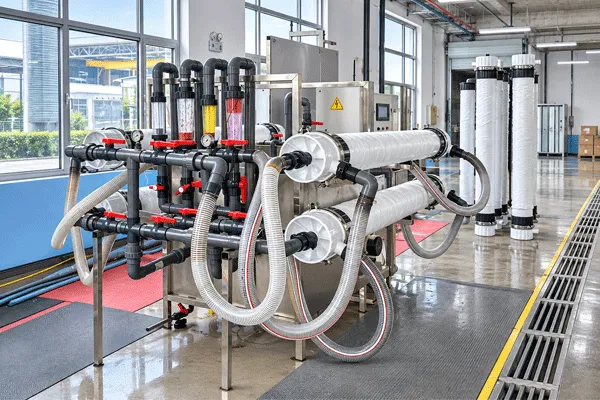
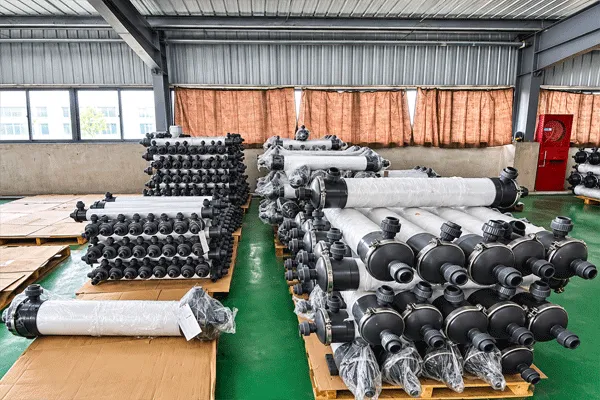
Dirty, hard, salty, or contaminated water can damage equipment, interrupt production, and lower product quality. Using the wrong treatment makes the problem more expensive. Industrial water treatment solves this by testing the source water first, then combining the right purification technologies for the required final water quality.
To purify water industrially, plants normally combine pretreatment, sediment and membrane filtration, activated carbon or softening when needed, reverse osmosis for dissolved salts, and UV or EDI for final polishing. The correct purification system depends on the raw water, flow rate, contaminants, industrial process, and required quality of the purified water.
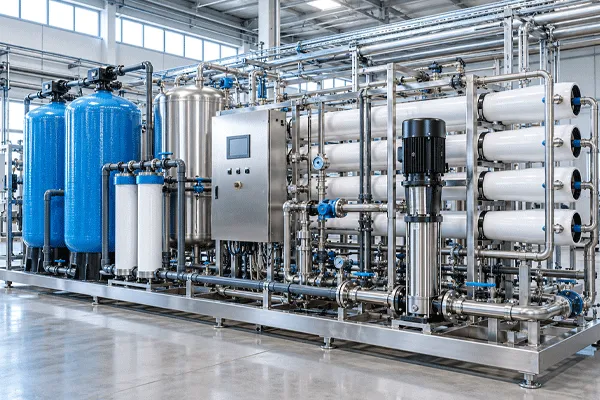
How to Purify Water Industrially: A Complete Guide to Industrial Water Treatment and Purification
Article Outline
- What does industrial water purification mean?
- Why is water quality testing the first step?
- What types of industrial water require treatment?
- How does pretreatment and filtration work?
- When should ultrafiltration be used?
- How does reverse osmosis purify industrial water?
- When are softening, carbon and heavy-metal removal needed?
- How do UV, EDI and polishing produce high-purity water?
- How is an industrial water treatment system designed?
- Can purified wastewater be reused in industrial processes?
- What is the future of industrial water treatment?
- Frequently asked questions
What Does Industrial Water Treatment and Purification Mean?
Industrial water treatment means changing the quality of water so it becomes suitable for a specific manufacturing, utility, cleaning, cooling, boiler, or high-purity application.
The important phrase here is specific application.
There is no universal definition of “clean enough” for every factory. Water that works well in a cooling tower may be unsuitable for pharmaceutical production. Water that is acceptable for equipment washing may damage a semiconductor process.
The U.S. Geological Survey notes that industrial water is used for many purposes, including processing, washing, cooling, transporting materials, sanitation, and incorporation into manufactured products.
That means the correct purification process depends on what the water will do after treatment.
Typical goals may include:
- Removing suspended solids
- Reducing turbidity
- Removing chlorine
- Controlling hardness
- Removing iron and manganese
- Reducing dissolved salts
- Controlling microorganisms
- Removing selected heavy metals
- Producing high-purity water
- Recovering wastewater for reuse
In our engineering approach, we therefore do not start by asking, “Which water purifier should the factory buy?”
We start with two questions:
What is in the source water, and what water quality does the process actually need?
Why Is Water Quality Testing the First Step?
Before designing any water treatment system, test the incoming water.
This may sound obvious, but it is one of the most important steps in industrial project design.
A laboratory or project-specific water quality testing program may evaluate:
- pH
- Turbidity
- Conductivity
- TDS
- Hardness
- Calcium
- Magnesium
- Silica
- Iron
- Manganese
- Chloride
- Sulfate
- Alkalinity
- Organic matter
- COD or TOC where relevant
- Microbial indicators
- Specific industrial contaminants
The required list depends on the water source.
Municipal water, groundwater, surface water, seawater, industrial wastewater, and reclaimed water all present different treatment challenges.
Why Testing Matters
Suppose two factories both need 10 m³/h of process water.
Factory A receives relatively clean municipal water with moderate hardness.
Factory B uses turbid groundwater with iron, hardness, and high TDS.
The required flow is the same, but the two water purification systems should be completely different.
Without reliable feed-water data, designers risk:
- Membrane fouling
- Scaling
- Poor salt rejection
- Excessive chemical use
- Short filter life
- Unstable product water
- Higher operating cost
The best industrial water treatment system is therefore not the most complicated one. It is the one built around measured water conditions and actual process requirements.
What Types of Water Are Used in Industrial Applications?
Factories do not use one single grade of water.
Different types of water may exist within the same plant.
| Industrial Water Type |
Typical Use |
Typical Treatment Level |
| Utility water |
Washing, general plant use |
Basic filtration |
| Cooling water |
Cooling towers and heat exchange |
Filtration + conditioning |
| Boiler feed water |
Steam generation |
Softening / RO / polishing |
| Process water |
Production processes |
Depends on process |
| Purified water |
Food, pharmaceutical, electronics |
RO and polishing |
| High-purity water |
Sensitive production |
RO + EDI or mixed bed |
| Reclaimed water |
Cooling, washing, utility reuse |
Biological + membrane treatment |
USGS identifies processing, washing, cooling, transportation, sanitation, and product manufacturing as major industrial uses of water.
This explains why a factory may need several different treatment lines.
Cooling Water
Cooling water may not require ultra-high purity.
However, hardness, suspended solids, microorganisms, and corrosion-related constituents must often be controlled.
Boiler Water
Boiler applications are much more sensitive to scale-forming ions.
Depending on boiler pressure and steam requirements, a plant may use:
Softening → Reverse Osmosis → EDI or Polishing
Process Water
Water for various production processes can have very specific requirements.
Food production, textile processing, pharmaceutical manufacturing, chemicals, electronics, and semiconductor production all use water differently.
The treatment design must follow the application rather than a generic definition of “pure water.”
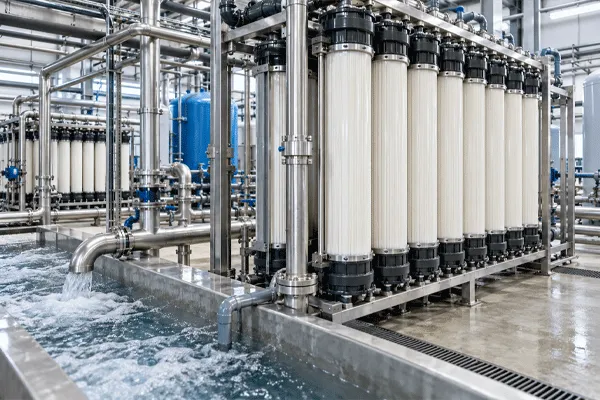
How to Purify Water Industrially: A Complete Guide to Industrial Water Treatment and Purification
How Does Pretreatment and Filtration Purify Industrial Water?
Pretreatment protects the expensive technologies that follow.
If raw water contains sand, suspended matter, colloids, oxidants, hardness, or organic contamination, sending it directly into an RO membrane can create rapid fouling and unstable operation.
A typical pretreatment train may look like:
Raw Water
   ↓
Screen / Strainer
   ↓
Multimedia Filtration
   ↓
Activated Carbon
   ↓
Softening or Chemical Dosing
   ↓
Cartridge Filter
   ↓
UF or RO
Different filtration methods remove contaminants at different sizes and by different mechanisms.
Sediment and Multimedia Filtration
These filters reduce:
- Sand
- Rust
- Suspended matter
- Turbidity
- Larger particles
EPA guidance notes that sediment and microporous filtration physically remove suspended material based on the filtration rating of the media or membrane.
Activated Carbon
Activated carbon is useful for adsorption.
It may be applied to control:
- Chlorine
- Taste and odor
- Selected organic substances
EPA describes granular activated carbon as a highly porous adsorption medium with a very large internal surface area.
For RO projects, chlorine control can also be important because membrane compatibility depends on the specific membrane chemistry.
This is why the filtration system should be considered as one integrated process.
When Should Ultrafiltration Be Used for Industrial Water Purification?
Ultrafiltration, or UF, is a pressure-driven membrane process used for fine physical separation.
EPA’s 2025 membrane guidance describes UF and microfiltration as low-pressure membrane processes and emphasizes the importance of monitoring membrane performance during operation.
UF can help remove:
- Fine suspended solids
- Colloids
- Turbidity
- Many microorganisms
- Larger organic material
It generally does not remove most dissolved salts.
This makes UF useful when a project needs strong particle control without full desalination.
Where UF Fits
A common industrial process is:
Source Water
   ↓
Pretreatment
   ↓
UF
   ↓
RO
The UF membrane protects downstream RO membranes by reducing the particulate and colloidal load.
EPA materials also recognize ultrafiltration as a membrane technology used for suspended solids and other larger contaminants, while RO is used for dissolved constituents.
As a manufacturer of hollow fiber UF membranes and integrated membrane systems, we normally consider factors such as:
- Feed turbidity
- Required flow rate
- Membrane flux
- Backwash frequency
- Operating pressure
- Fouling potential
- Cleaning strategy
- RO pretreatment requirements
A UF system performs best when those conditions are engineered together.
How Does Reverse Osmosis Purify Industrial Water?
Reverse osmosis is one of the most widely used technologies for industrial desalination and high-quality water production.
RO uses pressure to move water through a semipermeable membrane.
Water passes through the membrane as permeate, while much of the dissolved salt and other rejected material remains in the concentrate stream.
The FDA describes RO as a membrane process where pressure is applied to overcome osmotic pressure and separate relatively pure water from a less pure feed solution.
What Can RO Reduce?
Depending on the membrane, feed conditions, and system design, RO is commonly used to reduce:
- TDS
- Sodium
- Chloride
- Sulfate
- Calcium
- Magnesium
- Many dissolved contaminants
- Selected heavy metals
- Organics
- Fine particles
RO is therefore widely used in industrial processes where low dissolved-solids levels matter.
Typical Industrial RO Process
Pretreated Water
      ↓
Cartridge Filtration
      ↓
High-Pressure Pump
      ↓
RO Membrane
   ↙       ↘
Permeate   Concentrate
The permeate becomes the purified water.
The concentrate carries the rejected dissolved substances.
Why RO Performance Depends on Pretreatment
An RO membrane is not a substitute for good pretreatment.
Hardness can cause scale.
Suspended solids can foul membrane surfaces.
Oxidants may damage certain membrane materials.
Poor water quality therefore causes both performance and maintenance problems.
For industrial applications, RO design should consider:
- Feed TDS
- Temperature
- Recovery
- Salt rejection
- Pressure
- Scaling potential
- Membrane selection
- Product-water specification
The goal is not simply to “purify” the water.
It is to achieve stable purification over the long term.
When Are Softening, Carbon and Heavy-Metal Removal Needed?
Membrane treatment is powerful, but some feed waters require targeted pretreatment.
Water Softening
Ion-exchange softening is commonly used to soften water by reducing calcium and magnesium.
This can protect:
- Boilers
- Heat exchangers
- RO membranes
- Piping
- Process equipment
If hard water is sent directly to an RO system at high recovery without adequate scale control, mineral deposits can reduce membrane performance.
Carbon Filtration
A carbon water treatment stage may be used when chlorine, odor, or selected organic compounds must be controlled.
It is often installed ahead of sensitive membrane processes, depending on plant design.
Heavy Metals
There is no single universal treatment method for heavy metals.
Options may include:
- Precipitation
- Coagulation
- Adsorptive media
- Ion exchange
- Nanofiltration
- Reverse osmosis
The choice depends on which metal is present, its chemical form, pH, concentration, and required final limit.
This is another example of why proper analysis matters.
A purification system should remove the contaminants actually present—not simply include the largest possible number of treatment units.
How to Purify Water Industrially: A Complete Guide to Industrial Water Treatment and Purification
How Do UV, EDI and Final Polishing Produce High-Purity Water?
RO is often the main desalination step, but some industries need even higher water purity.
That is where polishing technologies become important.
UV Purification
UV purification can serve different purposes depending on system design and wavelength.
UV may be used for microbial control, while UV-based advanced oxidation can help reduce certain difficult organic contaminants.
EPA notes that ultraviolet treatment can inactivate pathogens and that UV advanced oxidation can target selected organic micropollutants.
Electrodeionization
EDI is commonly installed after RO when continuous high-purity water is required.
A typical configuration is:
Pretreatment
    ↓
RO
    ↓
Second-Pass RO, If Needed
    ↓
EDI
    ↓
High-Purity Water
EDI combines:
- Ion exchange resin
- Ion-selective membranes
- Electricity
The process continuously removes residual ionic contaminants without routine acid-and-caustic regeneration of conventional regenerable mixed beds.
This is particularly useful for:
- Semiconductor plants
- Electronics factories
- Pharmaceutical plants
- Power generation
- High-purity chemical processes
Pharmaceutical Water
Industrial water requirements become especially strict in pharmaceutical applications.
FDA guidance distinguishes potable water, purified water, and other pharmaceutical water grades, and notes that purified water used in manufacturing must meet the applicable quality requirements.
This is why “clean drinking water” and pharmaceutical purified water should never be treated as the same specification.
How Do You Design an Industrial Water Treatment System?
A reliable industrial water treatment system starts with three sets of information:
1. Feed Water
What is entering the plant?
Review:
- Source
- Flow
- TDS
- Hardness
- Turbidity
- Iron
- Silica
- Organics
- Microbiology
- Temperature
2. Product-Water Requirement
What does the process actually need?
Define:
- Conductivity
- TDS
- Hardness
- Silica
- Microbial limits
- TOC where relevant
- Required flow
- Peak demand
3. Operating Conditions
The best process also depends on:
- Hours per day
- Available space
- Labor
- Chemical availability
- Wastewater disposal
- Automation requirements
- Redundancy needs
- Future expansion
A simple project may require:
Sand Filter → Carbon Filter → Softener → RO
A higher-specification project may use:
Multimedia → UF → Double-Pass RO → EDI → UV
Industrial wastewater recovery may use:
Biological Treatment → MBR → UF/RO → Reuse
Engineering Matters More Than Adding Equipment
In our system design work, we look at the complete treatment train.
As a manufacturer of hollow fiber UF membranes, MBR membranes, RO membranes, EDI modules, small RO machines, and complete pure-water systems, we can integrate:
- Pumps
- Membranes
- Filters
- Dosing
- Tanks
- Instrumentation
- PLC controls
- SCADA communication
- Stainless-steel skids
- Containerized systems
This approach is especially useful for EPC contractors and system integrators because the interfaces between individual treatment processes are already considered during engineering.
Can Purified Wastewater Be Reused in Industrial Processes?
Yes.
Industrial water reuse is becoming an increasingly important part of modern water treatment solutions.
EPA defines industrial reuse as treating reclaimed water so it can be used again for applications such as cooling, manufacturing, energy production, food and beverage processes, mining, and other plant uses.
The treatment level depends on the reuse purpose.
Water used for equipment washing may need a different purification process from water that will feed an RO plant.
Example Industrial Reuse Train
Industrial Wastewater
       ↓
Biological Treatment
       ↓
MBR
       ↓
UF
       ↓
RO
       ↓
Reclaimed Process Water
Reuse can reduce:
- Freshwater demand
- Wastewater discharge
- Dependence on external water supplies
- Exposure to water shortages
EPA’s industrial reuse resources specifically identify manufacturing, cooling, food and beverage production, mining, energy, and similar applications as potential reuse opportunities.
In 2026, EPA also released an updated Water Reuse Action Plan emphasizing the role of reuse in supporting industry and strengthening water resources.
This makes advanced water recovery an increasingly important consideration for new industrial projects.
What Is the Best Industrial Water Treatment Method?
There is no single water treatment method that is best for every application.
The correct choice depends on the target contaminant.
| Treatment Method |
Main Function |
| Multimedia filtration |
Suspended solids and turbidity |
| Activated carbon |
Chlorine and selected organics |
| Softening |
Hardness |
| Ultrafiltration |
Fine solids and microorganisms |
| Reverse osmosis |
Dissolved salts |
| UV |
Microbial control / selected oxidation |
| EDI |
Residual ionic polishing |
| MBR |
Wastewater biological treatment + membrane separation |
For many projects, effective purification comes from combining several technologies.
For example:
Factory Utility Water
Filtration → Softening
General Process Water
Filtration → Carbon → RO
High-Purity Manufacturing
UF → Double-Pass RO → EDI
Industrial Water Reuse
Biological Treatment → MBR → RO
This is the key principle behind industrial water purification:
Do not choose one technology for the entire problem. Match each treatment stage to the contaminant it handles best.
What Is the Future of Industrial Water Treatment?
The future of industrial water treatment is moving toward higher recovery, greater automation, better monitoring, and more water reuse.
Several trends are already clear.
More Water Reuse
Factories are under increasing pressure to reduce freshwater demand and wastewater discharge.
This creates more interest in:
- MBR
- UF
- RO
- Advanced oxidation
- Concentrate management
- Closed-loop or near-closed-loop water systems
More Automation
Modern systems increasingly monitor:
- Pressure
- Flow
- Conductivity
- Turbidity
- pH
- Tank level
- Membrane differential pressure
- Product-water quality
PLC and SCADA systems can automatically manage pumps, valves, flushing, alarms, and cleaning sequences.
Modular and Containerized Equipment
Skid-mounted and containerized plants can shorten onsite installation work.
They are especially useful for:
- EPC projects
- Remote facilities
- Industrial parks
- Temporary production sites
- Export projects
Better Membrane Performance Monitoring
EPA’s recent membrane-filtration guidance emphasizes performance monitoring and trending even for increasingly automated membrane systems.
Automation does not remove the need for engineering.
It makes good engineering easier to control.
Frequently Asked Questions About Industrial Water Purification
What is the most common industrial water purification method?
There is no single most common method for every plant, but filtration and reverse osmosis are widely used in industrial water purification. Pretreatment protects downstream equipment, while RO is often used when dissolved salt removal is required.
Can reverse osmosis remove heavy metals?
RO can reduce many dissolved ionic contaminants, including various heavy metals, but performance depends on the specific ion, membrane, chemistry, pressure, and operating conditions. Water testing and proper membrane selection are necessary.
What is the difference between UF and RO?
UF mainly removes suspended solids, colloids, and many microorganisms while allowing most dissolved salts to pass.
RO uses a much tighter membrane process to remove a large portion of dissolved salts and other dissolved contaminants.
UF is therefore commonly used before RO.
How do factories produce high-purity water?
A typical high-purity water system may use:
Pretreatment → UF → Reverse Osmosis → Second-Pass RO → EDI → UV
The exact configuration depends on final conductivity, silica, microbial, and other water quality requirements.
Can industrial wastewater become process water again?
Yes.
Wastewater can be treated and reused when the treatment train can reliably meet the quality requirements of the target industrial application.
Processes may include biological treatment, MBR, UF, RO, disinfection, and polishing.
Is industrial purified water the same as drinking water?
No.
Drinking water is treated to meet potable-water requirements, while industrial purified water is produced to meet the needs of a specific process.
Some industrial applications need lower water quality than potable water; others, such as semiconductor or pharmaceutical processes, may require much higher purity.
Final Thoughts: How to Purify Water Industrially
Industrial water purification is not one filtration machine or one membrane.
It is a sequence.
The process starts by understanding the raw water, defining the final water requirements, and then selecting the technologies that address each contaminant.
Pretreatment removes the load that would damage downstream equipment.
Filtration controls suspended matter.
UF provides fine membrane separation.
RO removes dissolved salts.
UV supports microbial or advanced oxidation needs.
EDI can polish RO permeate into high-purity water.
For wastewater recovery, MBR and RO can help turn treated wastewater into useful reclaimed water.
As a manufacturer and engineering-oriented provider of UF, MBR, RO, EDI, pure-water plants, wastewater treatment systems, and integrated membrane equipment, we approach each project as a complete process. Feed-water quality, capacity, automation, space, operating cost, final specifications, and reuse goals all matter.
For EPC contractors, industrial plant owners, engineering companies, and system integrators, this integrated approach can make the difference between a system that merely starts successfully and one that continues producing stable high-quality water over the long term.
Key Things to Remember
- Water quality testing should come before equipment selection.
- Different industrial processes require different types of water.
- Pretreatment protects membranes and downstream equipment.
- Filtration removes suspended solids and improves water clarity.
- Ultrafiltration is useful for fine particulate and microbial separation.
- UF does not replace RO when dissolved salt removal is required.
- Reverse osmosis is a core technology for industrial desalination and purification.
- Softening helps control calcium and magnesium hardness.
- Carbon filtration can help control chlorine and selected organic contaminants.
- Heavy-metal treatment depends on the specific contaminant and chemistry.
- UV can support microbial control and selected advanced oxidation applications.
- EDI is useful for high-purity ionic polishing after RO.
- Industrial wastewater can often be treated for beneficial reuse.
- PLC and SCADA automation improve monitoring and operational control.
- Skid-mounted and containerized systems can simplify EPC installation.
- The best industrial water treatment solution is the one designed around source-water data and final water quality requirements—not the one with the most equipment.



 18:09