Banott Engineering Team | Membrane Process & System Engineering, Qingdao Banott Environmental Technology Co., Ltd. | Published: August 22, 2026
Flat sheet and hollow fiber MBR modules separate the same mixed liquor by different mechanics. Flat sheet tolerates thicker sludge and coarser screening and is cleaned by hand; hollow fiber packs more area per tank volume and can be backwashed. Sludge character, screening and operator access decide it, not format preference.
Flat Sheet MBR Membrane vs Hollow Fiber: How to Choose
The comparison most published sources cannot give you
Almost every side-by-side comparison of these two formats is written by a company that sells one of them. Flat sheet suppliers lead with MLSS tolerance and mechanical durability. Hollow fiber suppliers lead with packing density and energy per cubic meter of permeate. Both sets of arguments are correct within their own framing, which is the reason the comparison never resolves.
For a design institute the problem is worse than bias, because the numbers on either side are usually not comparable in the first place. Flux is quoted on different area bases. Aeration is quoted per module in one datasheet and per square meter in another. Membrane life is quoted without the cleaning regime that produced it. A specification written by averaging two vendor claims inherits both sets of assumptions and reconciles neither.
What follows separates the operating variables that actually differ from the marketing positions that surround them, and states which figure to demand for each variable so the two formats can be compared on one basis.
Where the mechanics genuinely diverge
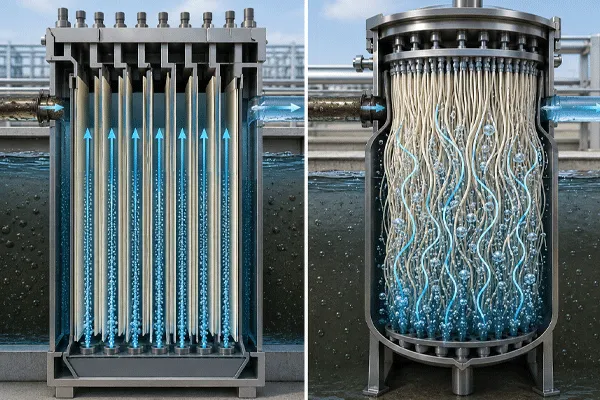
Both formats are submerged, both are driven by suction on the permeate side, and both depend on air scour to limit cake formation. The differences sit in four places.
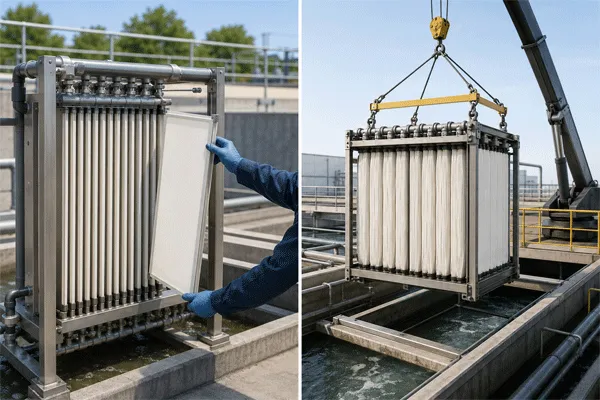
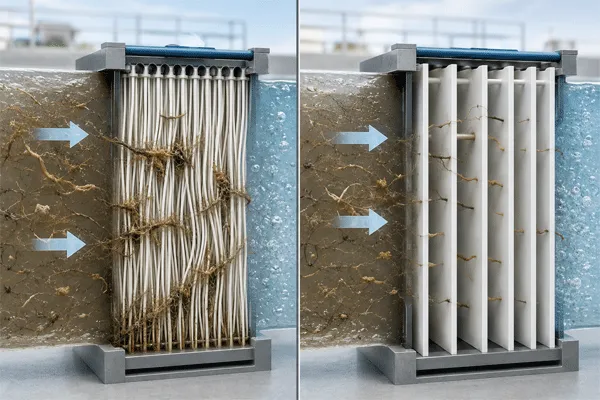
Flow path and hydraulic containment. In a flat sheet module, permeate travels through a sheet into a spacer and out through a nozzle at the panel top, with the feed side open to the tank across a defined channel between panels. In a hollow fiber module, the feed side is the space between thousands of fibers within a bundle, which is a far less defined geometry. Flow distribution in a fiber bundle depends on packing density, and it is harder to verify from a datasheet than a channel gap you can measure.
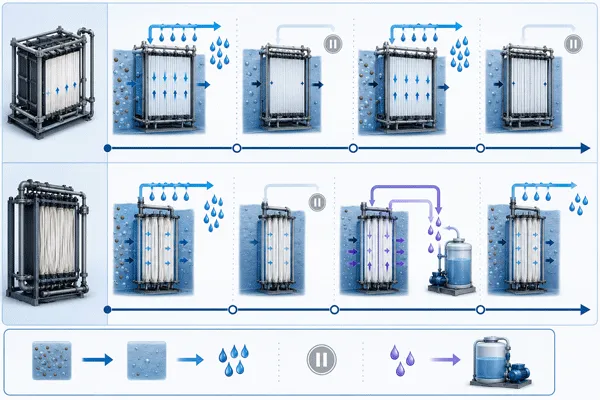
Reverse flow capability. Hollow fibers can normally take reverse permeate flow, so backwashing is available as a routine physical cleaning step. Flat sheets generally cannot, because the sheet is supported on one side and reverse pressure risks delamination. Flat sheet systems rely on relaxation instead: filtration stops, scour air continues, and the cake layer releases without reverse flow. Confirm this against the specific module rather than assuming it, because a small number of flat sheet designs do permit limited reverse flow.
That difference propagates into the hydraulic design. A backwash-capable system needs a backwash pump, a permeate buffer tank sized for the backwash volume, and a control sequence that accounts for the flow. A relaxation-based system needs neither, but recovers less per cycle and therefore usually runs at a lower design flux to compensate.
Response to thick and viscous mixed liquor. As MLSS rises, sludge viscosity rises with it, and scour air becomes less effective at moving liquid across a membrane surface. The defined channel between flat sheet panels keeps a cross-flow path open at viscosities where flow through a dense fiber bundle becomes uneven. This is the physical basis of the flat sheet MLSS argument, and it is a real effect, not a marketing position. What is a marketing position is any specific MLSS ceiling quoted without reference to the scour rate that accompanies it.
Failure mode. A broken hollow fiber creates a direct path from mixed liquor to permeate, and the effect on permeate turbidity is immediate. A damaged flat sheet does the same, but sheets are individually accessible and a failed panel can be located and replaced within a cassette. Locating one broken fiber inside a bundle of thousands is a different exercise, usually handled by isolating and testing modules in sequence rather than by inspection.
Flat Sheet MBR Membrane vs Hollow Fiber: How to Choose
The variable-by-variable table
| Operating variable |
Flat sheet |
Hollow fiber |
The figure to demand from the supplier |
| MLSS tolerance |
Higher; open channel between panels keeps a flow path at elevated viscosity |
Lower; flow distribution within the bundle degrades as viscosity rises |
The MLSS ceiling stated together with the scour air rate that supports it, not alone |
| Screening requirement |
Coarser aperture is usually acceptable; the panel gap sets the limit |
Finer aperture required; fiber bridging by hair and fibrous material is the failure mode |
The aperture the supplier will warrant against, in mm, and whether it is 1D or 2D screening |
| Physical cleaning during operation |
Relaxation only in most designs; no reverse flow |
Relaxation plus backwash |
Whether the module permits reverse flow, and at what pressure limit |
| Net vs gross flux |
Gross and net are closer, since relaxation costs time but no permeate |
Backwash consumes permeate as well as time, widening the gap |
Net flux at reference temperature, with the cycle that produces it |
| Packing density |
Lower membrane area per unit of tank volume |
Higher area per unit of tank volume |
Effective area per module and the module footprint, so area per m³ of tank can be calculated |
| Scour air |
Generally higher per unit membrane area |
Generally lower per unit membrane area |
Nm³/h per module and per m² of membrane, plus continuous or cyclic operation |
| Energy per m³ permeate |
Depends on the flux achieved, not on the format alone |
Depends on the flux achieved, not on the format alone |
Total connected blower kW divided by design permeate flow, from both suppliers on the same duty |
| Manual cleaning access |
Panels can be sprayed or wiped individually in place or after lifting |
Bundles are cleaned chemically; manual intervention is limited and riskier |
The recommended physical cleaning procedure and whether it can be done without removing the cassette |
| Breakage risk |
Sheet damage from impact or debris; localized |
Fiber breakage from abrasion, aggressive scour, or handling; distributed |
The integrity test method and the criterion for identifying a failed element |
| Replacement granularity |
Individual sheets can often be replaced within a cassette |
Usually the whole module is replaced |
The smallest replaceable unit and its price |
| Tank depth and head |
Panel height sets the tank depth requirement |
Fiber length sets it; more design variation exists |
Required submergence and the available static head at the permeate nozzle |
| Fouling recovery after neglect |
Physical access improves the odds of recovering a badly fouled unit |
Chemical recovery is the main route; a consolidated cake is harder to reverse |
Flux recovery percentage after recovery cleaning, and the number of cycles it was measured over |
Two rows in that table carry more weight than the rest for most projects. Screening requirement decides an upstream capital item and a permanent maintenance task. Replacement granularity decides a lifecycle cost line that appears in year eight of a financial model and is usually absent from a tender comparison.
Flat Sheet MBR Membrane vs Hollow Fiber: How to Choose
The misconception that distorts most format comparisons: flux is not comparable across formats
Design flux in LMH looks like a common unit and behaves like one, so engineers compare it across datasheets. Three things break the comparison.
First, gross flux and net flux differ, and datasheets rarely say which is quoted. Net flux accounts for the time spent in relaxation and, for backwash-capable modules, for the permeate consumed by backwashing. A hollow fiber module quoting gross flux and a flat sheet module quoting net flux can look closer than they are, or further apart, depending on which way the omission runs.
Second, flux is temperature dependent, and permeability changes with viscosity. A figure without a reference temperature and a correction method is not usable for design at a site where mixed liquor runs at 12 °C in winter.
Third, and most often missed, flux is only meaningful with the scour air rate attached. A high design flux sustained by a high scour rate is not a better module; it is a different point on the same trade curve, and the extra scour air appears in the operating cost. Comparing flux figures without comparing the aeration that supports them compares two proposals on one axis of a two-axis problem.
For a specification, the workable form is to require net flux at a stated reference temperature, with the filtration cycle defined, and with the scour air rate stated for the same operating point. Then normalize both offers to energy per cubic meter of permeate. That single derived number ends most format arguments, because it converts the two vendor positions into one comparable figure.
Reading the decision from the influent, not the catalogue
The choice usually resolves once four site conditions are known.
- Sludge character and design MLSS.If the process design calls for elevated MLSS, or if the influent produces viscous or poorly conditioned sludge, the open channel of a flat sheet arrangement is the lower-risk answer. If the design MLSS sits in a moderate range and the sludge is well behaved, packing density becomes the stronger argument and hollow fiber gains.
- Fibrous and hair content of the influent.Municipal and food processing streams carry material that bridges between fibers. If fine screening at the aperture the hollow fiber supplier requires cannot be reliably delivered and maintained on the site, the screening argument is decisive on its own.
- Available tank volume.Where the membrane tank is constrained by existing concrete, area per unit volume matters directly and hollow fiber uses the space better. Where volume is available, the advantage is worth less than it looks in a datasheet.
- Who cleans it, and how often they are on site.A plant with a resident operator and lifting access can realistically perform physical cleaning on flat sheet panels, which raises the ceiling on how much neglect the system survives. A plant visited weekly by a contractor is better served by a system whose routine cleaning is automated, which favors backwash-capable modules on a controlled sequence.
- Whether reuse follows.If the permeate feeds an RO stage, permeate integrity monitoring becomes more important than either format argument, because a breach reaches the RO elements before anyone reads a turbidity log. The integrity test method should then be specified before the format is.
Compared with the format-advocacy comparisons common among module suppliers, where one geometry is presented as generally superior, this sequence produces different answers for different sites, and that is the correct outcome. Neither format wins in the abstract.
Flat Sheet MBR Membrane vs Hollow Fiber: How to Choose
Banott flat sheet MBR modules: published parameters
The counterpart hollow fiber series is published with effective membrane areas of 3 m² (MBRIII3C), 10 m² (MBRIII10C) and 20 m² (MBI120C), which allows area per module to be compared directly for that series.
The PET linen support in the flat sheet modules is worth one line of explanation for a design reader, because it is the layer that carries mechanical load. It is what allows a sheet to withstand continuous scour and physical cleaning without the membrane layer itself bearing the stress, and it is also the reason reverse flow limits should be confirmed rather than assumed.
Sheet dimensions, effective area per sheet, pore size, design flux, maximum stack capacity per cassette, scour air requirement, screening aperture and CIP protocol are not published for the flat sheet series and are provided against a stated influent analysis on enquiry. Pricing is quotation-based; no list price is published.
Banott’s stated design approach starts from influent data and the required effluent standard rather than a catalog model number, and the company describes its water treatment engineering team as holding close to two decades of experience in membrane separation technology and engineering application. For a design institute, the practical use of that at concept stage is to request both formats sized against the same influent and the same effluent target, then compare the two on energy per cubic meter of permeate rather than on module specifications.
Specification language that keeps both formats biddable
Where a client wants competitive bidding across formats, the specification has to be written so that both can respond without one being excluded by an incidental clause.
- Specify permeate quality and integrity test criteria, not membrane geometry.
- Specify net flux at a stated reference temperature with the filtration cycle defined, and require the scour air rate at the same operating point.
- Require energy at the membrane tank battery limit in kW and in kWh per cubic meter of permeate at design flow, so offers normalize themselves.
- Require the screening aperture each bidder warrants against, and make the screening scope a bidder-stated item rather than a fixed client-supplied design, since the requirement differs by format.
- Require the smallest replaceable unit and its indicative price, together with a commitment on availability period.
- Require the cleaning protocol as a document, naming chemicals, concentrations, contact times and frequencies, and treat any membrane life figure as conditional on it.
- Require the physical cleaning and inspection procedure, including the access, lifting and space it assumes, and check that against the plant layout being drawn.
Item 7 is the one most often discovered late. A module that requires overhead lifting clearance the building does not have is a design problem found during installation, and it is found in the drawing stage only if someone asks.
What this comparison leaves open
Format selection narrows the equipment, and three questions remain that will influence the plant more than the choice between them.
Fouling behavior on the specific influent is not predictable from format. A stream with high colloidal organics or residual FOG will trouble both geometries, and the useful evidence is flux recovery measured over repeated cleaning cycles rather than any datasheet property.
Scour aeration control strategy — continuous, cyclic, or flow-proportional — changes operating cost more than the format does on many plants, and it is usually decided after the modules are ordered, which is the wrong order.
Membrane tank hydraulics, particularly sludge recirculation rate and how MLSS is prevented from concentrating locally within the tank, determine whether the modules see the mixed liquor the design assumed. A well-chosen module in a poorly circulated tank underperforms in a way that looks like a membrane problem and is not.
FAQ
Q: Is flat sheet always better for high MLSS?
A: It is more tolerant, and the reason is geometric rather than commercial: an open channel between panels sustains flow at viscosities where distribution within a dense fiber bundle becomes uneven. The qualifier is that any MLSS ceiling has to be read together with the scour air rate that supports it, since a figure quoted alone tells you nothing about the energy required to achieve it.
Q: Can flat sheet MBR membranes be backwashed?
A: Most designs are not backwashed, because the sheet is supported on one side and reverse pressure risks separating the layers. Relaxation with continued scour air is the normal physical cleaning step. A few designs permit limited reverse flow, so confirm the pressure limit against the specific module rather than treating it as a property of the format.
Q: Which format uses less energy?
A: Neither, as a property of the format. Energy is set by the flux achieved and the scour air needed to sustain it, so the comparison only means something as kWh per cubic meter of permeate at the same duty, on the same influent, at the same effluent target. Ask both bidders for that figure and the assumptions behind it.
Q: How does screening differ between the two?
A: Hollow fiber generally requires a finer aperture, because hair and fibrous material bridge between fibers and are not released by backwash. Flat sheet channels tolerate coarser material. Treat the required aperture as a warranted figure from the membrane supplier, and check whether the requirement refers to one-dimensional or two-dimensional screening, since a 2 mm bar screen and a 2 mm perforated screen do not pass the same material.
Q: Can a single sheet be replaced, or does the whole module go?
A: Flat sheet cassettes commonly allow individual sheets to be changed, while hollow fiber modules are usually replaced as a unit. That difference belongs in the lifecycle cost model, not only in the technical comparison, since it changes how a partial failure is handled financially.
Q: What flat sheet parameters does Banott publish?
A: Membrane material and support (PVDF with PET linen), outside-in flow mode, and three module structures: compact, integrated and standard. Sheet dimensions, effective area, pore size, design flux, stack capacity, scour air requirement, screening aperture and CIP protocol are provided on enquiry against a stated influent analysis.












 09:44
09:44