Banott Water Treatment Engineering Team | Published August 27, 2026
A compact RO system‘s rated GPD is a test-condition number, not a field guarantee. Actual output drops as feed water gets colder or saltier, and shifts with daily run hours. Within the published 300–3,000 GPD Small RO Machine range, matching the unit to real feed conditions — not the nameplate figure — is what determines the right model for a quote.
Расчет мощности небольших систем обратного осмоса: руководство по выбору систем производительностью 300–3 000 GPD
The Nameplate Number Is a Test Result, Not a Promise
Every RO element on the market is rated under a fixed reference condition: a set feed TDS, a set temperature (commonly 25°C in manufacturer test protocols), and a set feed pressure. That number goes on the spec sheet as “300 GPD” or “3,000 GPD.” It is real, but it describes lab conditions, not a jobsite in Lagos in July or a facility in Kazakhstan in January.
For a distributor quoting into a market you don’t operate in day to day, this gap matters more than it does for a domestic reseller. Your end customer’s feed water — its salinity, its temperature swing across seasons, its actual hours of use — is what the unit will be judged against, not the number printed on the box.
Three Variables That Move Your Actual Output
Feed TDS and osmotic pressure
RO separation works against osmotic pressure, which rises with feed salinity. Push the same feed pressure through water with higher TDS and the net driving force across the membrane drops, so permeate output falls. A unit rated for 1,000 GPD on a 500 ppm feed will not deliver 1,000 GPD on a 2,000 ppm brackish well without added feed pressure — and a compact, single-pass unit has a ceiling on how much extra pressure it can apply.
Температура корма
Colder water is more viscous, and permeate flux through a thin-film composite membrane falls as viscosity rises. As a general engineering approximation for polyamide RO membranes, output declines by roughly 2–3% for every degree Celsius below the 25°C reference point, and rises by a comparable margin above it. A unit sized against a 25°C test curve for a market where groundwater runs at 15°C is already starting from a smaller number than the datasheet suggests.
Duty cycle
A “3,000 GPD” rating is usually a 24-hour continuous-operation figure. Most compact systems in commercial or light-industrial service don’t run continuously — they cycle with a storage tank and a demand pattern. A unit running 10 hours a day at its rated flow delivers roughly 40% of the continuous-rated daily volume, not the full nameplate number. Undersizing against actual run hours is one of the more common ways a “correctly rated” quote falls short in the field.
Sizing Table: How the Same Unit’s Output Shifts With Conditions
The figures below are a generic engineering illustration of how derate stacks, not a Banott-published performance curve — Banott has not published a temperature or TDS correction curve for the Small RO Machine line, and any project-specific output figure should be confirmed with the factory against the actual feed water report.
| Feed condition |
Relative to 25°C / low-TDS reference |
Effect on a nameplate 1,000 GPD unit |
| 25°C, low TDS (reference) |
100% |
~1,000 GPD continuous |
| 15°C, low TDS |
~70–75% |
~700–750 GPD |
| 25°C, elevated TDS (brackish well) |
~80–90%, pressure-dependent |
~800–900 GPD, or requires higher feed pressure |
| 15°C, elevated TDS |
~55–65% |
~550–650 GPD |
| 25°C, low TDS, 10 hr/day duty cycle |
100% of hourly rate, ~40% of daily nameplate volume |
~400 GPD/day actual delivery |
Read this table as a sizing checklist, not a lookup chart: the point is that stacking two derate factors — cold feed plus part-time operation, for example — can put actual daily output well under half of what a customer sees on the spec sheet.
Расчет мощности небольших систем обратного осмоса: руководство по выбору систем производительностью 300–3 000 GPD
Where the 300–3,000 GPD Band Actually Applies
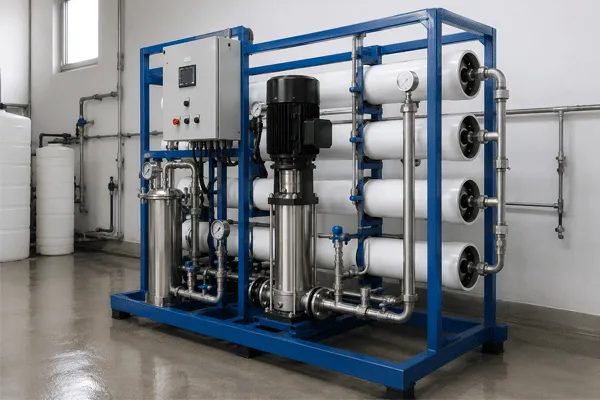
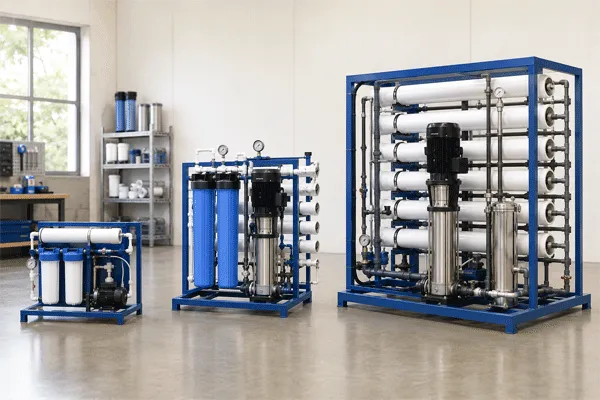
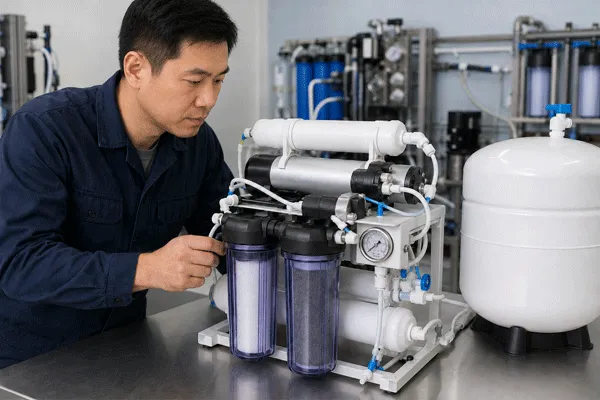
Banott’s Small RO Machine is positioned as a compact, integrated unit combining pretreatment and RO in a single skid for commercial and light-industrial applications where floor space and installation simplicity matter more than continuous high-volume output. The published capacity band is 300–3,000 GPD. Above that range, the product line moves into containerized or engineered system territory rather than a compact packaged unit — a distinction worth flagging to an end customer early, since a plant expecting to grow past a few thousand gallons a day is quoting the wrong category of product.
Within the band, a five-step sizing check keeps a quote defensible:
- Pull the customer’s feed water report— TDS, temperature range across seasons, hardness, and any known fouling risk (iron, silica, organics).
- Convert the required output to a continuous-equivalent rateby dividing the target daily volume by actual planned run hours, not 24.
- Apply a temperature derateagainst the coldest expected feed temperature the site will see, not an annual average.
- Check the TDS against the unit’s practical operating rangeand flag if feed pressure or a two-pass configuration would be needed — that detail isn’t published for this line and should go back to the factory as a specific enquiry.
- Size to the derated number, not the nameplate number, and build in a margin for membrane performance decline over the service interval before the next cleaning or replacement cycle.
What Banott Publishes — And What Requires a Direct Enquiry
The confirmed, publicly stated parameter for this product line is the capacity range: 300–3,000 GPD for the Compact Integrated RO Systems, positioned for commercial and light-industrial use where installation space is limited. No selling price is published against this range; Banott’s site requires a quote request rather than displaying pricing.
The following fields are not published in Banott’s current product material and should be confirmed directly with the factory before they appear in a distributor’s own resale spec sheet or tender document: specific model list and capacity increments within the 300–3,000 GPD band, pretreatment configuration included in the skid (cartridge filtration, softening, antiscalant dosing), footprint and shipping dimensions, power supply requirements, мембрана element size and salt rejection specification, and any temperature or TDS correction data. None of these should be estimated or filled in from general industry norms when quoting a specific project — they need a factory-confirmed answer against the actual feed water report.
Banott’s engineering team, which the company states has worked in ultrafiltration membrane separation and water treatment engineering applications for close to two decades, positions its process on starting from the customer’s influent data rather than a catalog model number — which is the same discipline this sizing approach follows.
The Pretreatment Mistake That Undersizes Every Quote
The most common error in compact RO sizing isn’t the derate math above — it’s treating the integrated pretreatment stage as a fixed constant regardless of feed water quality. A compact unit’s built-in pretreatment is sized for a defined feed water envelope. Push a higher-turbidity or higher-iron feed through it than it was configured for, and the pretreatment stage fouls faster, cycles the system into cleaning or standby more often, and the effective daily output drops well below anything in the sizing table above — even if the RO stage itself is correctly matched to TDS and temperature. A feed water report that only lists TDS and skips turbidity, iron, and silica is not a complete basis for a quote, and this gap shows up months after installation rather than at commissioning.
Расчет мощности небольших систем обратного осмоса: руководство по выбору систем производительностью 300–3 000 GPD
How This Differs From Feature-List Retail Units
Compared to the feature-bullet listings common on general marketplaces — where a 300 GPD unit is sold on мембрана stage count and filter change intervals rather than sizing methodology — a distributor quoting into commercial or light-industrial accounts needs the TDS, temperature, and duty-cycle variables addressed before the sale, not discovered after the unit underperforms on-site. That is the gap this sizing approach is built to close, and it is also where a distributor’s technical backup from the manufacturer becomes part of what’s actually being resold, not just the hardware.
Trade-offs to state plainly
- Sizing to derated output, not nameplate output, protects the quote but usually means recommending a larger model than a customer’s first request — worth explaining up front, since it affects price.
- The compact, integrated format that makes installation simple also caps how far feed water quality or capacity needs can be pushed before the product category itself is wrong for the project.
ЧАСТО ЗАДАВАЕМЫЕ ВОПРОСЫ
Q: Does the 300–3,000 GPD range apply at any feed temperature?
A: No. That range reflects the published capacity band for the product line; actual output at a specific site depends on feed temperature, TDS, and duty cycle, none of which are covered by a single published derate curve for this product. Confirm project-specific output with the factory against the feed water report.
Q: Is there a published price list for this capacity range?
A: No. Banott states the capacity range publicly but requires a direct quote request rather than listing prices, so any pricing a distributor provides should come from a current factory quote rather than a prior project’s number.
Q: What feed water data should a distributor collect before requesting a quote?
A: At minimum, TDS, seasonal temperature range, turbidity, iron and silica content, and the planned daily run-hour pattern. Missing pretreatment-relevant data (turbidity, iron, silica) is a common reason a sized unit underperforms after installation, independent of whether the RO-stage sizing itself was correct.
Q: Can a unit near the top of the range be run longer hours to exceed its rated daily output?
A: Running hours beyond the reference duty cycle raises fouling and cleaning frequency rather than raising sustainable output, and membrane life expectations for this line are not published — this should be confirmed with the factory rather than assumed from general RO operating practice.
Q: Above 3,000 GPD, what does Banott offer instead?
A: The 300–3,000 GPD band describes the compact, integrated Small RO Machine format specifically. Higher-volume requirements move into Banott’s containerized and engineered system product lines rather than this compact skid format.












 09:09
09:09