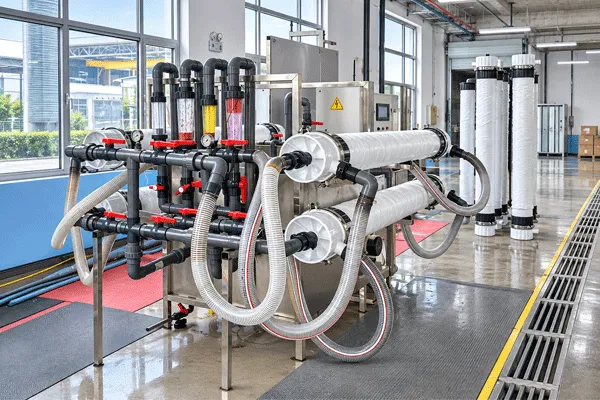
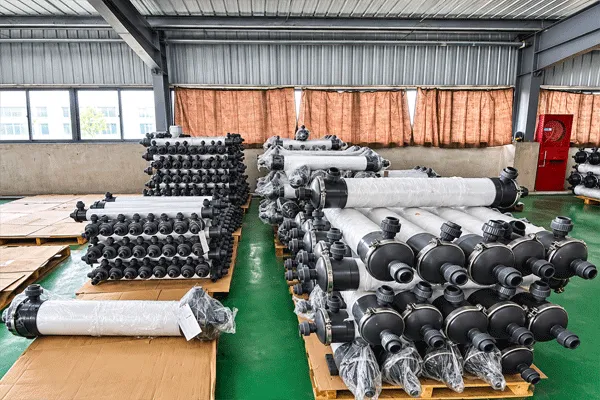
High-purity water production can become expensive when a plant relies on chemical regeneration, frequent maintenance, and unstable equipment performance. Choosing an EDI module based only on its purchase price can also lead to unexpected costs. A better approach is to evaluate the complete system and its long-term operating performance.
Electrodeionization water treatment offers a continuous way to produce high-purity water from suitable RO permeate. To determine whether an EDI system is a good investment, buyers should compare its capital cost, electricity use, pretreatment requirements, maintenance expenses, downtime risks, and total cost per cubic meter of product water.
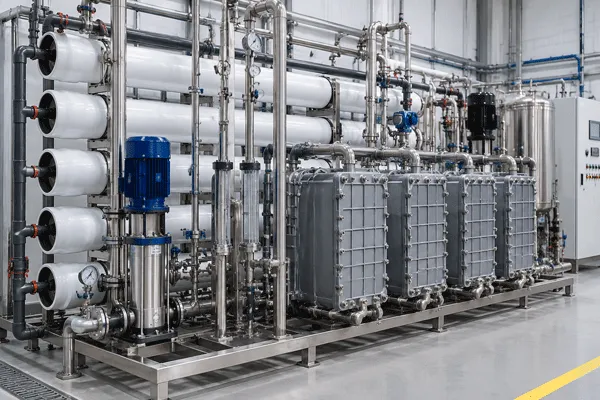
Очистка воды методом электродеионизации: стоимость модулей EDI, энергопотребление и показатели эффективности на протяжении всего жизненного цикла
План статьи
- Why Should Buyers Evaluate the Total Cost of EDI Water Treatment?
- What Costs Are Included in an EDI System Investment?
- How Do You Calculate EDI Energy Consumption?
- How Does RO Pretreatment Affect EDI Operating Costs?
- Is EDI More Economical Than Mixed-Bed Ion Exchange?
- What Maintenance and Replacement Costs Should You Expect?
- How Do You Calculate the Cost per Cubic Meter of EDI Water?
- How Do Capacity and System Design Affect Lifecycle Performance?
- What Should Buyers Check Before Purchasing an EDI Module?
- When Does Electrodeionization Offer the Best Long-Term Value?
1. Why Should Buyers Evaluate the Total Cost of EDI Water Treatment?
When selecting equipment for an industrial water purification system, the initial quotation is only one part of the investment. A low-cost unit may require more electricity, frequent maintenance, or expensive replacement parts. On the other hand, a higher initial investment may provide better operating efficiency and more stable water production over time.
This is particularly important for industries that need continuous high-purity water. Semiconductor manufacturers, pharmaceutical companies, power plants, and chemical factories cannot always stop production when their water purification equipment needs maintenance. Even a short interruption may affect production schedules and product quality.
Electrodeionization provides an alternative to conventional ion exchange by using electricity to support continuous resin regeneration. It normally avoids the routine acid and caustic regeneration required by traditional mixed-bed systems. However, it still consumes electrical power and requires suitable pretreatment, monitoring, and periodic maintenance.
For project owners, the right question is not simply how much an EDI module costs. It is how much the complete system will cost to deliver the required water quality throughout its expected service life.
CAPEX vs. OPEX: Understanding the Two Main Cost Categories
The total investment can be divided into two main categories:
- Capital expenditure (CAPEX): Initial equipment purchase, engineering, installation, piping, electrical work, and commissioning.
- Operating expenditure (OPEX): Electricity, chemicals used in upstream treatment, consumables, maintenance, cleaning, labor, and replacement components.
Both categories matter. An EDI system with a competitive purchase price may still have a high lifecycle cost if the upstream RO system performs poorly or the operating conditions are not properly controlled.
2. What Costs Are Included in an EDI System Investment?
The cost of an EDI system depends on its capacity, configuration, required product water quality, automation level, and installation conditions.
A complete electrodeionization system usually includes more than the EDI module itself. Buyers should review the entire equipment scope before comparing supplier quotations.
| Cost Component |
Typical Scope |
Cost Consideration |
| Модуль EDI |
Membrane and resin assembly |
Capacity, design, and manufacturer |
| Источник постоянного тока |
Electrical power and regulation |
Rated output and efficiency |
| Насосы |
Feed and circulation pumping |
Flow, pressure, and motor power |
| Инструменты |
Flow, pressure, conductivity, resistivity |
Monitoring and control requirements |
| Трубопроводы и арматура |
Feed, product, concentrate lines |
Materials and connection standards |
| Control cabinet |
PLC, HMI, electrical protection |
Automation complexity |
| Конструкция каркаса |
Skid and equipment supports |
Materials and dimensions |
| Engineering |
Design and technical documentation |
Project complexity |
| Установка |
Mechanical and electrical connections |
Site conditions |
| Ввод в эксплуатацию |
Testing and startup support |
Scope of supplier services |
Module-Only Price vs. Complete System Price
A common purchasing mistake is comparing the price of one EDI module with the quotation for a complete EDI skid.
These are not equivalent products.
An individual module provides the core deionization function. A complete skid may also include pumps, valves, instruments, a power supply, piping, electrical components, and automatic controls.
For EPC contractors, it is important to confirm whether the quotation covers:
- Equipment manufacturing.
- Factory assembly.
- Electrical integration.
- PLC programming.
- Factory acceptance testing (FAT).
- Export packaging.
- Installation guidance.
- Commissioning assistance.
- Spare parts and technical support.
A clear scope comparison helps prevent unexpected expenses during project execution.
3. How Do You Calculate EDI Energy Consumption?
Electricity is one of the main operating costs of an EDI installation. The amount depends on the electrical load, water flow, feed quality, recovery rate, and required product purity.
The EDI module uses direct current to move unwanted ions through selective membranes. The electrical load is affected by the ionic load entering the module and the operating conditions needed to achieve the target product quality.
Basic Power Calculation
The electrical power of a DC circuit can be calculated using:
Power (kW) = Voltage (V) × Current (A) ÷ 1,000
To estimate specific energy consumption:
Specific Energy (kWh/m³) = Electrical Power (kW) ÷ Product Water Flow (m³/h)
For example, an illustrative EDI installation operating at an electrical load of 3 kW and producing 10 m³/h of product water would have a specific electrical consumption of:
3 ÷ 10 = 0.30 kWh/m³.
This is a calculation example, not a guaranteed performance figure for any particular EDI module.
Annual Electricity Cost
Once specific energy consumption is known, buyers can estimate annual electricity expenses.
Annual Electricity Cost = Specific Energy × Daily Production × Operating Days × Electricity Tariff
The calculation should use actual operating data whenever possible.
For a complete RO-EDI water purification system, engineers should also account for the electricity consumed by:
- RO high-pressure pumps.
- Feed water pumps.
- Transfer pumps.
- Circulation pumps.
- Control and auxiliary equipment.
It is important to distinguish the electricity consumption of the EDI stage from the total energy required to produce high-purity water.
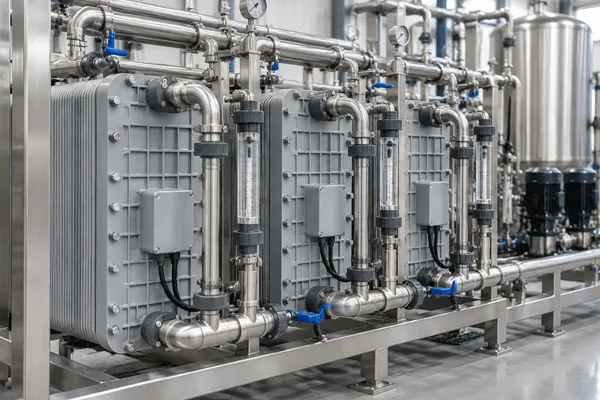
Очистка воды методом электродеионизации: стоимость модулей EDI, энергопотребление и показатели эффективности на протяжении всего жизненного цикла
4. How Does RO Pretreatment Affect EDI Operating Costs?
The performance of an EDI unit depends heavily on the quality of its incoming water.
In most industrial applications, EDI receives permeate from a reverse osmosis system rather than untreated source water. RO removes most dissolved salts before the water enters the EDI stage.
If the RO system performs poorly, the EDI module may receive a higher ionic load than expected. This can increase electrical demand, reduce product water quality, and raise the risk of scaling.
Important Feed-Water Cost Factors
| Параметр |
Potential Effect on EDI |
Design Consideration |
| Проводимость |
Higher ionic loading |
Check RO rejection and feed stability |
| Твёрдость |
Минеральные отложения |
Ensure suitable pretreatment |
| CO₂ |
Additional anion loading |
Evaluate degassing requirements |
| Кремнезем |
Scaling and performance decline |
Check silica concentration |
| Хлор |
Possible material damage |
Confirm effective dechlorination |
| Содержание |
Органическое загрязнение |
Evaluate upstream filtration |
| Температура |
Changes operating performance |
Maintain the approved range |
Carbon dioxide deserves particular attention. RO membranes may allow dissolved CO₂ to pass into the permeate, depending on the feed conditions and system configuration. Once it enters the EDI module, it can increase the ionic load.
A decarbonation unit or membrane degasser may therefore be useful in some applications.
Why Good Pretreatment Can Reduce Total Cost
Good pretreatment is not simply an additional expense. It can protect the EDI module, maintain stable operation, and reduce unexpected cleaning or replacement costs.
A properly designed train may include:
- Raw water pretreatment.
- Cartridge filtration or UF where required.
- Reverse osmosis.
- CO₂ control when necessary.
- EDI polishing.
- Final filtration or other downstream treatment when required.
The correct arrangement depends on the source water, required purity, and production conditions.
For buyers, the most important step is to evaluate the entire treatment train rather than purchase an EDI module without confirming its feed-water requirements.
5. Is EDI More Economical Than Mixed-Bed Ion Exchange?
Conventional mixed-bed ion exchange and EDI can both produce deionized water, but their operating costs come from different sources.
A mixed-bed system normally requires periodic chemical regeneration. This involves acid, caustic, chemical storage, operator handling, and wastewater management.
EDI uses electrical energy to support continuous regeneration of its ion exchange resin. It therefore avoids routine chemical regeneration during normal operation.
| Фактор затрат |
EDI |
Conventional Mixed Bed |
| Initial equipment cost |
Depends on module and skid configuration |
Depends on vessels and resin arrangement |
| Электроэнергия |
Required for the DC process |
Usually lower for the deionization vessel itself |
| Regeneration chemicals |
No routine resin regeneration chemicals |
Acid and caustic commonly required |
| Хранение химических веществ |
Usually reduced |
Often required |
| Регенерация сточных вод |
No routine regeneration waste stream |
Requires management |
| Труд |
Continuous automatic operation is possible |
Additional regeneration work |
| Maintenance |
Module, instruments, and upstream equipment |
Resin, valves, vessels, and regeneration equipment |
| Production mode |
Непрерывный |
May require regeneration cycles or redundant beds |
What Does the Research Say?
A published bench-scale study in Desalination evaluated an RO-EDI system for high-pressure boiler feed water.
Under that specific test, the reported water production cost was approximately US$0.53/m³, compared with US$0.66/m³ for the existing ion exchange beds.
The researchers also identified electricity and membrane replacement as important operating costs.
These figures are historical research results, not current commercial quotations or guaranteed savings. Actual project economics depend on capacity, local electricity prices, chemical costs, water quality, equipment configuration, and operating hours.
When Is Mixed Bed Still a Reasonable Choice?
EDI is not automatically the best option for every facility.
A mixed-bed system may remain suitable when:
- Water demand is small or intermittent.
- Existing regeneration infrastructure is available.
- The plant already has trained chemical-handling staff.
- Initial capital expenditure is the main constraint.
- Feed-water conditions do not meet the selected EDI module’s requirements.
The right decision comes from comparing total lifecycle cost under the same water quality and production conditions.
6. What Maintenance and Replacement Costs Should You Expect?
An EDI installation does not require routine acid-and-caustic resin regeneration, but it still needs regular inspection and maintenance.
The module operates continuously under controlled electrical and hydraulic conditions. Poor feed quality, unstable flow, incorrect pressure balance, or scaling can reduce performance.
Main Maintenance Items
| Компонент |
Maintenance Focus |
| Модуль EDI |
Product quality and operating performance |
| Источник постоянного тока |
Voltage, current, and electrical condition |
| Насосы |
Noise, vibration, seals, and pressure |
| Расходомеры |
Accuracy and calibration |
| Измерители проводимости |
Measurement accuracy |
| Клапаны |
Leakage and operating condition |
| Control cabinet |
Electrical protection and alarms |
| Upstream RO system |
Permeate quality and membrane condition |
How Can Operators Control Replacement Costs?
The best way to extend equipment service life is to maintain stable feed conditions and follow the module manufacturer’s operating instructions.
Операторы должны фиксировать:
- Product conductivity or resistivity.
- Feed conductivity.
- Electrical current and voltage.
- Product and concentrate flow.
- Inlet and outlet pressure.
- Temperature.
- Cleaning history.
- Operating hours.
A change in these parameters may indicate a developing problem.
For example, a gradual reduction in product resistivity may point to increased ionic loading, unsuitable feed conditions, or a module performance issue.
The supplier should provide clear cleaning procedures, replacement recommendations, inspection intervals, and compatible spare parts.
Avoid assuming that every EDI module has the same replacement interval. The expected service life depends on design, operating conditions, feed quality, and maintenance practices.
7. How Do You Calculate the Cost per Cubic Meter of EDI Water?
For industrial buyers, the most useful financial indicator is often the cost of producing one cubic meter of water that meets the required quality specification.
This makes it easier to compare different suppliers and treatment technologies.
A basic lifecycle cost model is:
Total Lifecycle Cost = Initial CAPEX + Cumulative OPEX + Replacement Costs + Downtime Costs
For a more useful comparison, the cost per cubic meter can be calculated as:
Unit Water Cost = Total Lifecycle Cost ÷ Total Qualified Product Water Produced
The word qualified is important. Water that does not meet the required quality specification should not be counted as usable product water.
What Should Be Included in OPEX?
Annual operating expenses may include:
- EDI electricity.
- RO pump electricity.
- Pretreatment chemicals.
- RO membrane cleaning.
- Cartridge filters.
- EDI cleaning when required.
- Labor and inspection.
- Spare parts.
- Wastewater and concentrate management.
- Equipment service.
- Module replacement allowances.
Illustrative Cost Evaluation
Consider an industrial facility that needs continuous high-purity water.
Instead of assuming that the cheapest quotation offers the best value, the procurement team can compare three proposed systems using the same operating conditions.
| Evaluation Item |
Supplier A |
Supplier B |
Supplier C |
| Initial investment |
Quoted value |
Quoted value |
Quoted value |
| EDI power consumption |
Verified data |
Verified data |
Verified data |
| RO energy demand |
Verified data |
Verified data |
Verified data |
| Расход химикатов |
Annual estimate |
Annual estimate |
Annual estimate |
| Maintenance |
Annual estimate |
Annual estimate |
Annual estimate |
| Module replacement |
Manufacturer estimate |
Manufacturer estimate |
Manufacturer estimate |
| Guaranteed water quality |
Defined target |
Defined target |
Defined target |
| Annual qualified production |
Calculated |
Calculated |
Calculated |
This is an evaluation framework, not actual Banott project pricing or supplier quotations.
The comparison should use the same annual production, water quality, electricity tariff, operating schedule, and financial period.
It should also include the cost of downtime and rejected product water. A system that produces more off-spec water may have a lower equipment price but a higher actual cost per cubic meter.
8. How Do Capacity and System Design Affect Lifecycle Performance?
The size of an EDI system affects both initial investment and long-term operating expenses.
An undersized unit may struggle to meet peak water demand. An oversized unit may increase capital costs and operate inefficiently under low-load conditions if it is not designed for suitable turndown operation.
Engineers should evaluate:
- Average and peak product water demand.
- Required continuous operating hours.
- Feed-water quality.
- Required product resistivity.
- Recovery rate.
- Module arrangement.
- Redundancy requirements.
- Future expansion.
- Available installation space.
Single-Module vs. Multiple-Module Configuration
A single-module configuration may suit smaller installations with stable water demand.
Larger projects may use multiple EDI units in parallel to increase production capacity or support maintenance flexibility.
A modular design can also make future expansion easier, provided the piping, electrical supply, controls, and upstream RO system have been designed accordingly.
Automation and Lifecycle Cost
PLC and SCADA integration can help operators monitor important parameters and identify abnormal operating conditions.
A well-designed control system may include:
- Automatic startup and shutdown.
- Feed-flow monitoring.
- Electrical protection.
- Conductivity and resistivity monitoring.
- Pressure alarms.
- Pump interlocks.
- Abnormal operating condition alerts.
- Historical data recording.
For facilities operating continuously, reliable automation can reduce manual work and help prevent costly interruptions.
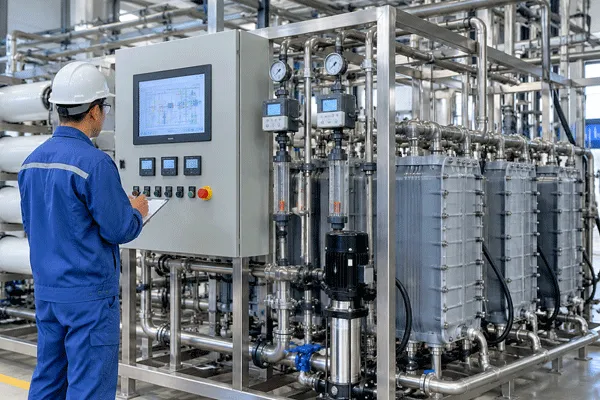
The promotion of EDI adoption in industrial water systems should therefore focus on measurable operational value, not simply the claim that the technology is chemical-free.
Очистка воды методом электродеионизации: стоимость модулей EDI, энергопотребление и показатели эффективности на протяжении всего жизненного цикла
9. What Should Buyers Check Before Purchasing an EDI Module?
A good purchasing decision starts with a clear technical specification.
Before requesting quotations, buyers should prepare the source water analysis, required capacity, product water quality, and expected operating schedule.
The following checklist can help EPC contractors, system integrators, and industrial procurement teams compare suppliers.
EDI Technical Specification Checklist
| Артикул |
Information to Request |
| Модель модуля |
Exact manufacturer model |
| Rated capacity |
Product flow under defined conditions |
| Feed requirements |
Conductivity, hardness, CO₂, silica, and TOC |
| Качество продукции |
Guaranteed resistivity or conductivity |
| Коэффициент восстановления |
Defined operating conditions |
| Power consumption |
Voltage, current, and power |
| Hydraulic data |
Feed, product, and concentrate flow |
| Pressure requirements |
Inlet pressure and differential limits |
| Dimensions |
Installation and maintenance clearance |
| Материалы |
Membrane, resin, housing, and connections |
| Maintenance |
Cleaning and inspection procedures |
| Замена |
Spare parts and module availability |
| Автоматизация |
PLC, HMI, and communication requirements |
Questions to Ask an EDI Manufacturer
- Is the rated capacity based on actual project feed-water quality?
- What product water quality can be guaranteed?
- What are the acceptable hardness, CO₂, and silica limits?
- What is the expected electrical consumption?
- What operating data can the control system monitor?
- What maintenance procedures are required?
- Имеются ли запасные части, необходимые для обеспечения длительного срока эксплуатации?
- Can the supplier provide engineering drawings and technical documentation?
- Does the quotation include commissioning support?
- Can the EDI equipment be integrated with an existing RO system?
A professional supplier should be able to explain the design assumptions behind its quotation.
For international distributors and EPC contractors, this is especially important because equipment compatibility, technical documents, export packaging, installation support, and spare parts can affect the total project cost.
10. When Does Electrodeionization Offer the Best Long-Term Value?
EDI is particularly attractive when a facility needs continuous high-purity water and wants to reduce the operational burden associated with conventional chemical regeneration.
It can be a strong choice for:
- Semiconductor and electronics manufacturing.
- Pharmaceutical production.
- Power generation and boiler feed water.
- Chemical and petrochemical processes.
- Laboratory water systems.
- High-purity process water.
- Industrial water reuse and purification projects.
However, its economic value depends on the complete water production arrangement.
An EDI module cannot compensate for poor RO permeate quality. Nor can it eliminate all chemical requirements in the upstream water treatment plant.
The most reliable solution combines proper pretreatment, suitable RO membranes, correctly sized EDI modules, accurate instruments, automatic controls, and a maintenance plan based on real operating conditions.
How Banott Supports EDI Water Purification Projects
At Banott, we understand that industrial buyers need more than an individual membrane or module. They need equipment that fits the project, performs consistently, and can be integrated into a complete water production system.
As a manufacturer and engineering-oriented water treatment provider, we offer:
- EDI modules for industrial high-purity water applications.
- RO membranes and integrated RO systems.
- Hollow fiber UF membrane pretreatment.
- MBR membrane solutions for wastewater treatment.
- Pure water and ultrapure water treatment plants.
- Skid-mounted and containerized system configurations.
- Customized equipment integration.
- PLC and SCADA automation support.
- Technical documentation and engineering coordination.
- Commissioning guidance and long-term spare parts support.
We work with EPC contractors, water treatment engineering companies, industrial plant owners, system integrators, and international distributors.
Our goal is to help customers select a suitable configuration based on actual feed-water conditions, product quality requirements, production capacity, and operating costs.
Explore our EDI Water Treatment Systems и Engineering & System Integration Services to learn more.
Часто задаваемые вопросы
Is electrodeionization water treatment more expensive than traditional ion exchange?
The initial investment may be higher or lower depending on the equipment configuration and project scale. However, EDI can reduce long-term expenses associated with acid and caustic regeneration, chemical handling, and regeneration wastewater. A lifecycle cost comparison is more useful than comparing equipment prices alone.
How much electricity does an EDI module consume?
Electricity consumption depends on feed-water ionic loading, product flow, required purity, recovery, and module design. Buyers should request actual power data under the proposed operating conditions rather than rely on a general industry estimate.
Does an EDI module require regular chemical cleaning?
Not necessarily. Cleaning requirements depend on module design and operating conditions. Although EDI avoids routine chemical resin regeneration, cleaning may still be needed if scaling, fouling, or contamination occurs.
Как долго служит модуль EDI?
There is no single service life that applies to every EDI module. Feed-water quality, operating conditions, maintenance, and manufacturer design all affect service life. Buyers should request the manufacturer’s expected service interval and replacement criteria.
Can an EDI system operate continuously?
Yes. Continuous operation is one of the main benefits of electrodeionization. When the feed water, electrical conditions, and hydraulic flow remain within the manufacturer’s operating limits, the system can continuously produce deionized water.
What information is needed to obtain an EDI system quotation?
Buyers should provide the required product flow, feed-water analysis, target resistivity, operating hours, installation conditions, and automation requirements. This information allows the manufacturer to evaluate the module capacity and complete system configuration.
Основные моменты, о которых следует помнить
- Evaluate the total lifecycle cost rather than the initial EDI module purchase price.
- Separate CAPEX from OPEX when comparing quotations.
- Electricity, pretreatment, maintenance, and replacement components all affect operating expenses.
- RO permeate quality has a direct influence on EDI performance and operating cost.
- EDI can reduce the chemical regeneration and waste-management costs associated with conventional mixed-bed systems.
- Calculate the cost per cubic meter using qualified product water, not simply the rated equipment capacity.
- Correct module sizing helps avoid unnecessary investment and unstable operation.
- PLC and SCADA integration can improve monitoring and operational control.
- Request clear technical specifications, power data, maintenance instructions, and replacement information before purchasing.
- A complete RO + EDI system should be evaluated as one integrated water production solution.
Planning an industrial high-purity water project?
Send Banott your required water capacity, source-water analysis, target resistivity, and project location. Our team can help evaluate the suitable RO and EDI configuration, review technical requirements, and prepare a customized equipment proposal.
Explore Banott EDI Solutions



 17:12