Before industrial ultrafiltration membrane modules are delivered to a water treatment project, their condition, connections, and specified performance requirements must be carefully evaluated. A damaged connection, incorrect module configuration, or undetected sealing problem can lead to installation delays and unexpected operating costs.
At Qingdao Banott Environmental Technology Co., Ltd., quality control is an important part of our membrane manufacturing and project delivery process.
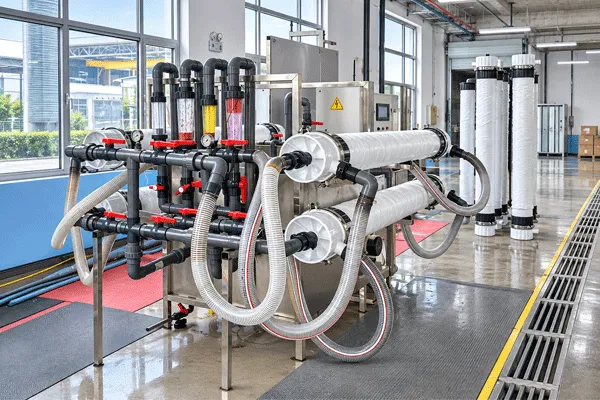
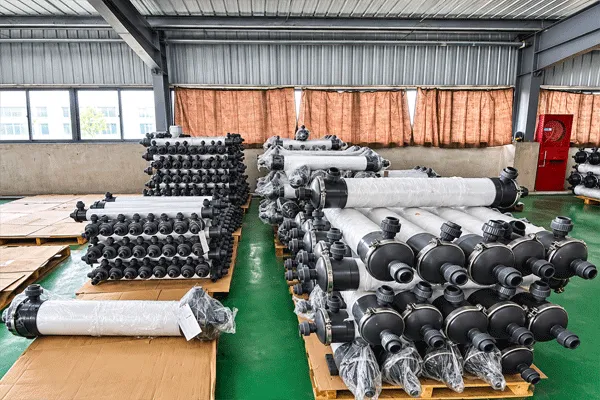
In this factory update, we share photographs and video footage of our UF membrane pre-shipment inspection area, showing hollow fiber ultrafiltration modules, testing equipment, flow meters, pressure gauges, connecting hoses, and piping arrangements.
These real workshop images provide EPC contractors, water treatment engineering companies, industrial plant owners, and international distributors with a closer look at the equipment and inspection considerations involved in preparing UF membrane products for engineering projects.
UF Membrane Pre-Shipment Inspection: Inside Banott’s Factory Testing Area
Inside Banott’s UF Membrane Inspection Area
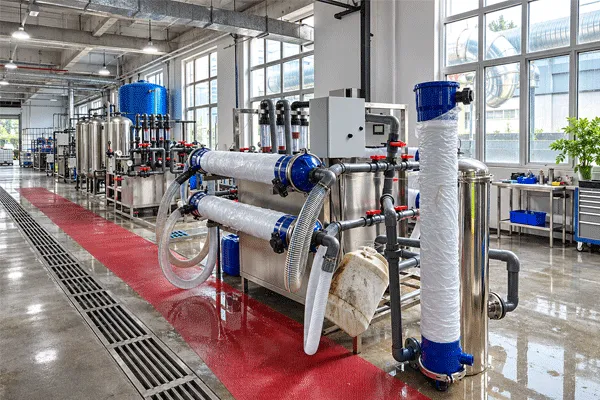
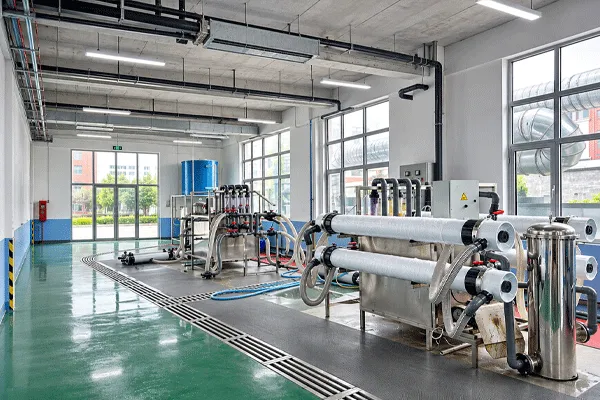
The first photographs show a dedicated workshop area containing industrial hollow fiber UF membrane modules connected to piping and monitoring equipment.
Several cylindrical membrane modules are mounted horizontally on supporting frames. The visible modules have light-colored cylindrical bodies, blue end caps, and mechanical connection points.
The equipment arrangement also includes flexible hoses, pressure gauges, transparent flow meters, control boxes, and valves.
Together, these components form a practical setup for checking UF membrane modules under specified factory inspection conditions.
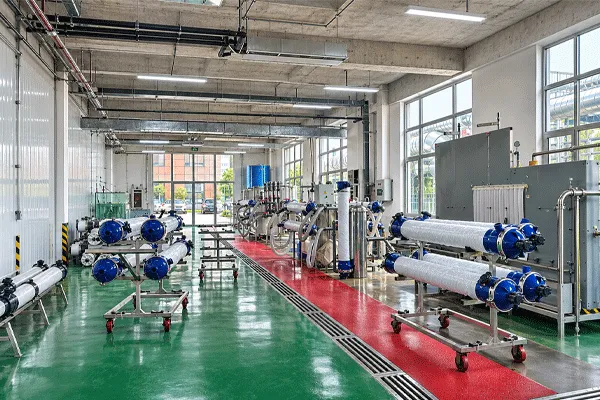
UF Membrane Pre-Shipment Inspection: Inside Banott’s Factory Testing Area
For engineering buyers, a manufacturer’s inspection facilities are an important consideration when evaluating membrane products.
UF modules must meet more than dimensional requirements. Their mechanical structure and filtration performance should also conform to the relevant product specifications.
Different module designs may require different test arrangements, operating conditions, and acceptance criteria.
For this reason, inspection requirements should be established according to the selected membrane model and the customer’s project specifications.
UF Membrane Connection and Assembly Inspection
Before a membrane module is installed in an industrial treatment system, its connection arrangement should be checked against the applicable product drawings.
The workshop photographs show horizontal UF modules connected with flexible hoses and external pipework.
The end caps are secured to the cylindrical module bodies, and the associated piping includes several valves and mechanical fittings.
These connection points are important because a membrane filtration system depends on controlled flow paths between the feed, filtrate, and any required drain or concentrate connections.
Important Mechanical Inspection Items
Typical inspection considerations include:
- Module housing condition.
- End-cap alignment.
- Connection dimensions and compatibility.
- Sealing components and fittings.
- External pipe connections.
- Visible damage or deformation.
- Product identification and specifications.
- Compatibility with the intended installation arrangement.
A mechanical inspection helps identify visible issues that could create problems during installation.
However, visual inspection alone cannot confirm membrane integrity or hydraulic performance. Appropriate testing and documented acceptance criteria are needed for those purposes.
Banott offers Industrial Hollow Fiber UF Membrane Modules in different sizes, materials, and configurations for industrial and municipal water treatment applications.
Flow Meters, Pressure Gauges, and Test Equipment
A key feature of the supplied photographs is the arrangement of instruments around the UF modules.
The visible equipment includes transparent vertical flow meters, pressure gauges, red-handled valves, rigid piping, and flexible connecting hoses.
UF Membrane Pre-Shipment Inspection: Inside Banott’s Factory Testing Area
Flow and pressure are important parameters in membrane filtration.
Depending on the test procedure, these measurements can help technicians assess whether the equipment is operating within the required hydraulic conditions.
What Do These Instruments Help Monitor?
Flow meters: Provide an indication of liquid flow through the monitored line.
Pressure gauges: Show pressure at the measurement point, supporting checks of operating conditions.
Valves: Allow operators to open, close, or regulate selected flow paths according to the test arrangement.
Flexible hoses: Connect membrane modules with the surrounding equipment while allowing practical installation and handling.
Control equipment: May support equipment operation and monitoring according to the configuration of the inspection station.
The accompanying video provides a closer view of the transparent flow meters and connected piping.
Although the instruments are visible, the footage does not provide a complete set of readable measurements or approved acceptance limits. The actual results must therefore be established from the corresponding inspection records.
Membrane Integrity and Leakage Testing
Membrane integrity is an important consideration for hollow fiber ultrafiltration products.
A hollow fiber membrane module contains many individual membrane fibers, along with potting materials, seals, end caps, and collection connections.
If a fiber or sealing component is damaged, water may bypass the intended membrane barrier.
This can affect filtrate quality and the suitability of the module for its intended application.
Depending on the product type and test specification, a manufacturer may use appropriate integrity or pressure-based methods to evaluate the membrane assembly.
Relevant inspection methods can include:
- Membrane integrity testing.
- Pressure-hold or pressure-decay testing.
- Leakage checks at specified connections.
- Verification of the module’s operating flow path.
- Inspection of seals and mechanical joints.
The exact method, test pressure, duration, and acceptance criteria must be defined for the specific membrane module.
A successful pressure or leakage check does not automatically demonstrate the membrane’s full filtration performance. Different tests evaluate different aspects of the product.
At Banott, membrane quality control forms part of our wider manufacturing approach, which includes membrane fabrication, module assembly, inspection, and product verification.
Our Quality Management and Inspection information explains the manufacturing controls and inspection activities that support project delivery.
Why Is Pre-Shipment Inspection Important for EPC Contractors?
For EPC contractors and industrial water treatment companies, equipment delivery is closely connected to installation schedules, commissioning plans, and contractual specifications.
A membrane module that arrives with an incorrect connection arrangement or unresolved mechanical problem can delay the project.
Pre-shipment inspection helps establish whether equipment conforms to the agreed requirements before it leaves the factory.
For international projects, the scope should be clearly defined in the purchase order or inspection and test plan.
| Inspection Area |
What Buyers Should Confirm |
| Product identification |
Model, quantity, and applicable specifications |
| Размеры модуля |
Compatibility with the equipment layout |
| Connection arrangement |
Correct positions, sizes, and connection types |
| External condition |
Visible housing and connection integrity |
| Membrane integrity |
Required test method and recorded result |
| Hydraulic performance |
Flow and pressure under specified conditions |
| Документация |
Relevant reports and inspection records |
| Packaging |
Protection for transportation and storage |
These checks are particularly useful for large projects involving multiple UF modules or replacement equipment.
For example, when a contractor is replacing an existing membrane system, even a small difference in connection dimensions may require additional piping work.
Confirming the product configuration before shipment can help reduce that risk.
From Factory Inspection to Project Delivery
The final stage of equipment preparation should connect manufacturing records with the customer’s actual project requirements.
Depending on the order, the required documents may include:
- Product model and quantity list.
- Technical datasheets.
- Dimensional drawings.
- Inspection and test records.
- Product identification information.
- Installation instructions.
- Storage and handling requirements.
- Packing list and shipping documents.
For membrane replacement projects, customers should also confirm compatibility with the existing membrane rack, piping, and operating conditions.
For new water treatment systems, the membrane modules must be coordinated with the pumps, valves, instruments, control logic, and overall process design.
«Баноттс» Engineering & System Integration services support the selection and integration of membrane equipment within complete industrial water treatment projects.
Our aim is to help customers coordinate membrane supply with installation requirements and long-term operation.
Banott’s Quality-Focused UF Membrane Manufacturing
Banott is a professional membrane manufacturer and engineering-oriented water treatment solution provider.
Our product range includes:
- Hollow Fiber UF Membranes.
- Hollow Fiber MBR Membranes.
- Flat Sheet MBR Membranes.
- Reverse Osmosis Membranes.
- EDI Modules.
- Pure Water Treatment Plants.
- Wastewater Treatment Plants.
- Customized Membrane Filtration Systems.
Our Мембрана UF из полых волокон portfolio supports industrial water purification, municipal treatment, RO pretreatment, and wastewater reuse projects.
We work with EPC contractors, water treatment engineering companies, municipal utilities, industrial factories, system integrators, and equipment distributors worldwide.
The workshop photographs and video in this update illustrate the inspection equipment and module connection arrangements used within our manufacturing environment.
For customers, these details provide useful insight into the equipment preparation activities associated with membrane production and delivery.
Supporting Your Next UF Membrane Project
Quality requirements should be considered from the beginning of a membrane project, not only after the equipment has been manufactured.
When sourcing UF modules, buyers should provide clear information about the required membrane configuration, operating conditions, dimensions, and acceptance criteria.
For international EPC projects, it is also useful to define the inspection documentation and shipment requirements before production begins.
At Banott, we support customers in reviewing these requirements and selecting suitable membrane products for their applications.
Looking for industrial hollow fiber UF membrane modules with factory inspection support?
Share your required flow capacity, existing membrane model, water quality requirements, installation dimensions, and project specifications with our team.
We can discuss suitable UF membrane configurations, equipment integration requirements, and the inspection documentation relevant to your order.
Contact Banott for UF Membrane Products and Engineering Support











 14:08