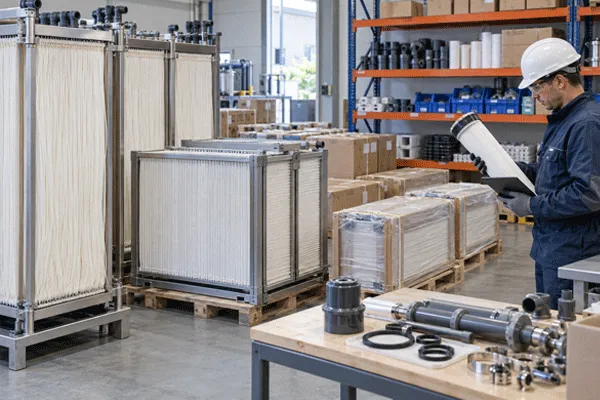
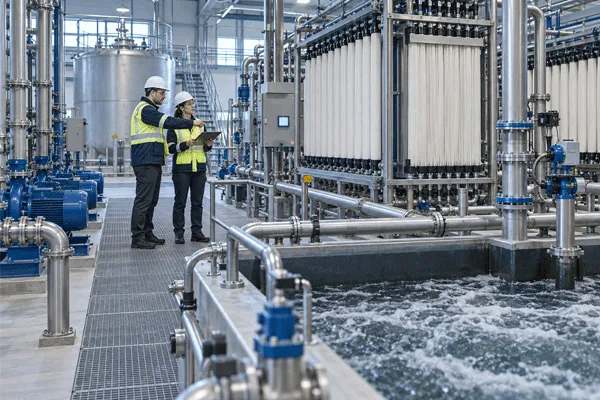
Traditional treatment may struggle with changing pollutants, limited space, strict discharge rules, and rising water costs. These problems can lead to unstable water quality and poor water recovery. Advanced membrane technology offers a compact, controlled, and flexible way to separate contaminants and produce water for discharge, reuse, or industrial processes.
Advanced membrane technology uses selective membrane materials, optimized membrane elements, automated controls, and integrated treatment processes to separate particles, microorganisms, salts, organics, and other contaminants from water. It includes microfiltration, ultrafiltration, nanofiltration, reverse osmosis, membrane bioreactors, membrane distillation, and hybrid membrane systems for water purification, wastewater treatment, desalination, and water reuse.
What Is Advanced Membrane Technology in Water and Wastewater Treatment?
Article Outline
- What does advanced membrane technology mean?
- How does the membrane separation process work?
- What are the main types of membrane processes?
- How does a membrane bioreactor improve wastewater treatment?
- Which membrane materials and module designs are available?
- Why does membrane fouling occur?
- How is membrane performance measured?
- Where are advanced membrane technologies used?
- How do integrated membrane systems support sustainable water reuse?
- How should EPC contractors select a suitable membrane system?
- What new membranes may shape future water treatment?
- Why does engineering support matter?
- Frequently asked questions
- Key points to remember
What Does Advanced Membrane Technology Mean?
A membrane is a selective barrier. It allows water and certain small substances to pass through while holding back larger particles, microorganisms, dissolved salts, organic molecules, or other unwanted materials.
However, advanced membrane technology means more than installing a filter with small pores. It combines improvements in:
- Membrane materials
- Pore structure and selectivity
- Module configuration
- Membrane surface properties
- Hydraulic design
- Pretreatment
- Cleaning methods
- Energy recovery
- Process automation
- Real-time monitoring
- Hybrid treatment integration
Modern membrane technologies can treat drinking water, industrial wastewater, municipal sewage, seawater, surface water, reclaimed water, and process water. The right technology depends on which contaminants must be removed and what quality of water the project must produce.
The U.S. Environmental Protection Agency recognizes microfiltration, ultrafiltration, nanofiltration, and reverse osmosis as common membrane filtration processes used in water treatment. These processes differ in separation ability, operating pressure, membrane properties, and the substances they reject.
In practical engineering, the word “advanced” often describes a complete system rather than one new membrane. For example, a modern industrial plant may combine biological treatment, hollow fiber membrane filtration, reverse osmosis, EDI polishing, ultraviolet treatment, and PLC or SCADA automation.
How Does the Membrane Separation Process Work?
A membrane separation process creates a driving force that moves one part of a fluid through a membrane while retaining another part. In many water applications, a pump creates pressure that pushes water toward the membrane surface.
Water that passes through the membrane is called:
- Permeate
- Filtrate
- Product water
- Treated water
The retained stream may be called:
- Concentrate
- Retentate
- Reject water
- Brine
The basic process can be shown as follows:
Feed Water
    │
    ▼
Pretreatment
    │
    ▼
Membrane Separation
    │
    ├── Permeate → Purified Water
    │
    └── Concentrate → Retained Contaminants
Different membrane processes use different separation mechanisms. Microfiltration and ultrafiltration mainly rely on pore size and physical exclusion. Nanofiltration and reverse osmosis also depend on membrane chemistry, molecular size, charge, diffusion, and pressure.
A contaminant will pass through the membrane only when its size and chemical properties allow it to cross the selective layer. This means that one membrane cannot remove every contaminant with the same efficiency.
The EPA notes that no single water purification system removes every impurity. Treatment technologies are therefore often installed in sequence. Pretreatment removes larger particles first, while finer purification stages handle dissolved contaminants later.
What Are the Main Types of Membrane Processes?
The main pressure-driven membrane processes are microfiltration, ultrafiltration, nanofiltration, and reverse osmosis. They do not perform the same job.
| Membrane Process |
Main Separation Target |
Common Applications |
| Microfiltration |
Suspended solids, algae, many bacteria |
Pretreatment, clarification, food processing |
| Ultrafiltration |
Colloids, bacteria, macromolecules, many viruses |
Drinking water, RO pretreatment, wastewater reuse |
| Nanofiltration |
Multivalent salts, hardness, color, larger organics |
Softening, color removal, selective purification |
| Reverse osmosis |
Dissolved salts, small organics, ions |
Desalination, pure water, industrial water reuse |
| Membrane bioreactor |
Biomass and suspended solids |
Municipal and industrial wastewater treatment |
| Membrane distillation |
Non-volatile contaminants and salts |
High-salinity water and thermal desalination |
| Membrane contactor |
Transfer of gas across a membrane |
Degassing, oxygenation, carbon dioxide removal |
Microfiltration
Microfiltration is usually the least restrictive of the four main pressure-driven processes. It removes suspended solids, larger microorganisms, oil droplets, and other particulate matter.
It may operate as a dead-end membrane process, where most feed water moves through the barrier, or as a crossflow system, where part of the feed moves across the membrane surface.
Ultrafiltration
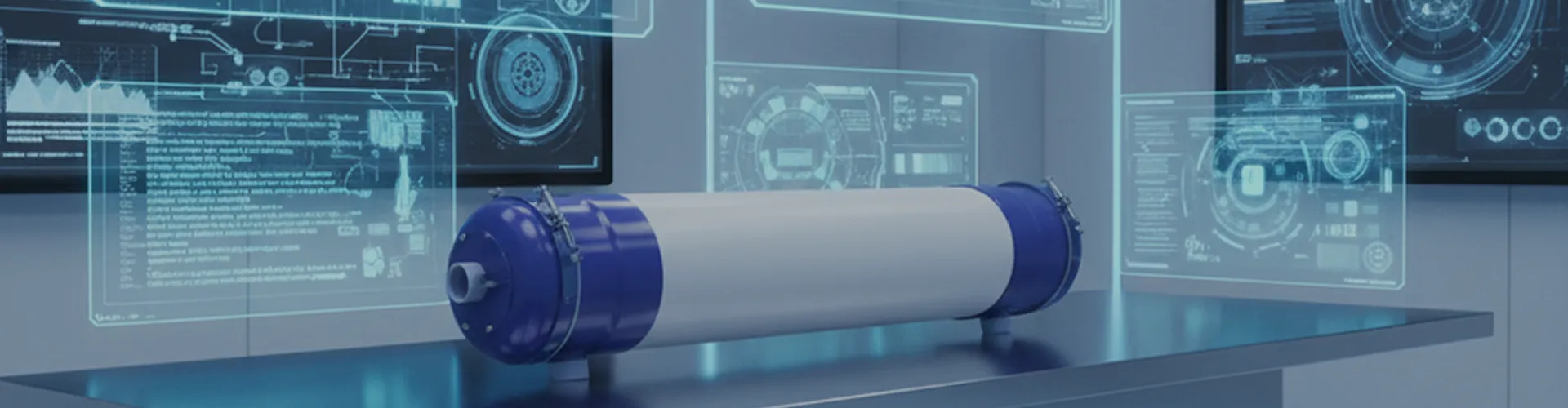
Ultrafiltration provides finer separation than microfiltration. A hollow fiber ultrafiltration membrane can remove turbidity, colloids, bacteria, macromolecules, and many larger biological contaminants.
The EPA describes microfiltration and ultrafiltration as low-pressure membrane processes and stresses that monitoring, integrity testing, and performance trending remain important even when systems are highly automated.
UF is frequently installed before an RO system because it protects the RO membranes from particles and colloidal fouling. It is also widely used in municipal water treatment and advanced wastewater reuse projects.
Nanofiltration
Nanofiltration sits between UF and RO. It can remove much of the hardness, color, natural organic matter, larger dissolved molecules, and multivalent ions while allowing more monovalent salt passage than reverse osmosis.
NF can be useful when complete desalination is unnecessary. This selective separation may reduce pressure and energy demand compared with a tighter RO process.
Reverse Osmosis
Reverse osmosis uses pressure to overcome natural osmotic pressure. Water passes through a dense selective layer, while most dissolved salts and many other contaminants remain in the concentrate.
RO membranes are widely used for:
- Brackish water treatment
- Seawater desalination
- Boiler feed water
- Pharmaceutical water preparation
- Electronics manufacturing
- Food and beverage processing
- Wastewater reclamation
- Pure water production
RO produces high-quality water, but it also creates a concentrated reject stream. Recovery, energy use, scaling, concentrate management, and pretreatment must therefore be considered during system design. The EPA describes RO as one of the finest membrane purification processes and notes that it produces both purified permeate and a concentrated reject stream.
What Is Advanced Membrane Technology in Water and Wastewater Treatment?
How Does a Membrane Bioreactor Improve Wastewater Treatment?
A membrane bioreactor, or MBR, combines biological wastewater treatment with membrane filtration. Microorganisms first break down biodegradable pollutants. The membrane then separates clean treated water from activated sludge.
Unlike a conventional activated-sludge plant, an MBR does not depend on a secondary settling tank to separate biomass from water. Hollow fiber MBR membranes or flat sheet MBR membranes provide a physical barrier between the mixed liquor and the product water.
Basic MBR process
Wastewater
    ↓
Screening and Pretreatment
    ↓
Biological Reactor
    ↓
MBR Membrane Separation
    ├── Permeate → Discharge or Reuse
    └── Retained Biomass → Bioreactor
The compact design makes MBR attractive when land is limited or when the project needs stable, low-turbidity effluent. It can support municipal sewage treatment, hotel wastewater treatment, industrial park projects, food-processing wastewater, and industrial wastewater treatment.
A 2025 study evaluating a full-scale industrial MBR over 18 years reported stable treated-water quality and stable transmembrane pressure when operators combined suitable operating control with chemical cleaning at a defined pressure threshold. This long operating record shows that membrane systems can provide durable service, but only when pretreatment, cleaning, and process management are handled correctly.
MBR permeate may be discharged directly when it meets local limits. For higher-quality water reuse, the plant can add UF polishing, reverse osmosis, disinfection, activated carbon, or other advanced treatment processes.
Which Membrane Materials and Module Designs Are Available?
Membrane materials can be divided broadly into organic polymeric membranes and inorganic membranes.
Common polymeric materials include:
- Polyvinylidene fluoride, or PVDF
- Polyethersulfone, or PES
- Polysulfone, or PS
- Polyamide
- Polypropylene
- Polyethylene
- Cellulose acetate
Polymeric membranes are widely used because they are relatively lightweight and can be fabricated into hollow fibers, flat sheets, tubular products, and spiral-wound membrane elements.
Inorganic membranes may use:
- Alumina
- Zirconia
- Titania
- Silicon carbide
- Stainless steel
- Glass
- Other ceramic materials
Ceramic membranes can offer strong thermal, mechanical, and chemical resistance. They may suit difficult industrial applications involving high temperature, aggressive cleaning, abrasive solids, oil, or harsh chemicals. Their initial cost can be higher, so the full lifecycle and cleaning requirements must be evaluated.
A 2024 experimental study produced ceramic membranes from industrial ceramic waste and tested them for humic-acid-contaminated water. The research illustrates how new membrane fabrication methods may combine waste reuse with improved water treatment materials, although full-scale commercial performance must still be verified for each application.
Common module formats
| Module Type |
Main Features |
Typical Uses |
| Hollow fiber |
High membrane area in a compact volume |
UF, MBR, MF |
| Flat sheet |
Open channels and accessible surfaces |
MBR, difficult wastewater |
| Spiral wound |
Compact and cost-effective |
RO and NF |
| Tubular |
Wide channels for solids-bearing streams |
Industrial wastewater |
| Plate-and-frame |
Flexible flow and membrane replacement |
Special separation duties |
| Ceramic monolith |
Durable multi-channel structure |
Harsh industrial filtration |
There is no universally suitable membrane. Engineers must match the membrane material and configuration to the source of water, contaminant type, cleaning method, temperature, pH, solids loading, and water-quality target.
Why Does Membrane Fouling Occur?
Membrane fouling happens when contaminants collect on or inside the membrane. These deposits reduce water flux, increase pressure demand, lower water production, or change rejection performance.
Major fouling types include:
- Particulate fouling
- Colloidal fouling
- Organic fouling
- Biological fouling
- Scaling
- Oil fouling
- Metal precipitation
- Irreversible pore blockage
Concentration polarization is related but not identical. It occurs when rejected substances become more concentrated near the membrane surface than in the main feed stream. This boundary layer can reduce membrane performance and increase scaling or fouling risk.
In an MBR, membrane fouling may involve sludge particles, microorganisms, extracellular polymeric substances, soluble microbial products, and inorganic deposits. A large engineering-scale membrane autopsy study identified combined organic, inorganic, and biological fouling in hollow fiber UF membranes from a plant treating approximately 160,000 cubic metres per day of mixed municipal and industrial wastewater.
How can engineers reduce membrane fouling?
Effective control may include:
- Fine screening
- Coagulation or flocculation
- Media filtration
- Activated carbon
- UF pretreatment
- Softening
- Antiscalant dosing
- pH adjustment
- Dechlorination
- Aeration
- Crossflow velocity
- Backwashing
- Relaxation
- Air scouring
- Chemically enhanced backwashing
- Clean-in-place procedures
Operating at the highest possible water flux is not always wise. Research on ultrapermeable membrane systems has shown that very high flux can intensify concentration polarization and membrane fouling. Better membrane properties must therefore be combined with suitable module and hydraulic design.
A good membrane does not replace good pretreatment. It makes good pretreatment more valuable.
What Is Advanced Membrane Technology in Water and Wastewater Treatment?
How Is Membrane Performance Measured?
Membrane performance cannot be judged through product water flow alone. Engineers need to track hydraulic performance, separation efficiency, membrane integrity, energy use, cleaning frequency, and water recovery.
Important indicators include:
| Performance Indicator |
What It Shows |
| Flux |
Water flow through each unit of membrane area |
| Transmembrane pressure |
Pressure driving water across the membrane |
| Permeability |
Flux relative to applied pressure |
| Rejection |
Percentage of a substance retained |
| Recovery |
Percentage of feed converted into product water |
| Pressure drop |
Hydraulic resistance through the module |
| Conductivity |
Dissolved ionic content |
| Turbidity |
Suspended and colloidal matter |
| Salt passage |
Dissolved salt crossing an RO membrane |
| Integrity result |
Whether the membrane barrier remains intact |
| Specific energy use |
Energy consumed per unit of product water |
Flux should be normalized when temperature changes significantly because water viscosity affects flow. RO performance may also be normalized for pressure, temperature, feed salinity, and recovery.
For low-pressure drinking-water membrane systems, the EPA emphasizes direct integrity testing, continuous indirect monitoring, and regular performance trending. Its 2025 optimization guidance states that low-pressure membrane systems can consistently produce very low-turbidity filtered water when equipment integrity and operation remain under control.
A well-designed PLC or SCADA system can trend:
- Feed and product pressure
- Transmembrane pressure
- Permeate flow
- Concentrate flow
- Conductivity
- Turbidity
- Tank levels
- Cleaning cycles
- Valve status
- Pump frequency
- Energy consumption
- Alarm history
Trend data helps operators detect a gradual loss in membrane performance before the water quality falls outside the required limit.
Where Are Advanced Membrane Technologies Used?
The application of membrane systems extends far beyond simple water filtration.
Municipal applications
Municipal systems use membrane technology for:
- Surface water clarification
- Drinking water production
- Pathogen control
- Municipal wastewater treatment
- Tertiary filtration
- Water reclamation
- Indirect potable reuse
- Desalination
Industrial applications
Industrial users may apply membrane separation in:
- Textile and dyeing wastewater treatment
- Food and beverage factories
- Pharmaceutical manufacturing
- Chemical plants
- Semiconductor and electronics production
- Boiler feed water preparation
- Cooling-water recovery
- Metal finishing
- Mining water treatment
- Landfill leachate treatment
- Oil-water separation
Membranes are also used in gas separation and energy applications, although those fields may use different membrane materials and driving forces from water purification systems.
The final process should reflect the required quality of water. A washing process may need filtered reclaimed water, while electronics or pharmaceutical production may require RO, EDI, UV oxidation, final UF, and a controlled distribution loop.
How Do Integrated Membrane Systems Support Sustainable Water Reuse?
Membrane technology supports sustainable water management by allowing treated wastewater to replace fresh water in suitable applications. This can reduce pressure on limited water supplies and decrease wastewater discharge.
A typical advanced water reuse system may include:
Industrial or Municipal Wastewater
             ↓
Biological Treatment or MBR
             ↓
Ultrafiltration
             ↓
Reverse Osmosis
             ↓
EDI or Other Polishing
             ↓
UV / Final Filtration
             ↓
Reclaimed High-Quality Water
The exact configuration depends on the original water quality and final reuse target. Not every project needs every stage. Over-treatment wastes energy and capital, while under-treatment creates quality and compliance risks.
Useful reuse applications include:
- Cooling-tower makeup
- Boiler feed water
- Process washing
- Irrigation
- Toilet flushing
- Landscape water
- Production-line rinsing
- Utility water
- Industrial process water
Water recovery also matters. A system with excellent rejection but poor recovery may consume too much feed water or create too much concentrate. Engineers should examine the complete water balance rather than focusing on one membrane element.
Hybrid systems may improve recovery by combining UF, NF, RO, evaporation, crystallization, biological treatment, adsorption, oxidation, or selective ion removal. However, zero-liquid-discharge and minimum-liquid-discharge projects require careful energy and concentrate analysis.
How Should EPC Contractors Select a Suitable Membrane System?
A membrane should never be selected only by nominal pore size, advertised capacity, or unit price. Successful selection starts with a representative water analysis and a clear product-water requirement.
Essential project information
EPC contractors and industrial buyers should define:
- Source of water
- Average and peak flow
- Daily operating hours
- Temperature range
- pH range
- Turbidity
- Suspended solids
- Chemical oxygen demand
- Biological oxygen demand
- Oil and grease
- Hardness
- Silica
- Iron and manganese
- Total dissolved solids
- Chloride and sulfate
- Microbial risk
- Required product water quality
- Required recovery
- Discharge requirements
- Available footprint
- Automation requirements
- Redundancy philosophy
Pilot testing is valuable when wastewater composition changes, when pollutants are difficult to characterize, or when the project applies membrane filtration to a new industrial stream.
Simplified technology-selection guide
| Project Need |
Possible Membrane Solution |
| Remove suspended matter and bacteria |
MF or UF |
| Protect downstream RO |
Hollow fiber UF |
| Replace secondary clarification |
MBR |
| Remove hardness and color selectively |
NF |
| Remove dissolved salts |
RO |
| Produce high-purity industrial water |
RO plus EDI |
| Treat high-solids wastewater |
Flat sheet MBR or tubular membrane |
| Handle harsh chemicals or temperature |
Ceramic membrane |
| Recover water from high salinity |
RO plus thermal or emerging membrane process |
The suitable membrane system should also include compatible pumps, pipes, instruments, tanks, chemical dosing, cleaning equipment, controls, spare parts, and safety interlocks.
What New Membranes May Shape Future Water Treatment?
Research into new membranes focuses on improving selectivity, permeability, durability, fouling resistance, energy efficiency, and material sustainability.
Promising directions include:
- Nanostructured composite membranes
- Graphene-derived selective layers
- Biomimetic water channels
- Antimicrobial membrane surfaces
- Photocatalytic membranes
- Electrically responsive membranes
- Low-fouling hydrophilic coatings
- High-flux hollow fibers
- Low-cost ceramic membranes
- Solvent-resistant nanofiltration
- Machine-learning-supported process control
Membrane distillation is also receiving attention for high-salinity water. It uses a temperature-driven vapour-pressure difference rather than hydraulic pressure to move water vapour through a hydrophobic membrane. A 2024 study investigated direct-contact membrane distillation for brackish-water desalination and showed that operating conditions strongly affect flux and PVDF membrane performance.
Researchers are also testing lower-energy MBR designs. A 2025 study developed a gravity-driven membrane bioreactor combined with biological fouling control to reduce energy demand and limit biofouling. Such developments are promising, but full-scale reliability, cleaning, cost, and long-term membrane performance must be proven before broad adoption.
Other work has investigated rapid fouling removal, improved ceramic fabrication, surface modification, and highly selective membrane structures. Advanced materials may improve membrane separation, but commercial success still depends on manufacturing consistency, module sealing, chemical stability, scale-up, and real wastewater testing.
Why Does Engineering Support Matter?
Membrane elements are only one part of a treatment plant. Even high-quality membranes can fail early when pretreatment, hydraulics, aeration, cleaning, chemical dosing, or automation are unsuitable.
As an engineering-oriented manufacturer, we develop customized water treatment solutions that can integrate:
- Hollow fiber MBR membranes
- Flat sheet MBR membranes
- Hollow fiber UF membranes
- RO membranes
- EDI modules
- Small RO machines
- Pure water treatment plants
- Wastewater treatment plants
- Integrated membrane filtration systems
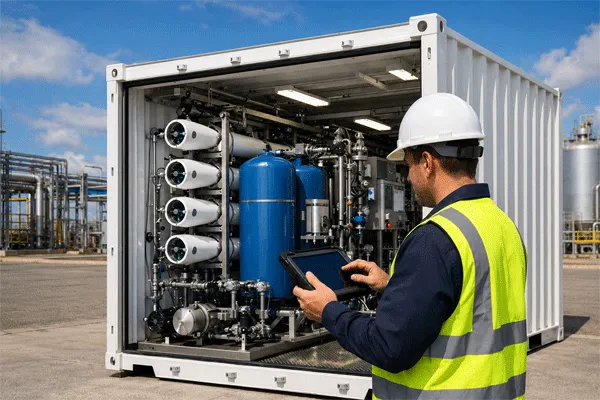
- Skid-mounted systems
- Containerized treatment plants
For EPC contractors, engineering companies, system integrators, and industrial plant owners, a complete technical package may include:
- Process flow diagrams
- Water balance
- Equipment data sheets
- Membrane calculations
- General arrangement drawings
- Piping and instrument diagrams
- Electrical load lists
- Instrument lists
- PLC control descriptions
- Operating manuals
- Maintenance schedules
- Recommended spare parts
- Commissioning guidance
A reliable water treatment solution must balance effluent quality, recovery, membrane life, energy use, chemical use, footprint, automation, and lifecycle cost. It should also leave room for maintenance and future expansion.
Frequently Asked Questions About Advanced Membrane Technology
Is advanced membrane technology one specific type of membrane?
No. It is a broad term covering improved membrane materials, module structures, separation processes, automation, cleaning strategies, and integrated systems. It may include MF, UF, NF, RO, MBR, membrane distillation, and membrane contactors.
What is the difference between filtration and membrane separation?
Traditional filtration often removes larger suspended solids. Membrane separation can provide much finer and more controlled removal. Depending on the membrane, it may separate microorganisms, colloids, macromolecules, hardness, dissolved organics, or salts.
Which membrane is best for wastewater treatment?
There is no single best membrane. MBR and UF are useful for suspended solids and biological treatment, while NF or RO may be needed for dissolved contaminants and water reuse. The suitable membrane depends on the wastewater analysis and product-water target.
Can a membrane system treat industrial wastewater without pretreatment?
In most cases, no. Screening, oil removal, biological treatment, coagulation, clarification, pH control, UF, or other pretreatment may be required. Poor pretreatment can cause rapid membrane fouling and frequent cleaning.
What is the difference between hollow fiber and flat sheet MBR membranes?
Hollow fiber membranes offer high packing density and compact installation. Flat sheet membranes have wider flow channels and can be easier to inspect or clean in some difficult wastewater applications. Selection depends on sludge characteristics, footprint, energy use, and maintenance preferences.
Can membrane technology produce potable water?
Yes, when the system is properly designed, validated, monitored, and combined with suitable disinfection and safety barriers. The process configuration must comply with applicable drinking-water standards and local regulations.
Key Points to Remember
- A membrane is a selective barrier that separates water from unwanted substances.
- Advanced membrane technology includes materials, modules, controls, pretreatment, and integrated processes.
- MF, UF, NF, and RO provide different levels of separation.
- MBR combines biological treatment with membrane filtration.
- Hollow fiber, flat sheet, spiral-wound, tubular, and ceramic modules serve different conditions.
- Membrane fouling can come from solids, organics, microorganisms, oil, metals, or scale.
- Good pretreatment is essential for stable membrane performance.
- Flux, pressure, permeability, rejection, integrity, recovery, and energy use should be monitored.
- Higher flux does not always mean better lifecycle performance.
- Membrane systems can support desalination, drinking water, industrial water, and wastewater reuse.
- Water recovery and concentrate management must be included in the system design.
- New membranes may improve selectivity and fouling resistance, but full-scale validation remains important.
- The best water treatment solutions are engineered around the complete process, not one membrane product.
- EPC projects need clear technical documents, automation logic, commissioning support, and spare-parts planning.










 10:36
10:36