Choosing the wrong membrane technology can lead to poor water quality, rapid fouling, high energy use, or an oversized plant. The problem is that MBR and RO are often treated as competing systems. In practice, they perform different jobs—and frequently work best together.
The main difference between MBR and RO is that an MBR combines biological treatment with membrane filtration to remove organic matter, biomass, and suspended solids from wastewater. RO uses pressure and a semi-permeable membrane to remove dissolved salts, ions, and many small contaminants. MBR treats wastewater biologically; RO further purifies water for reuse or high-purity applications.
MBR vs RO: What Is the Difference in Wastewater Treatment?
Article Outline
- What are MBR and RO membrane systems?
- How does a membrane bioreactor work?
- How does reverse osmosis work?
- What is the main difference between MBR and RO?
- Which contaminants can each membrane process remove?
- Is MBR better than conventional activated sludge?
- When should MBR and RO systems be combined?
- What causes membrane fouling in MBR and RO?
- How do energy use and operating costs compare?
- How should engineers select the right treatment process?
- What should EPC contractors specify before requesting a quotation?
- Frequently asked questions
- Key points to remember
What Are MBR and RO Membrane Systems?
An MBR, or membrane bioreactor, is a wastewater treatment process that combines an activated sludge biological reactor with a physical membrane barrier. Microorganisms break down biodegradable pollutants, while the MBR membrane separates treated water from activated sludge, bacteria, and suspended solids.
RO, or reverse osmosis, is a pressure-driven membrane process. It pushes water through a dense semi-permeable membrane while rejecting a large share of dissolved salts, ions, metals, and other small contaminants. RO is used in pure water production, desalination, process water systems, boiler feed preparation, electronics manufacturing, and advanced wastewater reuse.
The two treatment technologies therefore address different water quality problems:
| Technology |
Main Treatment Function |
| MBR |
Biological degradation plus solid-liquid separation |
| RO |
Removal of dissolved salts and small dissolved contaminants |
| MBR + RO |
Advanced wastewater treatment and high-quality water reuse |
The U.S. Environmental Protection Agency describes MBRs as systems that combine a suspended-growth biological reactor with solids removal through membrane filtration. The EPA also notes that MBRs can provide high removal of biochemical oxygen demand, suspended solids, bacteria, and, when properly designed, nutrients.
How Does a Membrane Bioreactor Work?
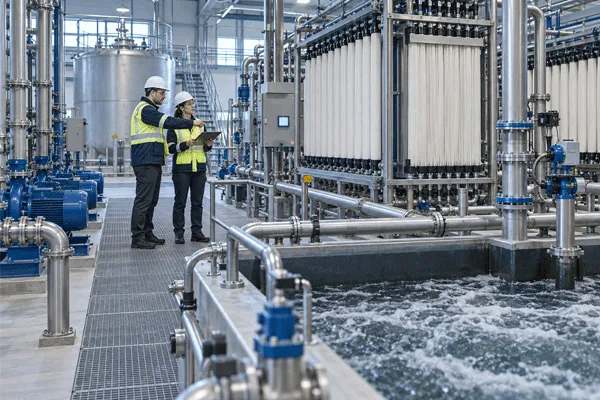
A typical MBR system receives screened wastewater in a biological tank. Air is supplied to support microorganisms that consume organic pollutants. Depending on the treatment goals, the plant may include anaerobic, anoxic, and aerobic zones for nitrogen and phosphorus control.
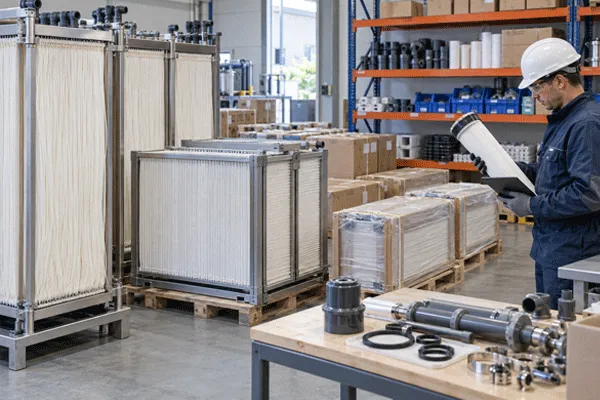
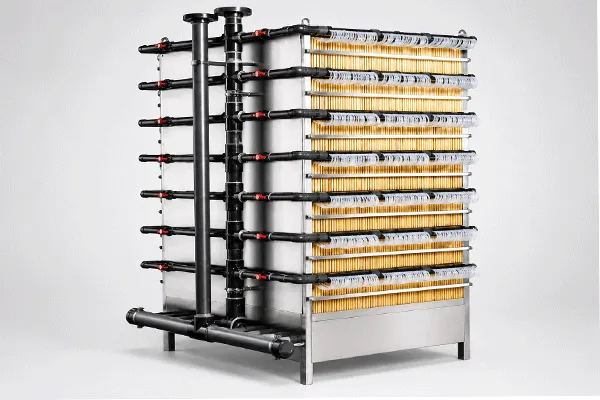
The mixed liquor then contacts a hollow fiber or flat sheet membrane module. Water passes through the membrane pores, while activated sludge and suspended solids remain in the biological tank. The collected permeate becomes the MBR effluent.
A simplified MBR process looks like this:
Raw wastewater
      ↓
Screening and equalization
      ↓
Biological treatment tank
      ↓
Aeration and membrane separation
      ↓
Disinfection or additional treatment
      ↓
Treated water or water reuse
The physical membrane replaces the secondary clarifier used in a conventional activated sludge system. This allows the MBR process to retain biomass independently of the treated-water flow and often operate with a higher mixed liquor concentration.
The result is a compact design with stable solid-liquid separation. However, the biological treatment process still needs correct loading, aeration, sludge age, temperature, pH, nutrient balance, and pretreatment.
An MBR is not simply a filter tank. It is a controlled biological treatment system supported by membrane filtration.
How Does Reverse Osmosis Work?
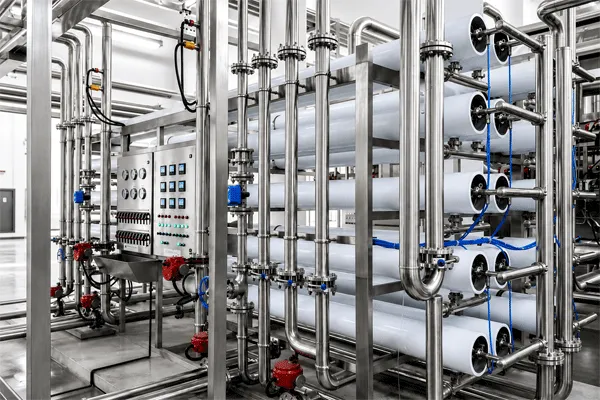
Reverse osmosis uses a pump to create pressure on the feed-water side of an RO membrane. Water molecules pass through the semi-permeable membrane, while much of the dissolved material remains in a concentrated reject stream.
The process creates two flows:
- Permeate: The purified water that passes through the membrane
- Concentrate: The reject stream containing concentrated salts and contaminants
The EPA explains that RO pressure forces water through a membrane that blocks contaminants while allowing treated water to pass. Unlike ordinary filtration, the process also creates a concentrated reject stream that must be managed.
A common RO system may include:
- Feed-water tank
- Cartridge or multimedia filtration
- Chemical dosing
- High-pressure pump
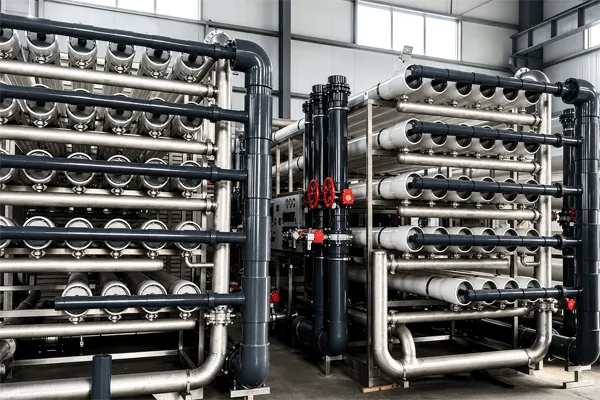
- RO membrane pressure vessels
- Permeate tank
- Concentrate discharge or recovery system
- Cleaning-in-place equipment
- PLC or SCADA control
RO does not rely on microorganisms. It is a physical separation process. It also does not normally serve as the first treatment step for raw sewage or heavily polluted industrial wastewater.
Suspended matter, oil, biological solids, and high organic loads can rapidly foul an RO membrane. For this reason, RO normally requires strong pretreatment.
MBR vs RO: What Is the Difference in Wastewater Treatment?
What Is the Main Difference Between MBR and RO?
The main difference between MBR and RO is what each process removes and how it removes it.
An MBR combines biological treatment with membrane filtration. Microorganisms consume biodegradable organic pollution, while the physical membrane retains biomass and solids.
RO does not biologically degrade pollution. Instead, pressure moves water through a dense membrane that rejects many dissolved substances.
MBR vs RO Comparison Table
| Comparison Point |
MBR |
RO |
| Full name |
Membrane bioreactor |
Reverse osmosis |
| Main purpose |
Wastewater biological treatment |
Water purification and desalting |
| Driving mechanism |
Biological activity plus filtration or suction |
High-pressure membrane separation |
| Typical feed |
Municipal or industrial wastewater |
Pretreated water or MBR effluent |
| Removes suspended solids |
Very effectively |
Feed should already contain very few |
| Removes biodegradable organics |
Yes, through biological treatment |
Some are rejected, but not biologically treated |
| Removes dissolved salts |
Limited |
Yes |
| Removes hardness ions |
Limited |
Yes |
| Produces biological sludge |
Yes |
No biological sludge |
| Produces concentrate |
Usually not a saline concentrate |
Yes |
| Common membrane type |
Microfiltration or ultrafiltration |
Dense RO membrane |
| Operating pressure |
Relatively low |
Higher |
| Common position |
Main wastewater treatment stage |
Advanced polishing stage |
| Main fouling risk |
Biomass and organic deposition |
Scaling, organics, colloids, and biofouling |
The systems are therefore not direct substitutes. Asking whether MBR or RO is “better” is like asking whether a biological reactor or a desalination unit is better. The correct answer depends on the feed water and required outlet quality.
Which Contaminants Can MBR and RO Remove?
An MBR is highly effective for removing suspended solids, biomass, turbidity, and biodegradable organic matter. With suitable biological design, it can also remove nitrogen and phosphorus.
The membrane barrier helps prevent activated sludge and many microorganisms from leaving with the treated water. This generally gives MBR effluent lower turbidity and more stable suspended-solid quality than effluent from a conventional secondary clarifier.
However, an MBR membrane does not efficiently remove all dissolved salts. Sodium, chloride, conductivity, hardness, and many small dissolved substances may remain in the water.
RO focuses on these smaller dissolved contaminants.
| Water Quality Parameter |
MBR Performance |
RO Performance |
| Suspended solids |
Very strong removal |
Must be minimized before RO |
| Turbidity |
Very strong reduction |
Further polishing |
| Biodegradable organics |
Biological removal |
Partial rejection of remaining compounds |
| Bacteria |
Strong physical retention |
Additional barrier |
| Dissolved salts |
Limited removal |
Strong removal |
| Conductivity |
Usually little reduction |
Major reduction |
| Hardness |
Limited |
Strong reduction |
| Heavy-metal ions |
Depends on form and pretreatment |
Often strong rejection |
| Nutrients |
Biological removal when designed |
Further removal of dissolved ions |
| Color |
Variable |
Often improved after pretreatment |
| Oil and grease |
Must be controlled |
Harmful to RO membrane |
The EPA MBR fact sheet states that membranes are effective at retaining solid material but that dissolved wastewater components may need additional treatment steps. This is a central reason for installing RO after MBR in advanced water reuse systems.
Is MBR Better Than Conventional Activated Sludge?
A conventional activated sludge process uses a biological reactor followed by a secondary settling tank. The settling tank depends on the sludge forming flocs that settle well.
An MBR uses a membrane instead of relying only on gravity settling. Poor sludge settleability therefore has less direct effect on effluent suspended solids.
The main advantages of membrane bioreactors can include:
- Smaller plant footprint
- High and stable effluent quality
- Very low suspended solids
- Better control of biomass retention
- Higher mixed liquor concentration
- Easier preparation for wastewater reuse
- Modular membrane expansion
- Elimination of a conventional secondary clarifier
- Reduced sensitivity to sludge settling problems
These benefits make an MBR solution useful for hotels, industrial parks, municipal facilities, food factories, pharmaceutical plants, farms, containerized plants, and projects with limited available land.
However, conventional activated sludge treatment may still be suitable when land is available, discharge requirements are moderate, operators are experienced, and project budgets are tight.
MBR also brings added responsibilities:
- Fine screening is essential.
- Membrane air scouring consumes energy.
- Membrane cleaning must be managed.
- Peak flows require careful design.
- Membrane replacement must be included in lifecycle planning.
- Oil, fibers, hair, and debris can cause serious operating problems.
The EPA notes that MBR systems require pretreatment, fouling control, membrane cleaning, air scouring, and eventual membrane replacement. It also advises careful design for peak hydraulic flows.
MBR vs RO: What Is the Difference in Wastewater Treatment?
When Should MBR and RO Systems Be Combined?
An MBR and RO system is often selected when a project must convert wastewater into reusable process water.
The MBR first removes biodegradable pollution, biomass, and suspended matter. The RO system then removes dissolved salts and other remaining dissolved contaminants. Together, they form a multi-stage treatment process.
A typical reuse plant may follow this sequence:
Raw wastewater
      ↓
Screening and equalization
      ↓
Oil, grease, or chemical pretreatment
      ↓
MBR biological treatment
      ↓
MBR permeate tank
      ↓
RO pretreatment and chemical dosing
      ↓
Reverse osmosis
      ↓
UV, EDI, or final polishing
      ↓
Industrial reuse or high-purity water
MBR and RO systems may be combined for:
- Textile and dyeing wastewater reuse
- Industrial park recycling projects
- Electronics and semiconductor facilities
- Boiler feed-water preparation
- Cooling-tower makeup
- Food and beverage process-water recovery
- Hotel and commercial building reuse
- Municipal wastewater reclamation
- Zero-liquid-discharge pretreatment
- Agricultural and landscape reuse
- Process rinsing water
- Ultrapure water system feed
An RO system should not be added merely because “better water” sounds desirable. Engineers must first define conductivity, total dissolved solids, hardness, silica, boron, organic matter, pathogens, and the final reuse standard.
If the final use is landscape irrigation or toilet flushing, high-quality MBR effluent plus disinfection may be enough. If the water will feed boilers, precision manufacturing, or an EDI module, RO may be necessary.
What Causes Membrane Fouling in MBR and RO?
Both systems can foul, but the fouling mechanisms differ.
In an MBR, membrane fouling often comes from biomass, extracellular polymeric substances, colloids, fibers, fats, oil, inorganic deposits, and solids attached to the membrane surface or trapped in its pores.
Common MBR fouling controls include:
- Fine screening
- Grease and oil removal
- Stable biological loading
- Air scouring
- Relaxation cycles
- Backwashing
- Maintenance cleaning
- Chemical cleaning
- Correct membrane flux
- Control of mixed liquor properties
A submerged MBR system commonly uses air below the membrane module. The rising bubbles help scour the membrane surface and reduce solids buildup. This aeration also contributes to the energy consumption of an MBR.
RO fouling may include:
- Mineral scaling
- Organic fouling
- Colloidal fouling
- Metal precipitation
- Silica deposition
- Biofouling
- Oxidative membrane damage
- Oil contamination
RO protection may require pH adjustment, antiscalant dosing, cartridge filtration, activated carbon, ultrafiltration, softening, dechlorination, or other pretreatment.
A key engineering lesson is simple:
Membrane cleaning should support a good design, not compensate for poor pretreatment.
Frequent cleaning can reduce production time, increase chemical consumption, shorten membrane life, and raise operating costs. Feed-water analysis and pilot testing are often valuable for challenging wastewater streams.
How Do Energy Use and Operating Costs Compare?
MBR energy use mainly comes from biological aeration, membrane air scouring, internal recirculation, permeate extraction, sludge handling, and pumping.
RO energy use mainly comes from the pressure needed to push water through the membrane. Required pressure rises with feed-water salinity, recovery target, membrane condition, and system design.
A simple comparison is shown below:
| Cost Factor |
MBR |
RO |
| Biological aeration |
Major cost |
Not applicable |
| Membrane air scouring |
Important |
Not normally used |
| High-pressure pumping |
Low or moderate |
Major cost |
| Cleaning chemicals |
Required |
Required |
| Biological sludge disposal |
Required |
Not produced by RO itself |
| Concentrate disposal |
Limited in normal MBR operation |
Essential consideration |
| Membrane replacement |
Required periodically |
Required periodically |
| Pretreatment |
Screening and process-specific treatment |
High-quality pretreatment essential |
| Operator skill |
Biological and membrane knowledge |
Chemical and membrane knowledge |
Neither system has one universal operating cost. Cost depends on plant size, influent quality, flow variation, required effluent, electricity price, chemicals, recovery rate, membrane area, automation, and concentrate disposal.
Engineers should compare lifecycle cost rather than equipment price alone. A cheaper system that fouls every week can become expensive very quickly.
How Should Engineers Select the Right Treatment Process?
The correct water treatment process starts with laboratory data and a clear outlet target.
At minimum, engineers should review:
- Daily and hourly flow
- Peak flow
- COD and BOD
- Suspended solids
- Oil and grease
- Ammonia and total nitrogen
- Total phosphorus
- Conductivity and TDS
- Hardness and alkalinity
- Chloride and sulfate
- Silica
- Heavy metals
- Temperature and pH
- Toxic or inhibitory compounds
- Required discharge or reuse limits
A practical selection approach is:
Choose MBR when:
- Raw water is sewage or biodegradable wastewater.
- The project needs biological treatment.
- Suspended solids must be very low.
- The site has limited space.
- Stable effluent is important.
- The water may be reused after disinfection or polishing.
Choose RO when:
- Dissolved salts must be reduced.
- Conductivity or hardness is too high.
- High-purity process water is required.
- The feed water has already received reliable pretreatment.
- Concentrate can be managed safely.
Choose MBR followed by RO when:
- Wastewater must be recovered for industrial use.
- Both organic pollution and dissolved salts must be removed.
- The project requires advanced wastewater treatment.
- Stable RO feed quality is important.
- Water reuse and recycling are central project goals.
What Should EPC Contractors Specify Before Requesting a Quotation?
A useful request for quotation should include more than the required flow.
| Project Information |
Example |
| Wastewater source |
Textile dyeing factory |
| Average flow |
1,000 m³/day |
| Peak flow |
60 m³/hour |
| Influent COD |
Laboratory data required |
| Suspended solids |
Laboratory data required |
| Conductivity |
Laboratory data required |
| Required outlet |
Process-water reuse |
| Operating hours |
24 hours/day |
| Available footprint |
Length × width × height |
| Installation type |
Civil, skid-mounted, or containerized |
| Automation |
PLC and SCADA |
| Power supply |
Voltage, phase, and frequency |
| Climate |
Ambient and water temperature |
| Discharge limits |
Local regulatory requirements |
| Documentation |
PFD, P&ID, GA drawing, manuals, and certificates |
| Services |
Installation guidance and commissioning |
For complex industrial wastewater treatment plants, one water sample is rarely enough. Wastewater quality can change by shift, production batch, season, or cleaning cycle.
We often recommend reviewing:
- Several recent laboratory reports
- Production schedules
- Chemical use in the factory
- Existing treatment performance
- Historical flow variation
- Required reuse points
- Operator capability
- Available concentrate-disposal routes
As an engineering-oriented manufacturer of water and wastewater treatment systems, we supply hollow fiber MBR membranes, hollow fiber UF membranes, flat sheet MBR membranes, RO membranes, EDI modules, small RO machines, pure water plants, wastewater plants, and integrated membrane filtration systems.
We also support customized EPC treatment solutions, containerized plants, skid-mounted equipment, PLC and SCADA automation, technical documentation, commissioning, spare parts, and long-term membrane supply.
Case Study: Industrial Wastewater Reuse With MBR and RO
Consider a manufacturing plant that wants to reduce freshwater consumption. Its existing conventional treatment system produces water that meets basic discharge requirements, but the effluent still has unstable turbidity, dissolved salts, and variable organic content.
Sending this water directly to RO creates frequent membrane fouling. Cartridge filters block quickly. Cleaning becomes more common, and RO production falls.
A better treatment solution may include:
- Equalization
- pH control
- Chemical pretreatment where needed
- Biological treatment with membrane filtration
- MBR permeate storage
- RO pretreatment
- Reverse osmosis
- Final disinfection or EDI polishing
The MBR provides stable, low-turbidity feed water. RO then reduces dissolved salts. The plant can reuse the final water for washing, cooling, production support, or other approved uses.
The lesson is important: RO performs best when the upstream treatment system protects it. MBR can provide an effective biological and physical barrier, but the complete design must still consider scaling, residual organics, silica, hardness, and concentrate disposal.
Frequently Asked Questions
Can MBR remove dissolved salts?
Not effectively. An MBR removes biodegradable organic matter, suspended solids, biomass, and many microorganisms. Most dissolved salts pass through an MBR membrane. RO or another desalting process is required when conductivity or TDS must be reduced.
Can RO treat raw sewage directly?
It should not normally be used directly on raw sewage. Suspended solids, oil, organic matter, microorganisms, and debris can rapidly foul an RO membrane. Raw wastewater first needs suitable physical, chemical, and biological treatment.
Is MBR effluent suitable as RO feed water?
It can be an excellent starting point because it normally contains very low suspended solids and turbidity. However, engineers must still check dissolved organics, hardness, silica, metals, temperature, pH, scaling potential, and biological activity.
Is MBR more expensive than conventional activated sludge?
MBR equipment and energy costs can be higher, but the process can reduce land requirements, eliminate secondary clarifiers, improve effluent quality, and simplify water reuse. The best choice depends on lifecycle cost and project goals.
Does an MBR require membrane cleaning?
Yes. MBR operation includes air scouring, relaxation, backwashing where applicable, maintenance cleaning, and periodic recovery cleaning. Cleaning frequency depends on wastewater quality, flux, pretreatment, and operating control.
What happens to the RO concentrate?
The concentrate must be discharged, treated, evaporated, recycled, or managed according to local regulations and site conditions. Concentrate management should be considered during the initial design—not after the RO plant has been installed.
Key Points to Remember
- MBR and RO perform different treatment functions.
- An MBR combines biological treatment with membrane filtration.
- RO uses pressure to remove dissolved salts and many small contaminants.
- MBR is suitable for municipal and industrial wastewater treatment.
- RO is suitable for desalting and high-purity water production.
- An MBR membrane does not provide major TDS or conductivity reduction.
- Raw wastewater should not normally feed an RO system directly.
- MBR followed by RO is a strong solution for advanced wastewater reuse.
- MBR fouling is often related to biomass, solids, oil, and organic matter.
- RO fouling is often related to scaling, colloids, organics, and biofouling.
- Pretreatment, automation, membrane cleaning, and operator training affect long-term performance.
- EPC contractors should provide water analysis, flow data, outlet standards, site conditions, and automation requirements before requesting a proposal.
- The best treatment system is based on the full water balance and lifecycle cost—not membrane price alone.
Planning an MBR, RO, or integrated wastewater reuse project? Send us your influent analysis, design flow, peak flow, required treated-water quality, available footprint, discharge or reuse standard, power supply, and project location. Our engineering team can help develop a customized membrane treatment solution, equipment configuration, process flow, and technical proposal.











 11:23
11:23