For a pharmaceutical effluent stream of a few tens of cubic metres per day, an MBBR-based biological system often meets the discharge limit at lower cost and lower operator burden than a full membrane train. An MBR earns its place when the limit is tight, the footprint is fixed, or the water is reused.
Pharmaceutical Wastewater Treatment: Process Selection Guide
Why pharmaceutical effluent resists a standard answer
Pharmaceutical plants do not produce one wastewater. A facility running synthesis, fermentation, formulation and packaging generates streams with almost nothing in common, and whether they are segregated or combined before treatment changes the process selection more than any equipment choice does.
Synthesis wastewater carries solvents, high COD and often high salinity. Fermentation broth waste carries a heavy but largely biodegradable organic load. Formulation and equipment washdown produce moderate-strength water containing active pharmaceutical ingredients at low concentration, and this is the stream that draws regulatory attention. Utility blowdown and sanitary sewage from the same site are ordinary in comparison, and combining them with process effluent mainly dilutes the problem while enlarging the plant.
Four characteristics recur across pharmaceutical sites and set the comparison dimensions used through the rest of this guide:
- Small flows relative to the load.A plant discharging a few tens of cubic metres a day can carry a COD concentration many times that of municipal sewage. Sizing on flow alone produces a badly wrong plant.
- Batch campaigns rather than continuous discharge.Production runs a product for a period, cleans down, then runs something different. The wastewater changes character with the campaign.
- Biomass inhibition.Antibiotics, disinfectants, solvents and preservatives are designed to suppress microbial activity. Some of what arrives at the bioreactor is actively hostile to the process it is supposed to feed.
- A non-biodegradable COD fractionthat aeration time cannot remove, varying by product portfolio.
Those four are the reason vendor comparison pages that rank MBBR against MBR on generic criteria give unusable answers for a pharmaceutical site. The criteria that decide it are load variability, inhibition risk, and how tight the discharge limit is.
The three trains actually on the table
MBBR (moving bed biofilm reactor). Biomass grows as a biofilm on plastic carriers kept in suspension by aeration. Because the biomass is attached rather than suspended, it does not wash out when flow surges, and the reactor recovers from an inhibitory slug faster than a suspended-growth system does. Solids separation still happens afterwards, usually by settling or a simple filter, and effluent suspended solids depend on how well that separation works.
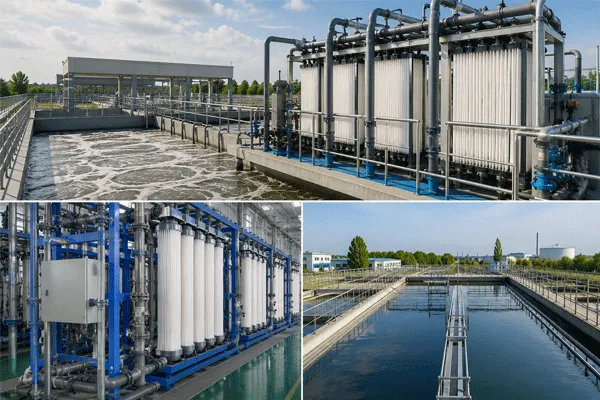
MBR (membrane bioreactor). Suspended biomass with submerged membranes replacing the clarifier. The barrier holds all biomass in the reactor regardless of settleability, allowing a much higher biomass concentration and a long sludge age in a small tank. Effluent suspended solids are set by the membrane, not by settling behaviour.
Hybrid: MBBR ahead of an MBR. Carriers in the first stage absorb the shock and the inhibitory fraction, protecting the suspended biomass in the membrane tank behind it. More equipment, more control points, better resilience.
A fourth option deserves mention because it is frequently the right one and rarely appears on comparison pages: segregating the worst stream and treating it separately, or hauling it off site, while giving the remaining bulk a simpler plant. On a site where one production line generates most of the difficulty in a fraction of the volume, this is often cheaper than building a plant capable of handling the combined worst case.
MBBR against MBR, dimension by dimension
| Dimension |
MBBR-based system |
MBR system |
Hybrid MBBR + MBR |
| Effluent suspended solids |
Depends on downstream separation |
Set by the membrane barrier |
Set by the membrane barrier |
| Tolerance of inhibitory slugs |
High, biofilm recovers |
Lower, suspended biomass is exposed |
Highest, carriers buffer the membrane stage |
| Tolerance of flow surge |
High, biomass stays put |
High, biomass stays put |
High |
| Footprint |
Compact, larger than MBR for equal load |
Smallest |
Larger than either alone |
| Achievable sludge age |
Moderate |
Long, decoupled from flow |
Long |
| Removal of slowly-degrading compounds |
Moderate |
Better, long sludge age helps |
Better |
| Operator skill required |
Lower, no membrane discipline |
Higher: TMP monitoring, CIP, fouling response |
Highest |
| Consumables |
Minimal, carriers are long-lived |
Membrane replacement plus CIP chemicals |
Both |
| Aeration energy |
Process air only |
Process air plus continuous scouring air |
Highest of the three |
| Suitability as a reuse feed |
Needs further treatment |
Direct feed to RO |
Direct feed to RO |
| Response when the limit tightens later |
May need rebuilding |
Headroom already present |
Headroom already present |
| Capital cost at small flow |
Lowest |
Higher |
Highest |
Compared with the general-purpose technology comparison pages that dominate search results for this topic, the row that matters most on a pharmaceutical site is usually inhibition tolerance rather than effluent quality, because a plant that meets the limit on a good week and crashes when a cleaning campaign hits is not a compliant plant.
Where a compact biological system beats the membrane train
The industry default is to reach for MBR whenever the effluent looks difficult. On small pharmaceutical streams that default is often wrong, and it is worth being specific about when.
An MBBR-based system is the better commercial answer when several of the following hold:
- The discharge limit is a sewer limit, not a surface water limit.Discharging to a municipal treatment works usually means meeting a COD and suspended solids ceiling rather than a stringent effluent standard. A biological system with adequate separation clears that comfortably, and the membrane adds capability nobody is paying for.
- The flow is small enough that operator time dominates operating cost.At a few tens of cubic metres a day, membrane cleaning, TMP monitoring and CIP chemical handling can consume more of a technician’s week than the plant is worth. Most pharmaceutical sites do not have a dedicated wastewater operator; they have a utilities engineer with other duties.
- The influent contains a meaningful inhibitory fraction.Biofilm on carriers survives what suspended biomass does not, and recovers without the reseeding a crashed MBR needs.
- Site space exists.MBBR’s footprint penalty against MBR only matters when there is no space, and many pharmaceutical sites have a corner of the utilities yard available.
- There is no reuse ambition.If the treated water leaves the site, the solids-free permeate an MBR produces is capability without a purpose.
Reverse the conditions and the answer reverses with them. Where the site discharges to a watercourse under a tight standard, or has no room, or wants the water back, an MBR is the process that gets there and MBBR alone will not.
The honest version of the comparison, then: MBR produces better water and costs more to own; MBBR produces adequate water for many pharmaceutical duties and costs less to own. The decision is set by the discharge standard on the permit, not by which technology is more advanced.
Pharmaceutical Wastewater Treatment: Process Selection Guide
Sizing a membrane train for a small in-plant flow
Where the assessment does land on MBR, small pharmaceutical flows raise a sizing question that municipal-scale guidance does not answer well: module granularity. A plant treating tens of cubic metres a day needs a membrane area that lands between standard cassette sizes, and choosing the wrong granularity leaves an operator either short of area or paying for capacity that never runs.
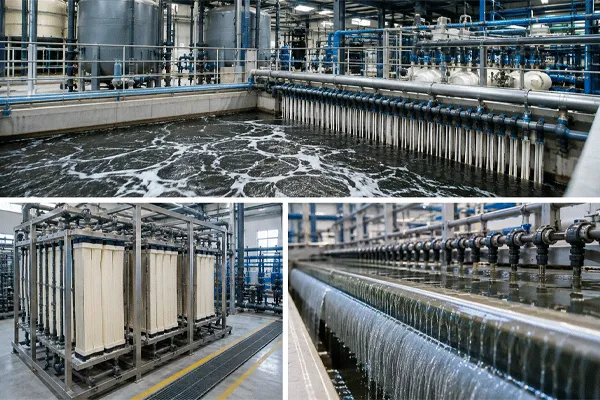
Banott’s hollow fiber MBR range is published by effective membrane area:
| Model |
Effective membrane area |
Published positioning |
| MBRIII3C |
3 m² |
Compact wastewater treatment systems |
| MBRIII10C |
10 m² |
Wastewater treatment, stable filtration performance |
| MBI120C |
20 m² |
Wastewater treatment systems, stable filtration performance |
The three-step range is useful at small scale precisely because it allows an area to be assembled in fine increments rather than in large cassette blocks. A stream requiring modest total area can be built from a combination that matches the duty and leaves a defined expansion path, which matters on a site where a production line addition changes the load two years later.
The area figure alone does not size a plant. The following are not published on the product pages and should be requested in writing before an order is placed:
| Parameter to request |
Why a pharmaceutical site needs it |
| Membrane material and nominal pore size |
Determines rejection and compatibility with solvent traces and CIP chemistry |
| Design flux at your MLSS and temperature |
Converts your flow into total membrane area and module count |
| Operating TMP range and alarm threshold |
Sets permeate pump duty and the fouling trigger |
| Scouring aeration rate per module |
The dominant operating cost line, and often the deciding number against MBBR |
| Module dimensions and required tank depth |
Decides whether a compact packaged tank will accept the module |
| CIP chemical types, concentrations and frequency |
Determines operator workload, which is the main argument against MBR at this scale |
| Chemical compatibility with residual disinfectants |
Cleaning agents from production washdown can reach the membrane |
| Expected membrane life on this duty, and replacement lead time |
Required for any honest lifecycle cost comparison |
Banott also produces flat sheet MBR modules in PVDF with a PET linen support, running outside-in, in compact, integrated and standard configurations. On small plants with limited maintenance staff, the flat sheet format’s simpler manual inspection is worth putting on the comparison sheet rather than defaulting to hollow fiber.
Inhibition, campaigns and the solvent problem
Three failure patterns account for most disappointing pharmaceutical wastewater plants, and none is a membrane fault.
A cleaning campaign kills the biology.
Clean-in-place operations in production release disinfectants and caustic in concentrated slugs. Arriving at a bioreactor undiluted, they suppress or destroy the biomass, and recovery takes weeks during which the plant is out of compliance. The fix is upstream: an equalisation tank sized for the largest single CIP discharge, and a dosing regime that bleeds it into the reactor rather than dumping it. This gets specified too small more often than any other item.
Solvents are assumed to be treatable.
Some are. Others volatilise in an aerated tank and become an air emission problem rather than a water problem, and some resist biology entirely. A treatability test on the actual effluent, not a literature assumption from the product’s chemistry, is what settles this.
The plant is designed for the current product portfolio.
Pharmaceutical production changes. A plant sized around today’s products can be badly matched to a new API introduced two years later. Building in a documented margin, and knowing which parameter constrains it, is cheaper than rebuilding.
An edge case worth flagging separately: sites handling antibiotics face a growing regulatory interest in antimicrobial resistance in effluent, which is a different question from COD compliance and may attract requirements that neither MBBR nor MBR alone addresses. Where the portfolio includes antibiotics, check what the permit is likely to require over the plant’s life rather than only what it requires now.
Pharmaceutical Wastewater Treatment: Process Selection Guide
Cost lines, and what can be quoted
Banott does not publish selling prices for MBR membrane modules or for containerised treatment plants. Pricing is issued against enquiry, and a meaningful figure needs the effluent characterisation, the discharge standard, the flow profile and the available space. Published capacity information exists for the small RO machine range at 300–3,000 GPD, and industrial RO membranes come in standard 4040 and 8040 element formats; neither carries a listed price.
When comparing an MBBR quotation against an MBR quotation, price them across the same five lines or the comparison will mislead:
- Reactor tankage and civil or packaged vessel scope
- Carriers or membrane modules, whichever the train uses
- Blowers and aeration, counting membrane scouring air separately from process air
- Mechanical and electrical: pumps, dosing, controls, TMP logging where applicable
- Ten-year consumables: membrane replacement cycles and CIP chemicals against carrier top-up
Membrane-only quotations look cheaper than they are. Carrier-based quotations look cheaper than they are when the downstream separation stage is omitted.
The Banott Water Treatment Engineering Team offers pre-sales process consultation covering process selection, membrane type and area sizing, and system configuration against submitted water quality data, drawing on nearly 20 years of experience in ultrafiltration membrane separation technology and its engineering application. For a stream with an inhibition risk, sending the actual data produces a more useful answer than a capacity figure.
Questions pharmaceutical sites ask before selecting a process
Q: Which is better for pharmaceutical wastewater, MBBR or MBR?
A: Neither is better in the abstract. MBBR is usually the better commercial answer for small flows discharging to sewer, particularly where the effluent contains an inhibitory fraction and the site has no dedicated wastewater operator. MBR is the better answer where the discharge standard is tight, the footprint is fixed, or the treated water will be reused.
Q: Can an MBR handle antibiotic-containing effluent?
A: It can operate on it, but the suspended biomass is exposed to whatever arrives. Adequate equalisation ahead of the reactor, and in some cases a carrier-based first stage, is what protects it. Where a specific API is a concern, a treatability test on the actual effluent is the only reliable basis for design.
Q: Will a membrane remove active pharmaceutical ingredients?
A: An MBR membrane operates at a pore size that removes suspended solids and biomass, not dissolved molecules. Removal of dissolved pharmaceutical compounds in an MBR comes from biological degradation and adsorption at long sludge age rather than from the barrier itself. Where a specific dissolved compound must be removed to a defined limit, a tighter membrane stage or another polishing process is required after the MBR.
Q: How much space does each option need?
A: MBR is the most compact for a given load because the membrane allows a high biomass concentration in a small tank. MBBR is compact relative to conventional activated sludge but larger than MBR at the same load. A hybrid needs both stages. Where space is genuinely the constraint, this row decides the selection on its own.
Q: What happens if my production portfolio changes?
A: The load and the inhibitory character change with it. Systems built with documented headroom and a defined expansion path handle this; systems sized exactly to the current campaign do not. Ask during design which parameter limits the plant and by how much.
Q: Can the treated water be reused inside the plant?
A: MBR permeate is solids-free and can feed reverse osmosis directly, which makes reuse for cooling, cleaning or utility duty technically workable. Pharmaceutical facilities also face qualification requirements on any water touching production, so the practical reuse targets are usually utility duties rather than process water.
Q: How often do the membranes need cleaning on this duty?
A: More often than on municipal sewage, with the interval set by your effluent, temperature and biomass concentration. Because operator time is the main cost argument against MBR at small scale, request cleaning frequency and CIP protocol as part of the quotation instead of estimating it.
Q: What does an MBR module cost?
A: Not published. Pricing is issued on enquiry against membrane area, module configuration and project capacity.
Q: Is a containerised system an option at this scale?
A: Containerised pure water and wastewater treatment plants are available as modular packaged units with a high degree of automation, which suits pharmaceutical sites where civil construction inside an operating facility is disruptive or where the plant may need relocating.












 16:37
16:37