Banott Engineering Team | Water & Wastewater Engineering | Published September 4, 2026
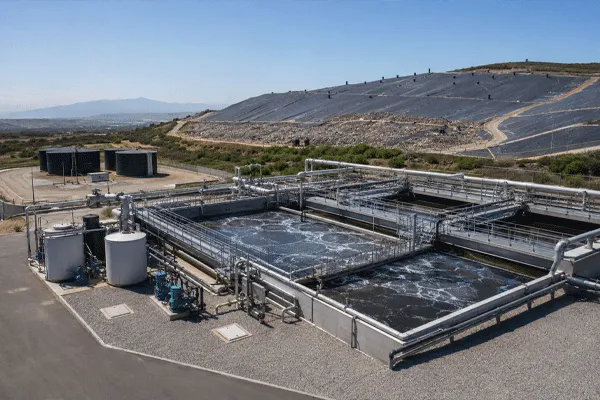
Landfill leachate is the liquid that percolates through waste and picks up ammonia, organic acids, and dissolved solids along the way. MBR is strong on the biological fraction of that load — but it is one stage in a train, not a complete answer by itself.
A note before the technical detail: landfill leachate appears in Banott’s application list as a use inferred from general MBR technology fit, not as a confirmed, documented project type on record. Everything below explains where MBR technology fits leachate treatment in engineering terms; it is not a claim of demonstrated leachate project history, and an EPC specifying against this application should request a leachate-specific reference before relying on it in a tender.
Çöp Depolama Alanı Sızıntı Suyu Arıtımı: MBR’nin Arıtma Sürecindeki Yeri
What Is Landfill Leachate, and Why It Behaves Differently From Municipal Wastewater
Leachate forms when rainwater or moisture moves through landfilled waste and dissolves soluble compounds along the way. What comes out the other side depends heavily on landfill age. Young landfill leachate (roughly under five years) tends to carry high BOD, high ammonia, and a BOD/COD ratio favorable to biological treatment. Mature landfill leachate — the more common case for an operating EPC contract on an established site — carries lower BOD relative to COD, because the easily biodegradable fraction has already broken down. What is left is dominated by humic and fulvic acid-type compounds: refractory, colored, and resistant to biological digestion.
This age-dependent shift is the single most important fact for anyone speccing a leachate train, and it is also the most commonly skipped step. A design built around young-landfill assumptions will underperform badly once the site matures past year five.
Where MBR Earns Its Place: Ammonia and BOD Removal
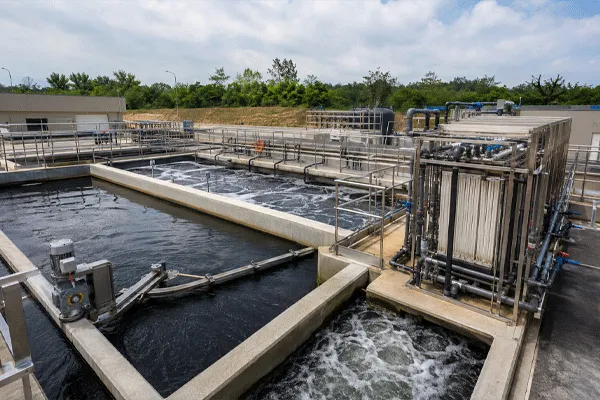
Membrane bioreactor technology combines biological treatment with membrane filtration in place of a secondary clarifier, holding back biomass so the system can run at a higher mixed-liquor concentration and produce a clear, low-turbidity permeate. For the ammonia and BOD fraction of leachate — which is exactly what young leachate and the biodegradable portion of mature leachate present — this is a genuine strength. The membrane barrier also protects downstream polishing stages from biomass carryover, which matters because whatever comes after MBR (see below) is usually more sensitive to solids than the MBR itself.
Compared with a stand-alone activated sludge or SBR system relying on gravity settling, adding a membrane separation stage holds effluent TSS and nitrification performance more consistently through the flow swings that collected leachate typically shows, since clarifier settling — unlike a membrane barrier — is vulnerable to upsets from foam, bulking sludge, or sudden load changes.
The Gap MBR Does Not Close: Refractory COD and Colour
This is the edge case worth stating plainly rather than glossing over: MBR is a biological process at its core, and biological processes do not break down refractory organics efficiently. Humic and fulvic acid compounds — the dominant COD source in mature leachate — pass through an MBR largely untouched. Colour, which correlates closely with these compounds, does the same. A plant relying on MBR alone against a mature-leachate discharge standard will typically meet BOD and ammonia limits while failing COD and colour.
This is not a flaw specific to any one manufacturer’s membrane. It is a property of biological treatment generally, and it is why published research and practitioner discussion around leachate consistently pairs MBR with an additional polishing stage rather than presenting it as a stand-alone solution.
Building a Specifiable Train: MBR Plus What Comes Next
The practical train for leachate at most operating landfills looks like: equalization to buffer the flow and load swings between wet and dry season, biological pretreatment feeding into MBR for BOD and ammonia removal plus a clean solids barrier, then a polishing stage sized to close the remaining COD and colour gap. Two polishing approaches dominate:
- Nanofiltration or reverse osmosisafter MBR, rejecting the refractory dissolved organics and salts that pass through the membrane bioreactor — effective but produces a concentrate stream that itself needs a disposal or further treatment plan.
- Advanced oxidation, such as catalytic ozonation, breaking down refractory compounds chemically rather than physically separating them — avoids a concentrate stream but adds oxidant cost and process complexity.
| |
MBR alone |
MBR + NF/RO |
MBR + Advanced Oxidation |
| BOD, ammonia removal |
Güçlü |
Güçlü |
Güçlü |
| Refractory COD, colour removal |
Weak |
Güçlü |
Güçlü |
| Concentrate/waste stream generated |
None beyond sludge |
Yes — requires disposal plan |
No, but oxidant dosing cost |
| Standart beden |
Young leachate, lenient discharge limit |
Mature leachate, strict COD/colour limit |
Mature leachate where concentrate disposal is constrained |
Which polishing route makes sense depends on your discharge permit’s actual COD and colour limits, and on whether your site has a practical route to manage an RO concentrate. Neither choice is universally cheaper — RO adds a concentrate-handling cost line, advanced oxidation adds a chemical/energy cost line, and a design that omits both to save capital cost is the design most likely to fail COD compliance after commissioning.
Çöp Depolama Alanı Sızıntı Suyu Arıtımı: MBR’nin Arıtma Sürecindeki Yeri
Hollow Fiber Membrane MBR: The Numbers an EPC Can Actually Spec
Banott’s hollow fiber membrane MBR line, used as the biological-plus-filtration stage in a train like the one above, is offered across three effective membrane area sizes:
| Model |
Effective Membrane Area |
Yapılandırma |
| MBRIII3C |
3 m² |
Submerged |
| MBRIII10C |
10 m² |
Submerged |
| MBI120C |
20 m² |
Submerged |
Design flux, transmembrane pressure range, and expected membrane life against a leachate-strength feed are not published as generic figures, and that is deliberate rather than an oversight — leachate strength varies enough by landfill age and season that a flux number quoted without your actual post-equalization COD, ammonia, and conductivity data would not survive contact with your real feed. This is a case where a tender submission needs project-specific engineering sizing, not a catalog spec sheet.
What Should Survive Your Tender Review, Regardless of Vendor?
For an EPC building leachate treatment into a larger landfill contract, three things typically decide whether a membrane supplier’s numbers hold up under review: guaranteed flux and TMP range backed by a datasheet you can attach to your submission, a stated CIP protocol and expected membrane life rather than a marketing range, and confirmation that replacement membranes will be available for the 10+ year life of the landfill contract, not just at commissioning. Vague performance language — “high flux,” “long life,” “low fouling” — without numbers attached is a disqualifier in most tender reviews, and it should be treated the same way when evaluating any membrane supplier for this application.
Çöp Depolama Alanı Sızıntı Suyu Arıtımı: MBR’nin Arıtma Sürecindeki Yeri
SSS
Q: Is MBR ever sufficient on its own for landfill leachate discharge?
A: It can be, but only where the discharge permit’s COD and colour limits are lenient enough that the refractory fraction MBR does not remove stays within limit — typically only realistic for younger leachate or permits without strict COD/colour caps. Most operating landfill contracts need a polishing stage behind MBR.
Q: Does leachate composition stay stable enough to design a fixed train once?
A: No. Leachate composition shifts as a landfill ages, moving from a BOD-dominated, biologically treatable profile toward a COD-dominated, refractory profile over years. A train sized only for early-stage leachate will underperform later without design margin or a plan to add polishing capacity.
Q: What happens to the RO concentrate if we choose that polishing route?
A: It becomes a separate waste stream requiring its own disposal plan — options range from recirculation back onto the landfill (where site conditions and moisture balance allow) to off-site disposal or further treatment, and this decision needs to be made at the design stage, not after commissioning.
Q: Where does Banott’s stated field experience apply to this application?
A: The Banott Water Treatment Engineering Team reports close to two decades of experience in ultrafiltration membrane separation and industrial/municipal water treatment engineering generally; leachate-specific project experience is not separately documented in current public materials, which is why this article treats the technology fit as an engineering explanation rather than a project reference.











 14:15
14:15