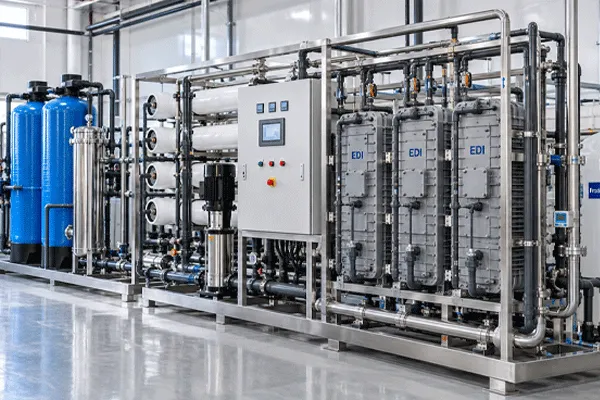
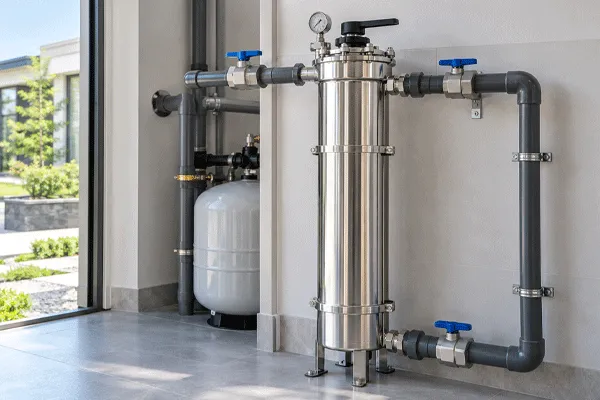
Una scarsa qualità dell'acqua può danneggiare le apparecchiature, interrompere la produzione, aumentare i costi operativi e rendere più difficile il riutilizzo dell'acqua. Scegliere apparecchiature di trattamento senza conoscere le caratteristiche dell'acqua in ingresso può aggravare il problema. Un impianto a osmosi inversa progettato correttamente offre un metodo affidabile per separare i contaminanti disciolti e produrre acqua più pulita.
Un impianto a osmosi inversa utilizza la pressione per far passare l'acqua attraverso una membrana RO semipermeabile. Le molecole d'acqua attraversano la membrana sotto forma di permeato trattato, mentre gran parte dei sali disciolti e delle altre sostanze respinte vengono espulse in un flusso concentrato. L'osmosi inversa è ampiamente utilizzata per l'acqua potabile, l'acqua di processo industriale, la desalinizzazione, il riutilizzo dell'acqua e il pretrattamento dell'acqua ad alta purezza.
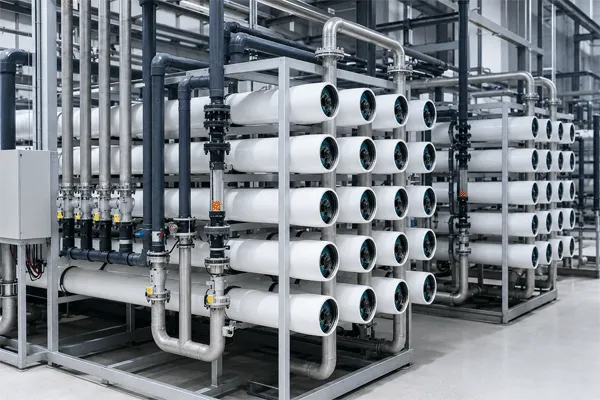
Che cos’è un sistema a osmosi inversa? Come funziona la filtrazione dell’acqua tramite osmosi inversa
Struttura dell'articolo
- Che cos'è l'osmosi inversa?
- Come funziona il processo di osmosi inversa?
- Quali componenti comprende un impianto a osmosi inversa?
- Quali sostanze contaminanti può rimuovere l'osmosi inversa?
- Cosa influisce sulla qualità dell'acqua trattata con osmosi inversa?
- Quali tipi di impianti a osmosi inversa sono disponibili?
- Perché è importante il pretrattamento prima di una membrana RO?
- Quanta acqua di scarto produce un impianto a osmosi inversa?
- Come si colloca la RO rispetto alla UF, alla MBR e all’EDI?
- In che modo gli ingegneri progettano un impianto industriale a osmosi inversa?
- Come va effettuata la manutenzione di un impianto RO?
- In quali ambiti viene utilizzata l'osmosi inversa?
- Domande frequenti
- Punti chiave da ricordare
Che cos’è l’osmosi inversa e perché viene utilizzata nel trattamento dell’acqua?
L'osmosi inversa, solitamente abbreviata in RO, è un processo di depurazione dell'acqua basato sull'uso di membrane. Nell'osmosi naturale, l'acqua passa attraverso una membrana semipermeabile verso la soluzione con una maggiore concentrazione di sostanze disciolte. L'osmosi inversa applica una pressione sufficiente a invertire il flusso naturale, spingendo l'acqua dal lato più concentrato verso quello più pulito.
L'Organizzazione Mondiale della Sanità descrive l'osmosi inversa come un processo a membrana ad alta pressione che genera un flusso di acqua trattata e un flusso di scarto più concentrato. L'OMS sottolinea che l'osmosi inversa riveste particolare importanza in applicazioni quali la desalinizzazione dell'acqua salmastra e dell'acqua di mare.
L'idea di base è semplice:
Acqua di alimentazione
    │
    ▼
Pretrattamento
    │
    ▼
Pompa ad alta pressione
    │
    ▼
┌───────────────────────┐
│ MEMBRANA RO     │
└───────────────────────┘
 │ │
 ▼ ▼
   Permeato Concentrato
 Acqua trattata   Acqua di scarto
La pressione spinge le molecole d'acqua attraverso la membrana, mentre molte sostanze disciolte rimangono sul lato di alimentazione. Il processo non funziona come un semplice filtro che trattiene solo le particelle visibili. Il comportamento di separazione di una membrana RO dipende dalla composizione chimica della membrana, dalla pressione di esercizio, dalla composizione dell'acqua di alimentazione, dalla temperatura, dal recupero e da altre condizioni operative.
Per gli appaltatori EPC e i proprietari di impianti industriali, questa distinzione è importante. Un impianto di osmosi inversa non dovrebbe essere scelto solo in base alla portata. La progettazione del sistema deve basarsi sull’analisi dell’acqua di alimentazione e sui requisiti di qualità dell’acqua trattata.
Come funziona il processo di osmosi inversa?
Per capire come funziona l'osmosi inversa, immaginate due flussi d'acqua separati da una membrana semipermeabile. In condizioni naturali, il solvente tende a spostarsi verso il lato con la concentrazione più elevata. Un sistema a osmosi inversa applica una pressione superiore alla pressione osmotica, in modo da invertire la direzione del flusso.
La FDA descrive l'osmosi inversa (RO) come un processo in cui una membrana sottoposta a pressione separa l'acqua relativamente pura da una soluzione meno pura. L'acqua attraversa la membrana, mentre molte sostanze disciolte e in sospensione rimangono trattenute.
Un tipico processo di osmosi inversa prevede quattro fasi principali:
- L'acqua di alimentazione entra nel circuito di trattamento.
- Il pretrattamento rimuove o controlla le sostanze che potrebbero intasare o danneggiare la membrana.
- Una pompa ad alta pressione spinge l'acqua attraverso gli elementi a membrana.
- L'acqua viene separata in permeato e acqua di scarto, detta anche concentrato o salamoia.
L'acqua ottenuta come permeato presenta normalmente un livello di solidi disciolti molto inferiore rispetto all'acqua di alimentazione in entrata. Il concentrato contiene una concentrazione più elevata dei sali e dei contaminanti respinti.
Osmosi inversa contro filtrazione normale
| Caratteristica |
Filtro convenzionale |
Osmosi inversa |
| Meccanismo di separazione principale |
Ritenzione fisica delle particelle |
Separazione a membrana sotto pressione |
| Obiettivo tipico |
Solidi sospesi |
Ioni disciolti e molti altri contaminanti |
| Forza motrice |
Pressione/portata |
Pressione superiore al fabbisogno osmotico |
| Linee di prodotti |
Di solito una presa principale |
Permeato + concentrato |
| Necessità di un pretrattamento |
Dipende dall'applicazione |
Di solito importante |
Il processo di filtrazione dell'acqua non si limita quindi alla semplice installazione di una membrana. Per garantire buone prestazioni è necessario che l'intero ciclo di trattamento funzioni in modo coordinato.
Cosa comprende un impianto ad osmosi inversa?
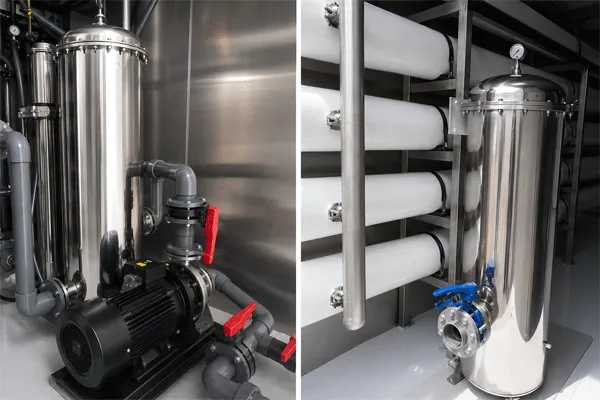
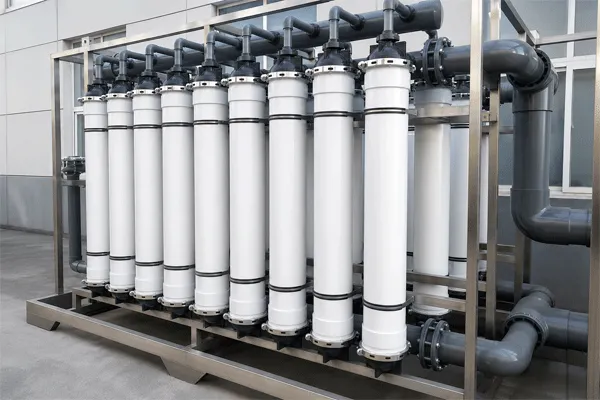
Un impianto a osmosi inversa comprende diverse apparecchiature. Una piccola unità installata nel punto di utilizzo può contenere solo pochi stadi, mentre un impianto industriale può includere il dosaggio di sostanze chimiche, la filtrazione multimediale, l’addolcimento, filtri a cartuccia, serbatoi a pressione con membrane multiple, strumentazione, apparecchiature di pulizia, serbatoi, controlli PLC e post-trattamento.
A common industrial RO system may include:
- Raw-water tank
- Feed pump
- Multimedia or media filter
- Activated carbon filter where appropriate
- Water softener or antiscalant dosing
- Filtro a cartuccia
- Pompa ad alta pressione
- Serbatoi a pressione per membrane RO
- Conductivity meters
- Flow and pressure instruments
- Serbatoio del permeato
- CIP cleaning system
- Chemical dosing equipment
- PLC / HMI or SCADA controls
The RO membrane is the heart of the separation step, but the surrounding equipment protects it and keeps operation stable. Poor pretreatment can shorten membrane life even when the membrane itself is high quality.
Che cos’è un sistema a osmosi inversa? Come funziona la filtrazione dell’acqua tramite osmosi inversa
What happens inside the membrane stage?
                    ┌──────── Permeate / RO Water
                    │
Feed Water ──► [ RO MEMBRANE ]
                    │
                    └──────── Concentrate / Reject
The ratio between permeate flow and feed-water flow is called recovery.
Recovery (%) = Permeate Flow ÷ Feed Flow × 100
A system processing 10 m³/h of feed water and producing 7.5 m³/h of permeate has a nominal recovery of 75%.
That does not mean every RO plant should operate at 75%. Feed-water chemistry, scaling risk, membrane configuration, temperature, and required water quality determine a safe operating recovery.
What Does Reverse Osmosis Remove From Water?
One reason reverse osmosis filtration is widely used is its ability to reduce many dissolved substances that conventional particle filters cannot effectively remove.
Depending on membrane type, operating conditions, pretreatment, and system certification, RO can reduce substances such as:
- Sali disciolti
- Hardness-related ions
- Sodio
- Cloruro
- Solfato
- Nitrato
- Some metals
- Many organic compounds
- Certain microorganisms
- Solidi disciolti totali
EPA states that point-of-use RO systems can potentially reduce contaminants including lead, some volatile organic compounds, PFAS, arsenic, bacteria, and viruses. However, EPA also stresses that verified contaminant-removal claims should be based on system testing and certification.
That qualification is important. Reverse osmosis removes different contaminants at different efficiencies, and no responsible supplier should claim that every membrane removes every contaminant to the same degree.
What RO does not solve by itself
An RO system is not a universal replacement for every treatment technology.
It may still need:
- Sediment removal
- Iron and manganese treatment
- Chlorine control
- Hardness management
- Biological control
- Oil removal
- Organic-load reduction
- regolazione del pH
- Disinfezione finale
- Remineralization
For example, heavily contaminated industrial wastewater may require coagulation, biological treatment, MBR, UF, activated carbon, or other processes before the water reaches the RO stage.
In engineered projects, the correct question is therefore not:
“Can we use reverse osmosis?”
It is:
“What treatment train will deliver the required water quality at a stable operating cost?”
What Determines Reverse Osmosis Water Quality?
The final reverse osmosis water quality depends on much more than the membrane model.
Important factors include:
| Fattore |
Why it matters |
| Feed-water TDS |
Changes osmotic pressure and required operating pressure |
| Temperatura |
Influences membrane water flux |
| pH |
Affects scaling and contaminant behavior |
| Durezza |
Can create mineral scale |
| Silice |
May limit recovery |
| Ferro e manganese |
Can foul membranes |
| SDI / suspended matter |
Indicates fouling risk |
| Organics |
Can contribute to membrane fouling |
| Cloro |
Can damage some common RO membranes |
| Ripresa |
Higher recovery concentrates salts more strongly |
| Membrane age |
Fouling and degradation affect performance |
| Pressione |
Influences permeate production |
This is why an engineer should request a complete feed water analysis before finalizing an industrial system.
For public water, the pretreatment may be relatively simple if the municipal supply is stable. Well water may require additional treatment for iron, manganese, hardness, turbidity, or other site-specific constituents.
Water with high hardness also requires special attention. A water softener, antiscalant system, pH adjustment, or other scale-control strategy may be necessary before the membrane.
The best reverse osmosis configuration is therefore not the largest system or the one with the highest nominal pressure. It is the system that matches the actual water treatment needs.
What Types of Reverse Osmosis Systems Are Available?
RO equipment ranges from compact residential units to large industrial plants.
1. Point-of-use reverse osmosis
A point-of-use reverse osmosis system treats water at one fixture, commonly under a kitchen sink.
EPA defines a point-of-use RO system as a device connected to a single fixture that uses pressure and a semipermeable membrane to create treated water and concentrate.
A typical point-of-use RO system may include:
- Sediment prefilter
- Filtro al carbone
- Membrana RO
- Storage tank
- Post-carbon filter
- Drinking-water faucet
This setup can provide drinking water at home without treating all household water.
2. Commercial reverse osmosis
Commercial systems serve applications such as:
- Alberghi
- Ristoranti
- Laboratori
- Small factories
- Beverage production
- Aziende agricole
- Laundries
- Commercial kitchens
Capacity is normally much greater than a household unit but smaller than a major industrial plant.
3. Industrial reverse osmosis
Industrial reverse osmosis plants may produce from several cubic meters to hundreds or thousands of cubic meters of treated water each day.
Applications include:
- Boiler-feed pretreatment
- Acqua di processo
- Food and beverage plants
- Pharmaceutical water pretreatment
- Produzione di componenti elettronici
- Reintegro della torre di raffreddamento
- Textile production
- Impianti chimici
- Wastewater reuse
- Desalinizzazione
For these projects, engineering support becomes as important as the membrane itself.
Why Is Pretreatment So Important Before an RO Membrane?
An RO system concentrates contaminants on one side of the membrane. This makes pretreatment essential.
Without suitable pretreatment, membranes may suffer from:
- Ridimensionamento
- Incrostazioni organiche
- Incrostazioni colloidali
- Biological growth
- Iron deposition
- Membrane oxidation
- High pressure drop
- Loss of permeate flow
- Reduced salt rejection
Imagine an industrial plant using hard feed water with high calcium and alkalinity. As the RO system produces permeate, salts become more concentrated in the remaining water. If their concentration exceeds solubility limits, scale can form on the membrane surface.
That increases operating pressure and cleaning frequency.
Common pretreatment options
| Water-quality problem |
Possible treatment approach |
| Solidi sospesi |
Media filtration, UF, cartridge filtration |
| Durezza |
Softener or antiscalant |
| Cloro |
Activated carbon or chemical dechlorination |
| Ferro / manganese |
Oxidation and filtration |
| Carico organico |
Biological treatment, carbon, UF or other pretreatment |
| Elevata torbidità |
Clarification / coagulation / filtration |
| Microbial fouling |
Appropriate disinfection and system hygiene |
The correct approach must come from water analysis.
As a manufacturer of RO membranes, UF membranes, Membrane MBR, EDI modules, pure-water plants, and integrated water treatment systems, we often view pretreatment and RO as one process rather than separate products. That engineering approach is particularly important in wastewater reuse and complex industrial projects.
How Much Reject Water Does a Reverse Osmosis System Produce?
RO creates two water streams, so some feed water leaves as concentrate.
The amount depends greatly on system design.
For small household units, efficiency can vary widely. EPA reports that a typical point-of-use RO system can send five gallons or more to drain for every gallon of treated water, while inefficient products can reach ten gallons of reject water per gallon of treated water. WaterSense-labelled systems must meet a limit of 2.3 gallons of reject water or less per gallon of treated water.
This is why buyers should not judge a household reverse osmosis water filter system only by purchase price.
Che cos’è un sistema a osmosi inversa? Come funziona la filtrazione dell’acqua tramite osmosi inversa
Industrial RO is different
Industrial systems are commonly engineered around recovery rather than a fixed waste-to-product ratio.
Ad esempio:
| Feed |
Permeato |
Concentrati |
Ripresa |
| 10 m³/h |
5 m³/h |
5 m³/h |
50% |
| 10 m³/h |
7.5 m³/h |
2.5 m³/h |
75% |
| 10 m³/h |
8 m³/h |
2 m³/h |
80% |
Higher recovery can reduce water use, but pushing recovery too far may increase scaling, fouling, pressure, and membrane-cleaning demand.
The goal is not simply to minimize reject water. The goal is to find the safe balance between:
- Water recovery
- Membrane stability
- Consumo energetico
- Uso di sostanze chimiche
- Smaltimento dei concentrati
- Final water cost
In some industrial reuse plants, part of the concentrate may receive further treatment. Whether this is practical depends on local discharge rules, water chemistry, and project economics.
How Does RO Compare With UF, MBR, and EDI Water Treatment?
A common mistake is to compare RO, UF, MBR, and EDI as if one must replace the others. In reality, they often work together.
RO vs UF
Ultrafiltration mainly targets suspended solids, colloids, and many microorganisms. RO goes further by separating a high proportion of dissolved ions.
WHO classifies RO as a high-pressure membrane process, while ultrafiltration is a lower-pressure membrane process with different separation characteristics.
RO vs MBR
An MBR combines biological wastewater treatment with membrane separation. It is primarily a wastewater-treatment technology.
For reuse projects:
Industrial Wastewater
        ↓
Biological Treatment / MBR
        ↓
UF-quality Effluent
        ↓
RO System
        ↓
Reclaimed High-Quality Water
MBR reduces organic pollution and suspended matter first. RO then removes much of the remaining dissolved material.
RO vs EDI
EDI—electrodeionization—is often installed after RO when the project needs very low ionic contamination.
A common ultrapure-water train may look like:
Pretreatment
     ↓
RO Stage 1
     ↓
RO Stage 2
     ↓
EDI
     ↓
High-Purity / Ultrapure Water
This is common in pharmaceutical, electronics, semiconductor, laboratory, and high-purity industrial applications.
| Tecnologia |
Main role |
| MBR |
Biological wastewater treatment + membrane solids separation |
| UF |
Suspended solids / colloid reduction |
| RO |
Dissolved salt reduction and desalination |
| EDI |
Final ion polishing for high-purity water |
Selecting among water treatment systems therefore depends on the required inlet and outlet quality.
How Do Engineers Design an Industrial Reverse Osmosis System?
A reliable industrial reverse osmosis filtration system begins with data.
Before equipment selection, engineers should know:
- Feed-water source
- Full water analysis
- Required capacity
- Required permeate quality
- Orari di apertura
- Feed temperature range
- Wastewater-discharge conditions
- Spazio disponibile
- Alimentazione elettrica
- Requisiti di automazione
- Local standards
- Future capacity expansion
From there, the engineer develops the treatment process.
Typical industrial design workflow
Water Analysis
      ↓
Define Product Water Standard
      ↓
Pretreatment Selection
      ↓
Membrane Projection
      ↓
Pump & Pressure Selection
      ↓
Recovery Optimization
      ↓
Instrumentation & Control
      ↓
CIP Design
      ↓
PLC / SCADA Integration
      ↓
Factory Assembly & Testing
      ↓
Commissioning
For an EPC contractor, documentation is also important.
A professional package may need:
- P&ID
- Process flow diagram
- General arrangement drawing
- Equipment list
- Electrical diagram
- Instrument list
- Membrane calculation
- Operating manual
- Maintenance procedure
- Spare-parts list
We manufacture and integrate systems for industrial wastewater treatment, municipal sewage projects, pure water production, water reuse, containerized plants, and skid-mounted treatment systems. For these projects, we can combine hollow-fiber MBR, hollow-fiber UF, flat-sheet MBR, RO membrane equipment, EDI, dosing, pumps, tanks, instrumentation, and PLC/SCADA control into one engineered solution.
That is usually more valuable to an EPC buyer than purchasing isolated components and trying to resolve interface problems at the project site.
How Should a Reverse Osmosis System Be Maintained?
RO plants need routine monitoring. Waiting until water quality drops sharply usually increases downtime and cleaning cost.
Operators should record:
- Pressione di alimentazione
- Pressione del concentrato
- Permeate pressure
- Portata del mangime
- Portata del permeato
- Portata del concentrato
- Conduttività del mangime
- Permeate conductivity
- Caduta di pressione
- Temperatura
- pH
- Dosaggio di sostanze chimiche
These values help operators identify changes before they become serious.
Common warning signs
| Symptom |
Possibile causa |
| Permeate flow decreases |
Fouling, scaling, low temperature |
| Permeate conductivity rises |
Membrane damage, leakage, fouling |
| Pressure drop rises |
Spacer fouling or blockage |
| Required pressure increases |
Scaling or membrane fouling |
| Recovery changes |
Valve, flow, or instrumentation issue |
Membrane cleaning should follow the membrane supplier’s operating and chemical limits.
A properly maintained system also requires attention to pretreatment. Replacing an RO membrane repeatedly will not solve a failed softener, exhausted carbon filter, poor UF operation, or uncontrolled biological growth.
EPA’s WaterSense specification for point-of-use systems includes a minimum membrane-life performance criterion of at least one year, but industrial membrane life depends heavily on application, operating conditions, cleaning practice, and pretreatment.
Where Is Reverse Osmosis Used?
Reverse osmosis provides a flexible platform for many types of water treatment.
Drinking and commercial water
RO can improve drinking water where the source has contaminants that the selected and certified system is designed to reduce. FDA also recognizes reverse osmosis as one treatment process used to produce water that may qualify for labeling as purified bottled water when regulatory requirements are met.
Industrial pure water
Factories use RO to reduce minerals before processes such as:
- Boiler operation
- Coating
- Washing
- Mixing
- Produzione farmaceutica
- Trasformazione di alimenti e bevande
- Electronics cleaning
Wastewater reuse
Industrial and municipal facilities increasingly combine biological treatment, membrane filtration, and RO when they want to reuse treated water rather than discharge all of it.
Desalinizzazione
RO is a major desalination technology for brackish water and seawater. USGS describes membrane-based reverse osmosis as a leading desalination process and notes that RO membrane systems generally use less energy than thermal desalination technologies.
Acqua ad elevata purezza
Double-pass RO combined with EDI can provide high purity water for demanding applications.
This broad application range explains why reverse osmosis is a core water purification technology, but it also explains why there is no one standard RO machine for every project.
Illustrative Case: From Industrial Wastewater to Reusable Process Water
Consider a factory that wants to reduce freshwater consumption.
Its wastewater already receives biological treatment, but the treated water still contains suspended matter and dissolved solids that prevent direct reuse in sensitive processes.
Instead of installing only an RO unit, the engineering team designs:
Wastewater
   ↓
Biological Treatment
   ↓
MBR
   ↓
Buffer Tank
   ↓
RO
   ↓
Reusable Process Water
The MBR reduces suspended solids and organic load. The RO stage then targets dissolved salts.
If still higher purity is required, a second RO pass or EDI can be added:
MBR → RO → Second-Pass RO → EDI
This illustrates a key lesson for industrial buyers:
A successful RO project is usually a complete water-treatment solution, not simply a membrane skid.
The exact system must be designed from laboratory data and the required reuse standard.
What Should EPC Contractors and Industrial Buyers Ask an RO System Manufacturer?
When comparing reverse osmosis solutions, do not focus only on equipment price.
Ask:
- What feed-water analysis is required?
- What permeate quality can the proposed system achieve?
- What design recovery is used?
- Which membrane model and pressure vessel are specified?
- What pretreatment is included?
- How is scaling controlled?
- Is CIP equipment included?
- Which instruments are supplied?
- Is PLC or SCADA control available?
- Can the system be skid-mounted or containerized?
- Which drawings and technical documents are provided?
- Is remote commissioning or on-site commissioning available?
- Which spare parts are recommended?
- How will the plant respond to seasonal feed-water changes?
These questions reveal whether you are buying a complete engineering solution or only assembled hardware.
As a professional manufacturer and engineering-oriented water treatment provider in China, we support EPC contractors, municipal plants, industrial factories, system integrators, hotels, farms, and international distributors with:
- Sistemi RO
- Piccoli impianti di osmosi inversa
- Hollow-fiber UF membranes
- Hollow-fiber MBR membranes
- Flat-sheet MBR membranes
- Moduli EDI
- Pure-water plants
- Wastewater-treatment plants
- Water reuse systems
- Sistemi containerizzati
- Skid-mounted plants
- Automazione PLC / SCADA
- OEM / ODM engineering
For a commercial project, send the source water analysis, target water quality, required flow, operating hours, and project location first. Those five items allow engineers to make a far more reliable technical proposal.
Domande frequenti
What is an RO system?
An RO system is a water-treatment system that applies pressure to send water through a semipermeable membrane. It produces a lower-salt permeate stream and a more concentrated reject stream.
Does reverse osmosis make water completely pure?
No treatment technology should be described as producing absolutely contaminant-free water under every condition. RO can significantly reduce many dissolved substances, but performance depends on the membrane, system configuration, feed water, operating conditions, and verified contaminant-reduction claims.
Is RO water the same as distilled water?
No. Distillation uses evaporation and condensation. RO water is produced with membrane separation under pressure. Both processes can reduce dissolved minerals, but they use different technologies.
Is reverse osmosis good for hard water?
RO can reduce many hardness ions, but very hard water may cause membrane scaling. Pretreatment with a water softener, antiscalant, or another scale-control process may be required.
Does an RO system waste water?
RO produces concentrate, so not all feed water becomes permeate. Efficiency depends on the system. EPA reports large differences among household point-of-use products, while industrial plants are engineered around a target recovery based on feed-water chemistry.
How often should an RO membrane be replaced?
There is no universal interval for every industrial installation. Membrane life depends on feed quality, pretreatment, operating pressure, cleaning, fouling, scaling, oxidation exposure, and maintenance. Operators should use normalized performance data rather than changing membranes only according to calendar age.
Punti chiave da ricordare
- Reverse osmosis is a membrane-based water purification process driven by pressure.
- An RO system separates feed water into treated permeate and concentrated reject water.
- The membrane can reduce many dissolved salts and other contaminants, but actual performance depends on the complete system.
- Reverse osmosis is different from simple particle filtration.
- Pretreatment is critical for reducing scaling, fouling, oxidation, and membrane damage.
- Feed-water analysis should come before equipment selection.
- Hard water may require softening or antiscalant treatment.
- Point-of-use systems and industrial RO plants have very different capacities and recovery strategies.
- Higher recovery is not always better if it creates severe scaling or fouling.
- RO often works with UF, MBR, and EDI rather than replacing them.
- MBR + RO is a common concept for advanced wastewater reuse.
- RO + EDI is widely used when higher-purity water is required.
- Industrial buyers should review membranes, pumps, pretreatment, recovery, controls, CIP, documentation, and commissioning together.
- PLC / SCADA automation can improve operation and data visibility in larger treatment plants.
- A reliable project starts with source water, required capacity, target water quality, and operating conditions.
- For EPC, industrial, municipal, reuse, and pure-water projects, a customized engineering approach is safer than selecting an RO machine only by nominal flow.











 17:47