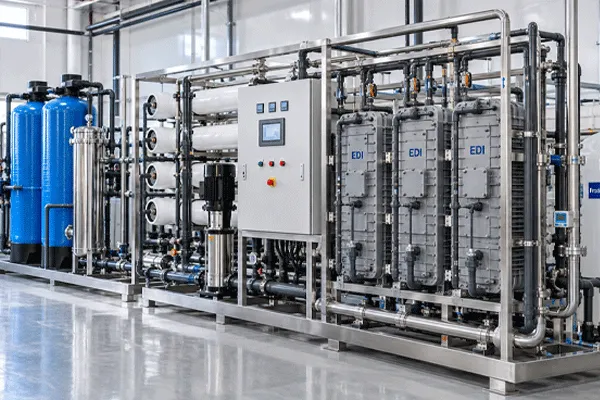
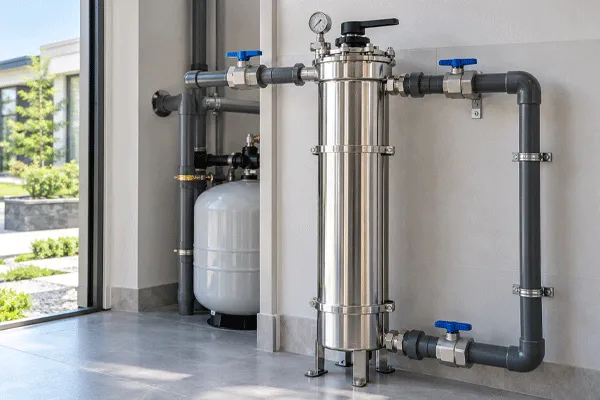
Una mala calidad del agua puede dañar los equipos, interrumpir la producción, aumentar los costes operativos y dificultar la reutilización del agua. Elegir equipos de tratamiento sin conocer las características del agua de entrada puede agravar el problema. Un sistema de ósmosis inversa diseñado adecuadamente ofrece una forma fiable de separar los contaminantes disueltos y producir agua más limpia.
Un sistema de ósmosis inversa utiliza presión para hacer pasar el agua a presión a través de una membrana de ósmosis inversa semipermeable. Las moléculas de agua atraviesan la membrana en forma de permeado tratado, mientras que gran parte de las sales disueltas y otros materiales rechazados se eliminan en un flujo concentrado. La ósmosis inversa se utiliza ampliamente para el agua potable, el agua de procesos industriales, la desalinización, la reutilización del agua y el pretratamiento de agua de alta pureza.
¿Qué es un sistema de ósmosis inversa? Cómo funciona la filtración de agua por ósmosis inversa
Esquema del artículo
- ¿Qué es la ósmosis inversa?
- ¿Cómo funciona el proceso de ósmosis inversa?
- ¿Qué componentes incluye un sistema de ósmosis inversa?
- ¿Qué contaminantes puede eliminar la ósmosis inversa?
- ¿Qué factores influyen en la calidad del agua de ósmosis inversa?
- ¿Qué tipos de sistemas de ósmosis inversa hay disponibles?
- ¿Por qué es importante el pretratamiento antes de una membrana de ósmosis inversa?
- ¿Qué cantidad de agua de desecho genera un sistema de ósmosis inversa?
- ¿En qué se diferencia la ósmosis inversa (RO) de la ultrafiltración (UF), el sistema MBR y la desionización electrolítica (EDI)?
- ¿Cómo diseñan los ingenieros un sistema industrial de ósmosis inversa?
- ¿Cómo se debe realizar el mantenimiento de un sistema de ósmosis inversa?
- ¿Dónde se utiliza la ósmosis inversa?
- Preguntas frecuentes
- Puntos clave que hay que recordar
¿Qué es la ósmosis inversa y por qué se utiliza en el tratamiento del agua?
La ósmosis inversa, normalmente abreviada como RO, es un proceso de purificación del agua basado en membranas. En la ósmosis natural, el agua se desplaza a través de una membrana semipermeable hacia la solución con mayor concentración de sustancias disueltas. La ósmosis inversa aplica la presión suficiente para invertir el flujo natural, empujando el agua desde el lado más concentrado hacia el lado más limpio.
La Organización Mundial de la Salud describe la ósmosis inversa como un proceso de membrana a alta presión que genera un flujo de agua tratada y un flujo de residuos más concentrado. La OMS señala que la ósmosis inversa es especialmente importante en aplicaciones como la desalinización de agua salobre y de agua de mar.
La idea básica es sencilla:
Agua de alimentación
    │
    ▼
Pretratamiento
    │
    ▼
Bomba de alta presión
    │
    ▼
┌───────────────────────┐
│ MEMBRANA DE ÓSMOSIS INVERSA     │
└───────────────────────┘
 │ │
 ▼ ▼
   Permeado Concentrado
 Agua tratada   Agua de rechazo
La presión empuja las moléculas de agua a través de la membrana, mientras que muchas sustancias disueltas permanecen en el lado de entrada. El proceso no funciona como un simple filtro que retiene únicamente las partículas visibles. El comportamiento de separación de una membrana de ósmosis inversa depende de las propiedades químicas de la membrana, la presión de funcionamiento, la composición del agua de entrada, la temperatura, el grado de recuperación y otras condiciones de funcionamiento.
Para los contratistas de EPC y los propietarios de instalaciones industriales, esta distinción es importante. Una planta de ósmosis inversa no debe seleccionarse únicamente en función del caudal. El diseño del sistema debe basarse en el análisis del agua de entrada y en los requisitos de calidad del agua final.
¿Cómo funciona el proceso de ósmosis inversa?
Para entender cómo funciona la ósmosis inversa, imagina dos corrientes de agua separadas por una membrana semipermeable. En condiciones naturales, el disolvente tiende a desplazarse hacia el lado con mayor concentración. Un sistema de ósmosis inversa aplica una presión superior a la presión osmótica, de modo que la dirección cambia.
La FDA describe la ósmosis inversa (RO) como un proceso en el que una membrana sometida a presión separa el agua relativamente pura de una solución menos pura. El agua atraviesa la membrana, mientras que muchas sustancias disueltas y en suspensión quedan retenidas.
Un proceso típico de ósmosis inversa consta de cuatro pasos principales:
- El agua de alimentación entra en la cadena de tratamiento.
- El pretratamiento elimina o controla las sustancias que podrían ensuciar o dañar la membrana.
- Una bomba de alta presión impulsa el agua a través de los elementos de membrana.
- El agua se separa en permeado y agua de rechazo, también denominada concentrado o salmuera.
El agua obtenida como permeado suele tener un nivel de sólidos disueltos mucho menor que el del agua de alimentación entrante. El concentrado contiene una mayor concentración de las sales y los contaminantes rechazados.
Ósmosis inversa frente a filtración normal
| Característica |
Filtro convencional |
Ósmosis inversa |
| Mecanismo principal de separación |
Retención física de partículas |
Separación por membrana bajo presión |
| Objetivo típico |
Sólidos en suspensión |
Iones disueltos y muchos otros contaminantes |
| Fuerza motriz |
Presión/caudal |
Presión superior a la necesaria para la osmosis |
| Líneas de productos |
Normalmente, una toma de corriente principal |
Permeado + concentrado |
| Necesidad de un tratamiento previo |
Depende de la aplicación |
Normalmente importante |
Por lo tanto, el proceso de filtración del agua implica mucho más que la simple instalación de una membrana. Para obtener un buen rendimiento, es necesario que todo el proceso de tratamiento funcione de forma coordinada.
¿Qué incluye un sistema de ósmosis inversa?
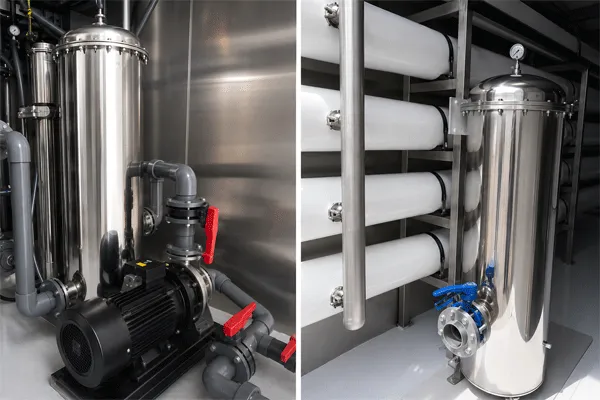
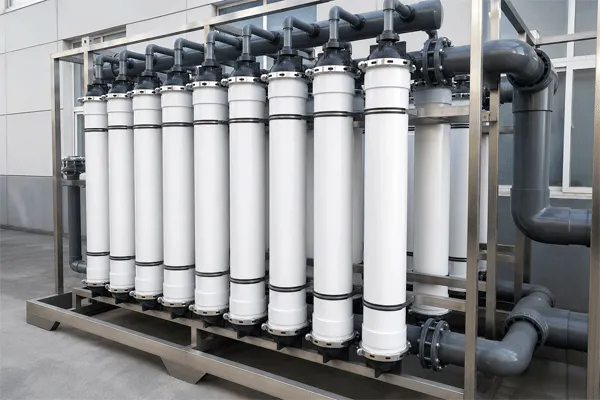
Un sistema de ósmosis inversa consta de varios equipos. Una pequeña unidad de punto de uso puede contener solo unas pocas etapas, mientras que una planta industrial puede incluir dosificación de productos químicos, filtración multimedia, descalcificación, filtros de cartucho, múltiples recipientes a presión con membranas, instrumentación, equipos de limpieza, depósitos, controles PLC y postratamiento.
Un sistema industrial habitual de ósmosis inversa puede incluir:
- Depósito de agua sin tratar
- Bomba de alimentación
- Filtro multimedia o de medios
- Filtro de carbón activo, cuando proceda
- Dosificación de descalcificadores o antiincrustantes
- Filtro de cartucho
- Bomba de alta presión
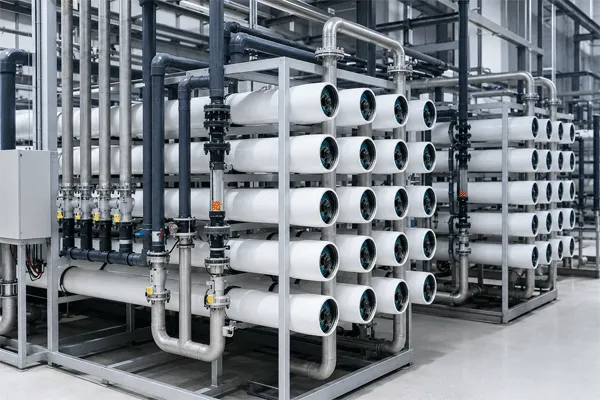
- Depósitos a presión para membranas de ósmosis inversa
- Medidores de conductividad
- Instrumentos de caudal y presión
- Depósito de permeado
- Sistema de limpieza CIP
- Equipos de dosificación de productos químicos
- Controles PLC / HMI o SCADA
La membrana de ósmosis inversa (RO) es el núcleo de la etapa de separación, pero los equipos que la rodean la protegen y garantizan un funcionamiento estable. Un pretratamiento deficiente puede acortar la vida útil de la membrana, incluso cuando esta sea de alta calidad.
¿Qué es un sistema de ósmosis inversa? Cómo funciona la filtración de agua por ósmosis inversa
¿Qué ocurre dentro de la etapa de membrana?
                    ┌──────── Permeado / Agua de ósmosis inversa
 │
Agua de alimentación ──► [ MEMBRANA DE ÓSMOSIS INVERSA ]
 │
 └──────── Concentrado / Rechazo
La relación entre el caudal de permeado y el caudal de agua de alimentación se denomina recuperación.
Recuperación (%) = Caudal de permeado ÷ Caudal de alimentación × 100
Un sistema que trata 10 m³/h de agua de alimentación y produce 7,5 m³/h de permeado tiene una recuperación nominal de 75%.
Eso no significa que todas las plantas de ósmosis inversa deban funcionar a 75%. La composición química del agua de alimentación, el riesgo de formación de incrustaciones, la configuración de las membranas, la temperatura y la calidad del agua requerida determinan un nivel de recuperación seguro para el funcionamiento.
¿Qué elimina el sistema de ósmosis inversa del agua?
Una de las razones por las que la filtración por ósmosis inversa se utiliza ampliamente es su capacidad para reducir muchas sustancias disueltas que los filtros de partículas convencionales no pueden eliminar de forma eficaz.
En función del tipo de membrana, las condiciones de funcionamiento, el pretratamiento y la certificación del sistema, la ósmosis inversa (RO) puede reducir sustancias como:
- Sales disueltas
- Iones relacionados con la dureza
- Sodio
- Cloruro
- Sulfato
- Nitrato
- Algunos metales
- Muchos compuestos orgánicos
- Ciertos microorganismos
- Total de sólidos disueltos
La EPA afirma que los sistemas de ósmosis inversa (RO) en el punto de uso pueden reducir potencialmente contaminantes como el plomo, algunos compuestos orgánicos volátiles, los PFAS, el arsénico, las bacterias y los virus. Sin embargo, la EPA también subraya que las afirmaciones verificadas sobre la eliminación de contaminantes deben basarse en pruebas y certificaciones del sistema.
Esa precisión es importante. La ósmosis inversa elimina distintos contaminantes con distintos grados de eficacia, y ningún proveedor responsable debería afirmar que todas las membranas eliminan todos los contaminantes en la misma medida.
Lo que la ósmosis inversa no resuelve por sí sola
Un sistema de ósmosis inversa no es un sustituto universal de todas las tecnologías de tratamiento.
Es posible que aún falte:
- Eliminación de sedimentos
- Tratamiento del hierro y el manganeso
- Control del cloro
- Control de la dureza
- Control biológico
- Eliminación de aceite
- Reducción de la carga orgánica
- Ajuste del pH
- Desinfección final
- Remineralización
Por ejemplo, las aguas residuales industriales muy contaminadas pueden requerir coagulación, tratamiento biológico, MBR, UF, carbón activo u otros procesos antes de que el agua llegue a la etapa de ósmosis inversa.
Por lo tanto, en los proyectos de ingeniería, la pregunta correcta no es:
“¿Podemos utilizar la ósmosis inversa?”
Es:
“¿Qué proceso de tratamiento garantizará la calidad del agua requerida con un coste operativo estable?”
¿Qué factores determinan la calidad del agua de ósmosis inversa?
La calidad final del agua obtenida mediante ósmosis inversa depende de mucho más que del modelo de membrana.
Entre los factores importantes se incluyen:
| Factor |
Por qué es importante |
| TDS del agua de alimentación |
Cambios en la presión osmótica y en la presión de funcionamiento necesaria |
| Temperatura |
Influye en el flujo de agua a través de la membrana |
| pH |
Influye en la formación de incrustaciones y en el comportamiento de los contaminantes |
| Dureza |
Puede provocar la formación de incrustaciones minerales |
| Sílice |
Puede limitar la recuperación |
| Hierro y manganeso |
Puede ensuciar las membranas |
| SDI / materia en suspensión |
Indica riesgo de incrustaciones |
| Productos ecológicos |
Puede contribuir a la obstrucción de la membrana |
| Cloro |
Puede dañar algunas membranas de ósmosis inversa habituales |
| Recuperación |
Una mayor recuperación concentra las sales en mayor medida |
| Edad de la membrana |
Las incrustaciones y la degradación afectan al rendimiento |
| Presión |
Las influencias impregnan la producción |
Por eso, un ingeniero debería solicitar un análisis completo del agua de alimentación antes de dar por finalizado un sistema industrial.
En el caso del agua de la red pública, el pretratamiento puede ser relativamente sencillo si el suministro municipal es estable. El agua de pozo puede requerir un tratamiento adicional para eliminar el hierro, el manganeso, la dureza, la turbidez u otros componentes específicos del lugar.
El agua con alta dureza también requiere una atención especial. Puede ser necesario instalar un descalcificador, un sistema antical, un sistema de ajuste del pH u otra estrategia de control de la cal antes de la membrana.
Por lo tanto, la mejor configuración de ósmosis inversa no es el sistema más grande ni el que tiene la presión nominal más alta, sino aquel que se adapta a las necesidades reales de tratamiento del agua.
¿Qué tipos de sistemas de ósmosis inversa hay disponibles?
Los equipos de ósmosis inversa abarcan desde unidades residenciales compactas hasta grandes plantas industriales.
1. Ósmosis inversa en el punto de consumo
Un sistema de ósmosis inversa en el punto de uso trata el agua en un solo grifo, normalmente debajo del fregadero de la cocina.
La EPA define un sistema de ósmosis inversa en el punto de uso como un dispositivo conectado a un único grifo que utiliza presión y una membrana semipermeable para producir agua tratada y concentrado.
Un sistema típico de ósmosis inversa (RO) en el punto de uso puede incluir:
- Prefiltro de sedimentos
- Filtro de carbón
- Membrana de ósmosis inversa
- Depósito de almacenamiento
- Filtro de post-carbono
- Grifo de agua potable
Este sistema permite disponer de agua potable en casa sin necesidad de tratar toda el agua del hogar.
2. Ósmosis inversa comercial
Los sistemas comerciales se utilizan en aplicaciones como:
- Hoteles
- Restaurantes
- Laboratorios
- Pequeñas fábricas
- Producción de bebidas
- Granjas
- Lavanderías
- Cocinas industriales
Su capacidad suele ser mucho mayor que la de una unidad doméstica, pero menor que la de una gran planta industrial.
3. Ósmosis inversa industrial
Las plantas industriales de ósmosis inversa pueden producir desde varios metros cúbicos hasta cientos o miles de metros cúbicos de agua tratada al día.
Entre sus aplicaciones se incluyen:
- Pretratamiento del agua de alimentación de la caldera
- Agua de proceso
- Plantas de alimentación y bebidas
- Pretratamiento del agua para uso farmacéutico
- Fabricación de productos electrónicos
- Relleno de la torre de refrigeración
- Producción textil
- Plantas químicas
- Reutilización de aguas residuales
- Desalinización
En estos proyectos, el apoyo técnico de ingeniería cobra tanta importancia como la propia membrana.
¿Por qué es tan importante el pretratamiento antes de una membrana de ósmosis inversa?
Un sistema de ósmosis inversa concentra los contaminantes en un lado de la membrana. Por ello, el pretratamiento resulta imprescindible.
Sin un pretratamiento adecuado, las membranas pueden sufrir:
- Escalado
- Incrustaciones orgánicas
- Incrustaciones coloidales
- Crecimiento biológico
- Depósito de hierro
- Oxidación por membrana
- Gran caída de presión
- Pérdida del caudal de permeado
- Menor rechazo de sal
Imaginemos una planta industrial que utiliza agua de alimentación dura con un alto contenido en calcio y alcalinidad. A medida que el sistema de ósmosis inversa (RO) produce permeado, las sales se concentran cada vez más en el agua restante. Si su concentración supera los límites de solubilidad, pueden formarse depósitos de cal en la superficie de la membrana.
Esto aumenta la presión de funcionamiento y la frecuencia de limpieza.
Opciones habituales de pretratamiento
| Problema de calidad del agua |
Posible enfoque terapéutico |
| Sólidos en suspensión |
Filtración por medios filtrantes, ultrafiltración, filtración por cartuchos |
| Dureza |
Ablandador o antiincrustante |
| Cloro |
Decloración con carbón activo o química |
| Hierro / manganeso |
Oxidación y filtración |
| Carga orgánica |
Tratamiento biológico, carbón, ultrafiltración u otros tratamientos previos |
| Alta turbidez |
Clarificación / coagulación / filtración |
| Incrustaciones microbianas |
Desinfección adecuada e higiene del sistema |
El enfoque adecuado debe basarse en el análisis del agua.
Como fabricante de membranas de ósmosis inversa, Membranas de UF, Membranas MBR, EDI módulos, plantas de agua pura y sistemas integrados de tratamiento de agua; a menudo consideramos el pretratamiento y la ósmosis inversa como un único proceso, en lugar de como productos independientes. Este enfoque de ingeniería reviste especial importancia en la reutilización de aguas residuales y en proyectos industriales complejos.
¿Cuánta agua de descarte genera un sistema de ósmosis inversa?
La ósmosis inversa (RO) genera dos corrientes de agua, por lo que parte del agua de alimentación sale en forma de concentrado.
La cantidad depende en gran medida del diseño del sistema.
En el caso de los pequeños sistemas domésticos, la eficiencia puede variar considerablemente. La EPA señala que un sistema típico de ósmosis inversa (RO) en el punto de uso puede verter cinco galones o más al desagüe por cada galón de agua tratada, mientras que los productos ineficientes pueden llegar a generar hasta diez galones de agua de desecho por cada galón de agua tratada. Los sistemas con la etiqueta WaterSense deben cumplir un límite de 2,3 galones de agua de descarte o menos por cada galón de agua tratada.
Por eso los compradores no deberían juzgar un sistema doméstico de filtrado de agua por ósmosis inversa únicamente por su precio de compra.
¿Qué es un sistema de ósmosis inversa? Cómo funciona la filtración de agua por ósmosis inversa
La ósmosis inversa industrial es diferente
Los sistemas industriales suelen diseñarse teniendo en cuenta la recuperación, más que una proporción fija entre residuos y producto.
Por ejemplo:
| Feed |
Permeado |
Concéntrate |
Recuperación |
| 10 m³/h |
5 m³/h |
5 m³/h |
50% |
| 10 m³/h |
7,5 m³/h |
2,5 m³/h |
75% |
| 10 m³/h |
8 m³/h |
2 m³/h |
80% |
Un mayor grado de recuperación puede reducir el consumo de agua, pero si se lleva al extremo, puede aumentar la formación de incrustaciones, las obstrucciones, la presión y la necesidad de limpiar las membranas.
El objetivo no es simplemente reducir al mínimo el agua de descarte. El objetivo es encontrar el equilibrio adecuado entre:
- Recuperación de agua
- Estabilidad de la membrana
- Consumo energético
- Uso de productos químicos
- Eliminación de concentrados
- Coste final del agua
En algunas plantas de reutilización industrial, es posible que parte del concentrado se someta a un tratamiento adicional. La viabilidad de esta medida depende de la normativa local en materia de vertidos, de la composición química del agua y de la rentabilidad del proyecto.
¿En qué se diferencia la ósmosis inversa (RO) de los sistemas de tratamiento de agua por ultrafiltración (UF), MBR y EDI?
Un error habitual es comparar la ósmosis inversa (RO), la ultrafiltración (UF), el sistema MBR y la desionización electrolítica (EDI) como si una tuviera que sustituir a las demás. En realidad, suelen funcionar conjuntamente.
Ósmosis inversa frente a ultrafiltración
La ultrafiltración se centra principalmente en los sólidos en suspensión, los coloides y muchos microorganismos. La ósmosis inversa va más allá, ya que separa una elevada proporción de iones disueltos.
La OMS clasifica la ósmosis inversa (RO) como un proceso de membrana a alta presión, mientras que la ultrafiltración es un proceso de membrana a menor presión con características de separación diferentes.
RO frente a MBR
Un MBR combina el tratamiento biológico de aguas residuales con la separación por membranas. Se trata, principalmente, de una tecnología de tratamiento de aguas residuales.
Para proyectos de reutilización:
Aguas residuales industriales
 ↓
Tratamiento biológico / MBR
 ↓
Efluente con calidad de UF
 ↓
Sistema de ósmosis inversa
 ↓
Agua recuperada de alta calidad
El MBR reduce en primer lugar la contaminación orgánica y las partículas en suspensión. A continuación, la ósmosis inversa elimina gran parte del material disuelto restante.
RO frente a EDI
La EDI (electrodeionización) suele instalarse después de la ósmosis inversa (RO) cuando el proyecto requiere un nivel muy bajo de contaminación iónica.
Un circuito típico de agua ultrapura podría tener el siguiente aspecto:
Pretratamiento
 ↓
Etapa 1 de ósmosis inversa
 ↓
Etapa 2 de ósmosis inversa
 ↓
EDI
 ↓
Agua de alta pureza / ultrapura
Esto es habitual en aplicaciones farmacéuticas, electrónicas, de semiconductores, de laboratorio e industriales de alta pureza.
| Tecnología |
Función principal |
| MBR |
Tratamiento biológico de aguas residuales + separación de sólidos mediante membranas |
| UF |
Reducción de sólidos en suspensión / coloides |
| RO |
Reducción de la sal disuelta y desalinización |
| EDI |
Pulido iónico final para agua de alta pureza |
Por lo tanto, la elección de un sistema de tratamiento de agua depende de la calidad requerida tanto en la entrada como en la salida.
¿Cómo diseñan los ingenieros un sistema industrial de ósmosis inversa?
Un sistema industrial fiable de filtración por ósmosis inversa se basa en los datos.
Antes de seleccionar los equipos, los ingenieros deben saber lo siguiente:
- Fuente de agua de alimentación
- Análisis completo del agua
- Capacidad necesaria
- Calidad requerida del permeado
- Horario de apertura
- Rango de temperatura del pienso
- Condiciones de vertido de aguas residuales
- Superficie útil disponible
- Fuente de alimentación
- Requisitos de automatización
- Normas locales
- Ampliación futura de la capacidad
A partir de ahí, el ingeniero desarrolla el proceso de tratamiento.
Flujo de trabajo típico en el diseño industrial
Análisis del agua
 ↓
Definición de los parámetros del agua de producto
 ↓
Selección del pretratamiento
 ↓
Diseño del sistema de membranas
 ↓
Selección de bombas y presión
 ↓
Optimización de la recuperación
 ↓
Instrumentación y control
 ↓
Diseño del sistema CIP
 ↓
Integración de PLC y SCADA
 ↓
Montaje y pruebas en fábrica
 ↓
Puesta en marcha
Para una empresa contratista de certificación energética (EPC), la documentación también es importante.
Un paquete profesional puede necesitar:
- P&ID
- Diagrama de flujo del proceso
- Plano de disposición general
- Lista de equipamiento
- Esquema eléctrico
- Lista de instrumentos
- Cálculo de membranas
- Manual de instrucciones
- Procedimiento de mantenimiento
- Lista de piezas de recambio
Fabricamos e integramos sistemas para el tratamiento de aguas residuales industriales, proyectos de alcantarillado municipal, producción de agua pura, reutilización de agua, plantas en contenedores y sistemas de tratamiento montados sobre bastidor. Para estos proyectos, podemos combinar MBR de fibra hueca, UF de fibra hueca, MBR de láminas planas, equipos de membranas de ósmosis inversa (RO), EDI, dosificación, bombas, depósitos, instrumentación y control PLC/SCADA en una única solución de ingeniería.
Esto suele resultar más ventajoso para un comprador de EPC que adquirir componentes por separado e intentar resolver los problemas de interfaz en las instalaciones del proyecto.
¿Cómo se debe mantener un sistema de ósmosis inversa?
Las plantas de ósmosis inversa requieren un seguimiento periódico. Esperar a que la calidad del agua se deteriore considerablemente suele aumentar el tiempo de inactividad y los costes de limpieza.
Los operadores deben registrar:
- Presión de alimentación
- Presión de concentración
- Presión del permeado
- Caudal de alimentación
- Caudal de permeado
- Caudal de concentrado
- Conductividad del pienso
- Conductividad del permeado
- Caída de presión
- Temperatura
- pH
- Dosificación de productos químicos
Estos valores ayudan a los operadores a detectar los cambios antes de que se agraven.
Señales de alerta habituales
| Síntoma |
Posible causa |
| El caudal de permeado disminuye |
Incrustaciones, formación de sarro, bajas temperaturas |
| Aumenta la conductividad del permeado |
Daños en la membrana, fugas, incrustaciones |
| Aumenta la caída de presión |
Acumulación de residuos o obstrucción del espaciador |
| Aumentos de presión necesarios |
Formación de incrustaciones o obstrucción de membranas |
| Cambios en la recuperación |
Problema con una válvula, el caudal o la instrumentación |
La limpieza de las membranas debe realizarse respetando los límites operativos y químicos establecidos por el proveedor de las membranas.
Un sistema con un mantenimiento adecuado también requiere prestar atención al pretratamiento. Sustituir repetidamente una membrana de ósmosis inversa (RO) no resolverá los problemas derivados de un descalcificador defectuoso, un filtro de carbón agotado, un mal funcionamiento de la ultrafiltración (UF) o un crecimiento biológico descontrolado.
La especificación WaterSense de la EPA para sistemas de punto de uso incluye un criterio de rendimiento relativo a la vida útil mínima de la membrana de al menos un año, pero la vida útil de las membranas industriales depende en gran medida de la aplicación, las condiciones de funcionamiento, las prácticas de limpieza y el pretratamiento.
¿Dónde se utiliza la ósmosis inversa?
La ósmosis inversa ofrece una plataforma flexible para numerosos tipos de tratamiento del agua.
Agua potable y agua comercial
La ósmosis inversa puede mejorar la calidad del agua potable cuando la fuente contiene contaminantes que el sistema seleccionado y certificado está diseñado para reducir. La FDA también reconoce la ósmosis inversa como uno de los procesos de tratamiento utilizados para producir agua que puede cumplir los requisitos para ser etiquetada como «agua embotellada purificada», siempre que se cumplan los requisitos normativos.
Agua pura industrial
Las fábricas utilizan la ósmosis inversa (RO) para reducir los minerales antes de procesos como:
- Funcionamiento de la caldera
- Recubrimiento
- Lavado
- Mezcla
- Producción farmacéutica
- Elaboración de alimentos y bebidas
- Limpieza de aparatos electrónicos
Reutilización de aguas residuales
Las instalaciones industriales y municipales combinan cada vez más el tratamiento biológico, la filtración por membranas y la ósmosis inversa cuando desean reutilizar el agua tratada en lugar de verterla en su totalidad.
Desalinización
La ósmosis inversa (RO) es una de las principales tecnologías de desalinización del agua salobre y del agua de mar. El USGS describe la ósmosis inversa basada en membranas como uno de los principales procesos de desalinización y señala que los sistemas de membranas de ósmosis inversa suelen consumir menos energía que las tecnologías de desalinización térmica.
Agua de alta pureza
La ósmosis inversa de doble paso, combinada con la desionización electrolítica (EDI), puede proporcionar agua de alta pureza para aplicaciones exigentes.
Este amplio abanico de aplicaciones explica por qué la ósmosis inversa es una tecnología fundamental para la depuración del agua, pero también explica por qué no existe un único sistema de ósmosis inversa estándar válido para todos los proyectos.
Caso ilustrativo: De las aguas residuales industriales al agua de proceso reutilizable
Imaginemos una fábrica que quiere reducir su consumo de agua dulce.
Sus aguas residuales ya se someten a un tratamiento biológico, pero el agua tratada sigue conteniendo materia en suspensión y sólidos disueltos que impiden su reutilización directa en procesos sensibles.
En lugar de instalar únicamente una unidad de ósmosis inversa, el equipo de ingeniería diseña:
Aguas residuales
   ↓
Tratamiento biológico
   ↓
MBR
   ↓
Depósito regulador
   ↓
Ósmosis inversa
   ↓
Agua de proceso reutilizable
El MBR reduce los sólidos en suspensión y la carga orgánica. A continuación, la etapa de ósmosis inversa (RO) se centra en las sales disueltas.
Si se requiere una pureza aún mayor, se puede añadir una segunda etapa de ósmosis inversa (RO) o un sistema de desionización electrolítica (EDI):
MBR → RO → RO de segunda etapa → EDI
Esto pone de manifiesto una lección clave para los compradores industriales:
Un proyecto de ósmosis inversa (RO) que tiene éxito suele consistir en una solución completa de tratamiento de agua, no simplemente en un módulo de membranas.
El sistema concreto debe diseñarse a partir de los datos de laboratorio y de la norma de reutilización exigida.
¿Qué deberían preguntar los contratistas de EPC y los compradores industriales a un fabricante de sistemas de ósmosis inversa?
A la hora de comparar soluciones de ósmosis inversa, no te fijes únicamente en el precio del equipo.
Pregunta:
- ¿Qué análisis del agua de alimentación es necesario realizar?
- ¿Qué nivel de calidad de permeabilidad puede alcanzar el sistema propuesto?
- ¿Qué método de recuperación de diseños se utiliza?
- ¿Qué modelo de membrana y qué recipiente a presión se especifican?
- ¿Qué tratamiento previo se incluye?
- ¿Cómo se controla la escala?
- ¿Se incluyen los equipos CIP?
- ¿Qué instrumentos se incluyen?
- ¿Se dispone de control mediante PLC o SCADA?
- ¿Se puede instalar el sistema sobre un bastidor o en un contenedor?
- ¿Qué planos y documentos técnicos se facilitan?
- ¿Se ofrece la puesta en marcha a distancia o in situ?
- ¿Qué piezas de recambio se recomiendan?
- ¿Cómo responderá la central a los cambios estacionales en el agua de alimentación?
Estas preguntas permiten saber si estás comprando una solución de ingeniería completa o solo hardware montado.
Como fabricante profesional y proveedor de soluciones de tratamiento de aguas con enfoque técnico en China, ofrecemos apoyo a contratistas EPC, plantas municipales, fábricas industriales, integradores de sistemas, hoteles, explotaciones agrícolas y distribuidores internacionales mediante:
- Sistemas de ósmosis inversa
- Pequeñas máquinas de ósmosis inversa
- Membranas de ultrafiltración de fibra hueca
- Membranas MBR de fibra hueca
- Membranas MBR planas
- Módulos EDI
- Plantas de agua pura
- Plantas de tratamiento de aguas residuales
- Sistemas de reutilización del agua
- Sistemas en contenedores
- Plantas montadas sobre patines
- Automatización mediante PLC y SCADA
- Ingeniería OEM/ODM
En el caso de un proyecto comercial, envíe en primer lugar el análisis del agua de origen, los parámetros de calidad del agua deseados, el caudal necesario, las horas de funcionamiento y la ubicación del proyecto. Estos cinco datos permiten a los ingenieros elaborar una propuesta técnica mucho más fiable.
Preguntas frecuentes
¿Qué es un sistema de ósmosis inversa?
Un sistema de ósmosis inversa (RO) es un sistema de tratamiento de agua que aplica presión para hacer pasar el agua a través de una membrana semipermeable. Produce un flujo de permeado con menor contenido en sal y un flujo de rechazo más concentrado.
¿La ósmosis inversa hace que el agua sea completamente pura?
No se debe afirmar que ninguna tecnología de tratamiento produzca agua totalmente libre de contaminantes en todas las circunstancias. La ósmosis inversa (RO) puede reducir significativamente muchas sustancias disueltas, pero su rendimiento depende de la membrana, la configuración del sistema, el agua de alimentación, las condiciones de funcionamiento y las afirmaciones contrastadas sobre la reducción de contaminantes.
¿Es RO ¿El agua es igual que el agua destilada?
No. La destilación se basa en la evaporación y la condensación. El agua obtenida mediante ósmosis inversa se produce mediante separación por membranas a presión. Ambos procesos pueden reducir los minerales disueltos, pero utilizan tecnologías diferentes.
¿Es la ósmosis inversa adecuada para el agua dura?
La ósmosis inversa (RO) puede reducir muchos iones que contribuyen a la dureza, pero el agua muy dura puede provocar la formación de incrustaciones en la membrana. Puede ser necesario un pretratamiento con un descalcificador, un antiincrustante u otro proceso de control de incrustaciones.
¿Un sistema de ósmosis inversa desperdicia agua?
La ósmosis inversa (RO) produce concentrado, por lo que no toda el agua de alimentación se convierte en permeado. La eficiencia depende del sistema. La EPA señala grandes diferencias entre los productos domésticos de uso directo, mientras que las plantas industriales se diseñan en función de un objetivo de recuperación basado en la composición química del agua de alimentación.
¿Con qué frecuencia hay que cambiar una membrana de ósmosis inversa?
No existe un intervalo universal válido para todas las instalaciones industriales. La vida útil de las membranas depende de la calidad del agua de alimentación, el pretratamiento, la presión de funcionamiento, la limpieza, la formación de incrustaciones, la formación de sarro, la exposición a la oxidación y el mantenimiento. Los operadores deben utilizar datos de rendimiento normalizados, en lugar de cambiar las membranas únicamente en función de su antigüedad.
Aspectos clave que hay que recordar
- La ósmosis inversa es un proceso de purificación del agua basado en membranas y que funciona mediante presión.
- Un sistema de ósmosis inversa separa el agua de alimentación en permeado tratado y agua de rechazo concentrada.
- La membrana puede reducir muchas sales disueltas y otros contaminantes, pero su rendimiento real depende del sistema en su conjunto.
- La ósmosis inversa es diferente de la simple filtración de partículas.
- El pretratamiento es fundamental para reducir la formación de incrustaciones, las acumulaciones de suciedad, la oxidación y los daños en las membranas.
- El análisis del agua de alimentación debe realizarse antes de seleccionar los equipos.
- El agua dura puede requerir un tratamiento de descalcificación o antiescalante.
- Los sistemas de uso directo y las plantas industriales de ósmosis inversa tienen capacidades y estrategias de recuperación muy diferentes.
- Una mayor recuperación no siempre es mejor si provoca la formación de incrustaciones graves o la acumulación de suciedad.
- La ósmosis inversa (RO) suele funcionar junto con la ultrafiltración (UF), el MBR y la EDI, en lugar de sustituirlas.
- El sistema MBR + RO es un concepto habitual en la reutilización avanzada de aguas residuales.
- El sistema RO + EDI se utiliza ampliamente cuando se necesita agua de mayor pureza.
- Los compradores industriales deberían analizar conjuntamente las membranas, las bombas, el pretratamiento, la recuperación, los controles, el CIP, la documentación y la puesta en marcha.
- La automatización mediante PLC y SCADA puede mejorar el funcionamiento y la visibilidad de los datos en las plantas de tratamiento de mayor tamaño.
- Un proyecto fiable se basa en el agua de origen, la capacidad necesaria, la calidad del agua deseada y las condiciones de funcionamiento.
- En el caso de los proyectos de EPC, industriales, municipales, de reutilización y de agua pura, un enfoque de ingeniería a medida resulta más seguro que seleccionar una máquina de ósmosis inversa basándose únicamente en el caudal nominal.











 17:47
17:47