Banott Engineering Team | Water Treatment Engineering, Qingdao Banott Environmental Technology Co., Ltd. | Published / Updated: 14 August 2026
An MBR upgrade on textile effluent reliably cuts COD and suspended solids and shrinks the footprint of a biological plant, but aerobic biology plus a microfiltration barrier removes only part of the colour. Meeting a colour limit, or reusing the water, needs a stage after the membrane.
Behandlung von Textilabwässern: Leitfaden zur MBR-Modernisierung und Wiederverwendung
What is actually in dyehouse effluent
Textile wastewater is not one water. A mill that scours, bleaches, dyes and finishes produces several streams with different characters, and whether they are combined before treatment changes the answer to almost every design question.
Desizing and scouring liquors carry the bulk of the organic load: starches, waxes, and surfactants. These are biodegradable to varying degrees and respond to biological treatment. Bleaching adds residual oxidant and raises pH. Dyeing is where the trouble concentrates — reactive dyes hydrolyse in the bath, and the hydrolysed fraction that fails to fix on the fibre leaves with the effluent along with the salt used to drive fixation. Finishing contributes resins and softeners that resist biology entirely.
Four properties follow from that mix and shape any upgrade decision:
- High and variable colour, largely from dissolved dye molecules rather than suspended particles
- High salinity, particularly from reactive dyeing, which suppresses biological activity and later limits reuse options
- Elevated temperature, often arriving well above the range biological treatment prefers
- Swinging pH and batch-driven shock loads, because dyehouses discharge in campaigns rather than continuously
- A COD fraction that is genuinely non-biodegradable, which no amount of aeration time will remove
The last two matter most when an upgrade is being judged. A plant with a wide COD swing and a hard non-biodegradable residual will show a treatment result that looks unstable, and the instinct is to blame the biology when the cause is upstream batching.
What an MBR upgrade changes, and what it leaves alone
An MBR replaces settling with a physical barrier. The clarifier stops limiting how much biomass the aeration tank can hold, so the same tank carries more active organisms and tolerates load swings better. That is the mechanism behind every benefit claimed for MBR on textile effluent, and it is a real one.
What improves:
- Schwebstoffe im Abwasserfall to whatever the membrane rating enforces, and stop tracking sludge settleability. For a dyehouse whose sludge bulks whenever a finishing batch arrives, this alone can end recurring limit exceedances.
- Biodegradable COD removalimproves and stabilises, because higher biomass concentration and longer sludge age give slow-degrading compounds more contact with organisms adapted to them.
- Fußabdruckshrinks, or existing tank volume absorbs more flow. On a mill hemmed in by production buildings this is usually the reason the conversation started.
- Downstream equipment is protected.Any polishing stage after the MBR receives water free of solids, which changes its economics substantially.
What does not change:
- Dissolved colourpasses through. Microfiltration and ultrafiltration pore sizes do not reject dissolved dye molecules, and aerobic biology degrades only a portion of them.
- Salinitypasses through untouched.
- The non-biodegradable COD fractionpasses through, minus whatever adsorbs onto sludge.
- Temperaturis unchanged by the membrane; it has to be managed before the biology.
The honest framing for a mill owner: an MBR fixes the solids and stability problem and improves COD. If the enforcement action against your plant is about colour, the MBR is a necessary step in the train rather than the answer by itself.
Why aerobic biology cannot finish the colour job
Reactive and disperse dyes are engineered to survive washing, light and heat. That stability is the product feature the mill sells. It is also why an aerobic reactor, which works by oxidising organic molecules, struggles with the chromophore groups that produce colour.
Aerobic decolourisation of textile dyes happens partly by adsorption onto sludge flocs and partly by genuine degradation. Adsorption is not removal in the long run: the colour leaves with the waste sludge and reappears as a sludge disposal characteristic and cost. Genuine aerobic degradation of azo chromophores is slow, and much slower than the degradation of the surrounding organic load, which is why a plant can report strong COD performance and still discharge visibly coloured water.
The route that works better is anaerobic contact ahead of the aerobic stage. Under reducing conditions, azo bonds break relatively readily, decolourising the stream and producing aromatic amines that the aerobic MBR stage then treats. An anaerobic or anoxic zone followed by an aerobic MBR is a different plant from an aerobic MBR alone, and the difference shows up in the colour column of the discharge report.
Where a hard numeric colour limit applies and the biological train still falls short, the remaining options are physical-chemical: coagulation ahead of the biology to strip a colour fraction early, adsorption, oxidation, or a tight membrane after the MBR. Which of those is right depends on the limit, the dye chemistry in use, and whether the mill also wants the water back.
Choosing the module format: hollow fiber or flat sheet
Both formats are manufactured in-house, so on a Banott project the comparison can be made on process grounds rather than on stock availability.
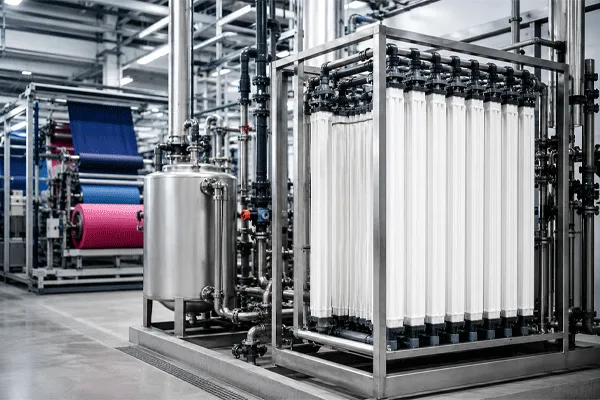
Flat sheet MBR modules are supplied in PVDF membrane with a PET linen support, running outside-in, in three configurations: a compact module for tight footprints, an integrated module where a self-contained structure suits the tank arrangement, and a standard module for conventional sewage and wastewater duty.
Hollow fiber MBR modules are published by effective membrane area:
| Modell |
Effektive Membranfläche |
Veröffentlichte Positionierung |
| MBRIII3C |
3 m² |
Kompakte Abwasserbehandlungsanlagen |
| MBRIII10C |
10 m² |
Abwasserbehandlung, konstante Filterleistung |
| MBI120C |
20 m² |
Abwasserbehandlungsanlagen, konstante Filterleistung |
For textile effluent specifically, the module questions that decide the outcome are not in either product listing and should be requested in writing before an order:
| Zu anfordernde Parameter |
Why a dyehouse needs it |
| Maximum continuous operating temperature |
Dyeing effluent frequently arrives hot; membrane and potting materials have limits |
| pH tolerance range, continuous and during CIP |
Bleaching and dyeing swing pH well outside neutral |
| Membranmaterial und nominelle Porengröße |
Determines rejection and chemical compatibility |
| Auslegungsdurchfluss bei Ihrem MLSS-Wert und Ihrer Temperatur |
Converts your flow into membrane area and cassette count |
| Reinigungsbelüftungsrate pro Modul |
The largest single operating cost line in an MBR |
| CIP-Chemikalientypen, Konzentrationen und Anwendungshäufigkeit |
Textile effluent typically drives shorter cleaning intervals than municipal sewage |
| Expected membrane life on high-fouling industrial duty |
Feeds the replacement budget your finance team will ask for |
Flat sheet modules are generally simpler for an operating team to inspect and clean manually and tolerate fibrous material better; hollow fiber packs more area into the same tank volume. A mill with a small maintenance crew and heavy lint loading, and a mill with severe space constraints, will not reach the same answer.
Behandlung von Textilabwässern: Leitfaden zur MBR-Modernisierung und Wiederverwendung
Temperature, pH and shock loads
Membranes fail on textile duty for reasons that trace back to the mill floor more often than to the membrane.
Effluent leaving a dyehouse can arrive at temperatures that suppress biological activity and sit above the continuous operating limit of membrane materials. Cooling ahead of the bioreactor, whether by a cooling tower, a heat exchanger with heat recovery, or simply enough equalisation volume for the heat to dissipate, is part of the upgrade scope and not an optional extra. Heat recovery is worth pricing seriously here, because a dyehouse is also a large consumer of hot water.
pH neutralisation before the reactor protects both the biology and the membrane. Where bleaching residual oxidant reaches the tank, it degrades some membrane materials directly, and quenching should be confirmed.
Equalisation deserves more volume than a first pass usually allows. A dyehouse discharging in campaigns sends the reactor a load profile that a continuous-flow design cannot absorb. Undersized equalisation shows up as unstable effluent quality that gets misdiagnosed as a membrane problem.
An edge case worth catching early: mills that also run a caustic recovery or salt recovery operation, or that dose antifoams and biocides in the dyeing process, should list those chemicals during the enquiry. Biocides entering a bioreactor damage the biomass that the whole upgrade depends on.
Six checks before committing to the upgrade
- Write down which parameter is actually failing.COD, colour, suspended solids, or a reuse target. The correct train differs for each, and an MBR is a full answer for only some of them. Output: the enforcement notice or reuse target, in numbers.
- Sample the streams separately for at least one full production cycle.Combined-stream averages hide the batch peaks that size the equalisation tank. Output: a data set covering a representative range of the mill’s dye recipes.
- Measure the biodegradable fraction, not just total COD.A BOD/COD ratio and a treatability test tell you how much of the load biology can reach. Output: a treatability result that sets a realistic biological target.
- Confirm the temperature and pH profile at the treatment plant inlet.Take it at the inlet, not at the dyehouse drain. Output: a profile across a production week.
- Check the tank you intend to convert.Side water depth, plan area, crane access for cassette removal, and existing blower capacity. Scouring air is additional to process air, and reusing existing blowers without a duty check is a routine source of budget overrun. Output: a survey drawing and a blower calculation.
- Decide the sludge route before the design is frozen.MBR operation changes sludge production and dewatering behaviour, and dye adsorbed onto sludge affects disposal classification in some jurisdictions. Output: a revised sludge mass balance and a disposal cost line.
When water reuse becomes realistic
Reuse is where an MBR upgrade earns back its operating cost in a mill, because a dyehouse consumes enormous volumes of process water and pays for it twice, once at the intake and once at the discharge.
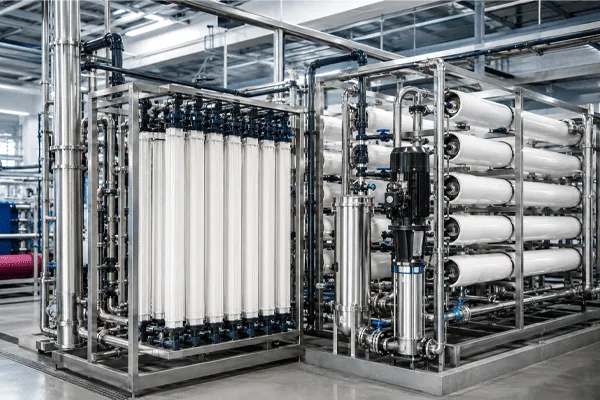
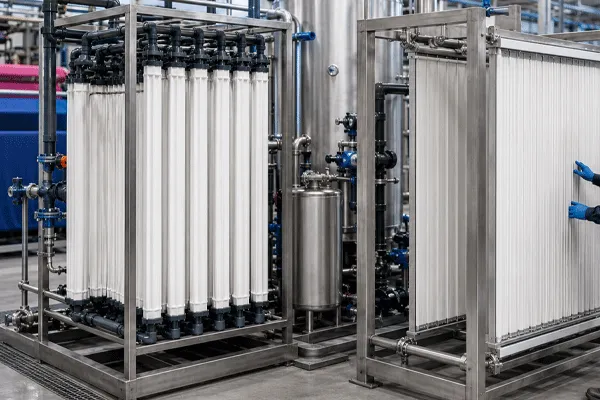
MBR permeate is solids-free, which makes it a workable feed for reverse osmosis without the pretreatment train that raw or clarified effluent would need. A membrane train arranged as biological treatment, MBR separation, then RO produces water suitable for many process duties. Banott’s RO membrane series is supplied in standard 4040 and 8040 element formats for industrial desalination duty, and the same product scope covers UF as RO pretreatment where an additional barrier is warranted.
Three constraints decide whether reuse pencils out:
- The RO concentrate has to go somewhere.It carries the salt, the colour and the non-biodegradable COD in concentrated form. In a coastal mill with a discharge permit this may be manageable; inland, concentrate handling can cost more than the reuse saves. This is the question to answer first, not last.
- Salinity dictates recovery.Reactive dyeing effluent is salty, and salt sets the achievable recovery ratio before osmotic pressure and scaling limit the system.
- Not every duty needs RO permeate.Rinsing, cooling and cleaning duties often accept MBR permeate directly or after a lighter polish, and matching water quality to duty rather than treating everything to the highest standard is usually where the money is.
Where reuse is the objective from the start, containerised pure water and wastewater treatment plants are available as modular packaged units, which suits mills where site space or local construction capability constrains a conventional build.
Behandlung von Textilabwässern: Leitfaden zur MBR-Modernisierung und Wiederverwendung
Compared with the usual upgrade routes
Against the two routes textile mills most commonly consider when a discharge limit tightens, MBR trades operating attention for footprint and stability.
| Dimension |
MBR upgrade in existing tanks |
Conventional biology plus tertiary filtration |
Physical-chemical train (coagulation, oxidation, adsorption) |
| Fußabdruck |
Smallest, works inside existing volume |
Larger, needs added filtration area |
Moderate, plus chemical storage |
| Suspended solids performance |
Durch Membranbarriere festgelegt |
Depends on clarifier and filter |
Good, sludge-heavy |
| Biodegradable COD |
Strong and stable |
Adequate, load-sensitive |
Begrenzt |
| Colour on its own |
Partial only |
Partial only |
Strongest single-stage option |
| Chemical consumption |
CIP chemicals |
Filter aids, moderate |
High and continuous |
| Sludge production |
Lower biological sludge |
Mäßig |
High chemical sludge, disposal cost |
| Operator skill needed |
Higher, TMP and CIP discipline |
Ähnlich wie bei bestehenden |
Moderate, dosing control |
| Suitability as reuse feed |
Direct RO feed |
Needs further pretreatment |
Variable |
| Consumables and replacement |
Membrane replacement cycle |
Media replacement |
Ongoing chemicals |
Supplier category literature tends to present the first column as the answer to every textile effluent question. It is the right answer when solids stability, footprint or reuse is the driver. A mill facing a colour limit alone, with land available and no reuse ambition, may find the third column cheaper to build even though it costs more to run.
Kostenpositionen und was angeboten werden kann
Banott does not publish selling prices for MBR membrane modules or for containerised treatment plants. Pricing is issued against enquiry, and the enquiry needs influent data, the target effluent standard, the flow, and the tank survey before a meaningful figure can be produced. Published capacity information exists for the small RO machine range at 300–3,000 GPD, and industrial RO membranes come in standard 4040 and 8040 formats, but neither carries a listed price.
Budget the upgrade as five lines rather than one, because a membrane-only quotation will look attractive and will not build a working plant:
- Membrane modules and cassettes
- Equalisation, cooling and neutralisation upstream
- Aeration and blower work, with scouring air counted separately from process air
- Mechanical and electrical scope: permeate pumps, recirculation, CIP dosing, controls and TMP logging
- Sludge handling revision
The Banott Water Treatment Engineering Team offers pre-sales process consultation covering membrane type selection, membrane area sizing and system configuration against submitted water quality data, drawing on nearly 20 years of experience in ultrafiltration membrane separation technology and its engineering application. Submitting a real data set produces a more useful answer than a capacity figure alone.
FAQ
Q: Will an MBR meet my colour limit?
A: Not on its own, in most cases. An aerobic MBR removes suspended solids and a substantial share of biodegradable COD, but dissolved dye passes through the membrane and degrades slowly under aerobic conditions. Anaerobic contact ahead of the MBR, or a polishing stage after it, is normally required where a numeric colour limit applies.
Q: Can I convert my existing activated sludge tank instead of building new?
A: Often yes, and that is the usual attraction. The decision rests on side water depth, plan area, crane access above the tank for cassette handling, and whether existing blowers can supply scouring air on top of process air. A tank survey answers this before any membrane is priced.
Q: How often will the membranes need cleaning on dyeing effluent?
A: More often than on municipal sewage, and the interval depends on your specific effluent, temperature and MLSS. Cleaning frequency and CIP chemistry should be requested from the supplier as part of the quotation rather than estimated, since it directly determines operator workload.
Q: Does MBR reduce my sludge disposal cost?
A: Biological sludge production generally falls at the longer sludge ages MBR operation allows. Whether total disposal cost falls depends on dewatering behaviour at higher biomass concentration and on how dye adsorbed onto sludge is classified for disposal in your jurisdiction.
F: Was kostet ein MBR-Modul?
A: Nicht veröffentlicht. Die Preise werden auf Anfrage unter Berücksichtigung der Membranfläche, der Modulkonfiguration und der Projektleistung mitgeteilt.
Q: Is reused water good enough for dyeing itself?
A: Depends on the duty and the dye recipe. RO permeate from an MBR-fed system meets many process requirements, but colour-sensitive dyeing has tight conductivity and residual colour tolerances, and mills commonly route reused water to rinsing, cooling and cleaning first while keeping fresh water for the most sensitive baths.











 16:11
16:11