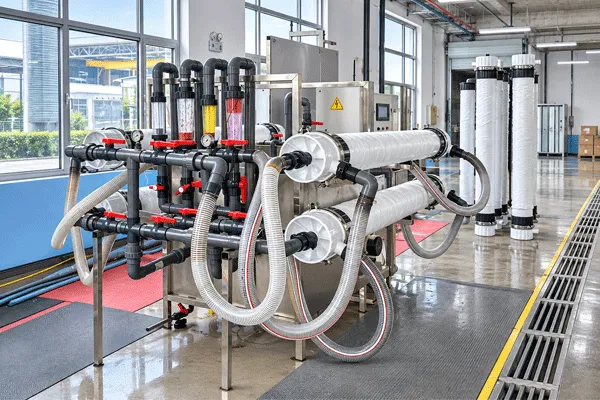
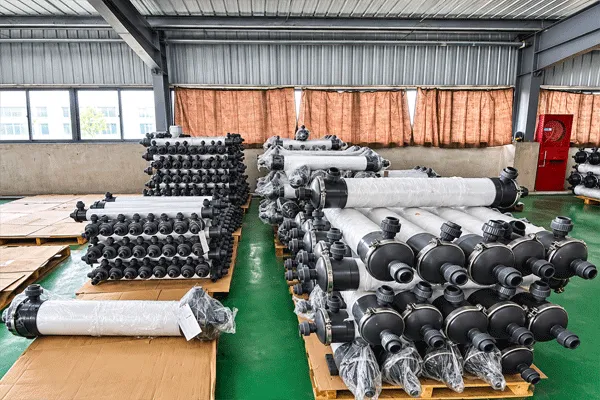
Behind every hollow fiber MBR membrane module is a manufacturing process that involves specialized equipment, careful material handling, and coordinated assembly work. While finished membrane products are often the focus of wastewater treatment projects, the production environment also provides valuable insight into a manufacturer’s capabilities.
At Qingdao Banott Environmental Technology Co., Ltd., we specialize in membrane filtration products and integrated water and wastewater treatment solutions for industrial and municipal applications.
Ein Blick in die MBR-Membranfertigungshalle von Banott: Von der Hohlfaseraufbereitung bis zur Membranmontage
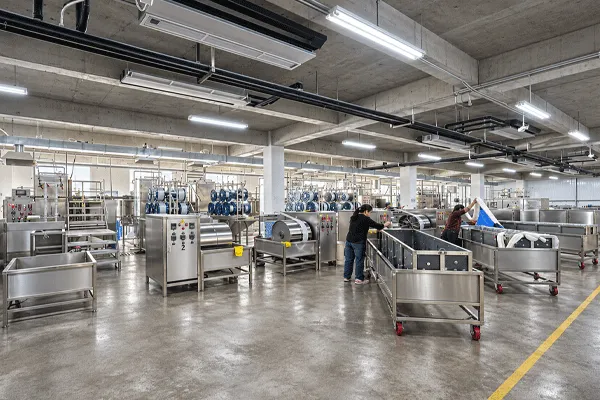
Today, we are sharing a collection of photographs from our MBR membrane manufacturing workshop, offering a closer look at hollow fiber materials, production equipment, membrane curtain handling, and assembly activities.
These workshop images give EPC contractors, water treatment engineering companies, system integrators, and international distributors a practical view of the manufacturing operations behind our membrane products.
Inside Banott’s MBR Membrane Production Workshop
Our manufacturing workshop brings together different work areas involved in preparing and handling hollow fiber membrane products.
The photographs show production equipment, workstations, suspended membrane fiber assemblies, material reels, and workers carrying out hands-on operations.
Each area serves a different purpose within the broader membrane manufacturing environment.
In membrane production, effective coordination between equipment operations and manual assembly is important. Production equipment supports material handling and processing, while trained workers handle tasks requiring careful positioning, adjustment, and component preparation.
The workshop photographs also show how different workstations can be arranged to accommodate various stages of membrane component production.
For international buyers, seeing these activities helps provide a more complete understanding of the physical manufacturing operations behind the finished product.
Hollow Fiber Material Handling and Production Equipment
Hollow fiber membranes are the main filtration components in hollow fiber MBR modules.
Before these fibers are incorporated into membrane assemblies, their handling must follow the requirements of the intended membrane design.
The photographs show multiple reels of white fiber material, along with industrial equipment incorporating winding or guiding components.
Fiber-handling equipment plays an important role in supporting the preparation and movement of membrane materials.
In a typical manufacturing environment, relevant considerations include:
- Material identification and traceability.
- Appropriate handling of membrane fibers.
- Controlled movement through equipment.
- Protection against unnecessary mechanical stress.
- Suitable storage and handling conditions.
- Compatibility with downstream assembly operations.
Because hollow fiber membranes are relatively thin and flexible, handling methods must consider the mechanical properties of the selected membrane material.
The visible equipment illustrates the production environment. Exact machine functions, processing parameters, and production capacities depend on the equipment specifications.
Membrane Fiber Arrangement and Curtain Preparation
Another important part of the workshop is the area where membrane fibers are arranged and prepared for assembly.
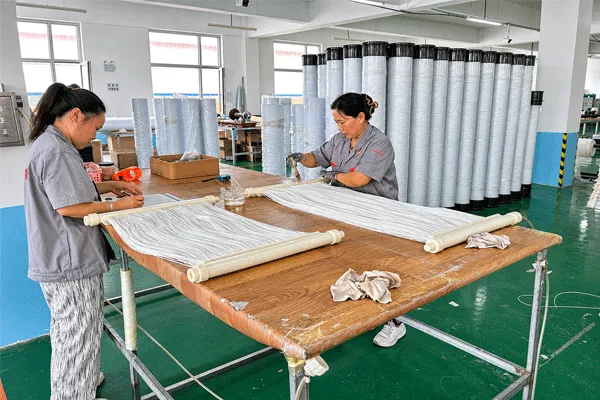
One photograph shows a worker carefully handling a group of white hollow fibers spread across a long worktable.
The fibers are positioned in an elongated arrangement, making their flexible structure clearly visible.
Preparing membrane fibers for assembly requires attention to the arrangement specified in the product design.
Depending on the membrane configuration, important considerations may include fiber length, positioning, bundle distribution, and compatibility with the intended header structure.
These details matter because the finished membrane assembly must match its specified dimensions and installation requirements.
Why Is Fiber Arrangement Important?
In a submerged MBR system, many hollow fibers work together to provide the required filtration surface.
The arrangement of these fibers must be considered alongside module dimensions, hydraulic conditions, aeration requirements, and the supporting frame design.
For manufacturers, the purpose is not simply to place as many fibers as possible within a small space.
The arrangement must also be suitable for the intended operating conditions and future maintenance requirements.
Banott provides PVDF Hollow Fiber MBR Membrane Modules in different configurations for industrial and municipal wastewater treatment projects.
Ein Blick in die MBR-Membranfertigungshalle von Banott: Von der Hohlfaseraufbereitung bis zur Membranmontage
Membrane Curtain Handling and Manual Assembly
The production photographs also show workers handling membrane curtain components at dedicated worktables.
In one image, a worker holds a membrane header while the attached hollow fiber bundle extends across the work surface.
The worktable provides space for arranging the membrane component and examining its physical position during handling.
Manual operations remain important in membrane manufacturing because flexible fibers and connected components require suitable support during movement and assembly.
For membrane curtain products, the manufacturing and assembly plan should address:
- Fiber positioning and handling.
- Header alignment.
- Component dimensions.
- Mechanical compatibility.
- Protection of the membrane surface.
- Requirements for further assembly.
- Appropriate inspection procedures.
These considerations are especially relevant for membrane components that will later be integrated into larger assemblies.
The production photographs demonstrate the handling of membrane materials and components. They do not, by themselves, establish completed integrity testing or final product acceptance.
Suspended Membrane Fibers and Workshop Organization
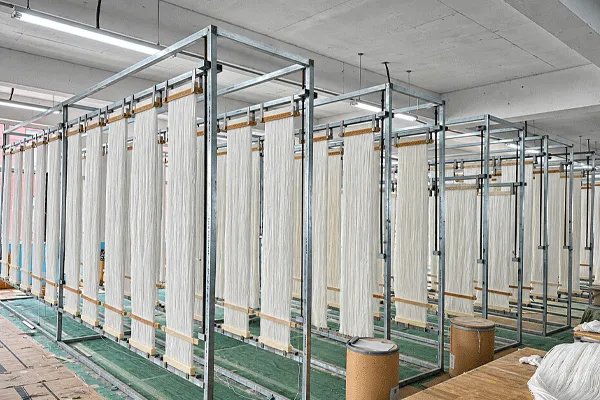
Several photographs show rows of white membrane fiber assemblies hanging vertically from metal support frames.
The hanging arrangement provides an alternative to placing membrane materials on horizontal worktables.
It also demonstrates the use of dedicated supporting structures within the production area.
Depending on the manufacturing stage and process requirements, suitable supporting frames can help organize components and provide access for handling or subsequent operations.
The photographs show multiple suspended assemblies arranged across the workshop.
From a production management perspective, adequate space and appropriate supporting equipment are important for handling large numbers of membrane components.
For buyers evaluating a membrane manufacturer, this type of workshop visibility can help them understand the physical production environment and the range of component-handling arrangements available.
The exact function of each hanging station should be established from its operating procedure rather than inferred solely from photographs.
Production Coordination and Equipment Integration
Manufacturing a hollow fiber membrane module involves more than preparing individual fibers.
The finished product must be compatible with the required header connections, support structure, permeate collection arrangement, and overall membrane system design.
Different work areas therefore need to support the same product requirements.
The workshop photographs show both equipment-assisted and manual operations.
This combination is valuable in membrane manufacturing because machinery can support repeatable material handling, while workers carry out operations involving assembly, positioning, and component preparation.
For an engineering-oriented supplier, manufacturing coordination is also connected to the documentation needed by the customer.
Typical project information may include:
| Manufacturing Consideration |
Importance for Buyers |
| Membrane material specification |
Confirms compatibility with the application |
| Abmessungen des Moduls |
Supports installation planning |
| Membranfläche |
Provides a basis for system sizing |
| Header configuration |
Helps verify piping connections |
| Supporting frame dimensions |
Supports equipment integration |
| Inspection requirements |
Defines the necessary acceptance criteria |
| Packaging and storage instructions |
Helps protect products before installation |
These items become particularly important for international EPC projects and membrane replacement applications.
A membrane module that meets the intended filtration requirements must also fit the actual installation conditions.
Supporting Industrial and Municipal Wastewater Treatment Projects
Banott is a manufacturer and engineering-oriented provider of membrane filtration equipment and water treatment solutions.
Our product portfolio includes hollow fiber MBR membranes, flat sheet MBR membranes, hollow fiber UF membranes, RO membranes, EDI modules, and integrated treatment systems.
We support projects involving industrial wastewater treatment, municipal sewage treatment, water reuse, and membrane system upgrades.
For EPC contractors and engineering companies, membrane product selection should be coordinated with the broader project design.
This may involve reviewing:
- Treatment capacity and wastewater characteristics.
- Membrane module type and effective filtration area.
- Tank dimensions and available installation space.
- Membrane frame and piping requirements.
- Operating and cleaning conditions.
- Replacement compatibility.
- Technical documentation and maintenance needs.
Through our Engineering & System Integration services, we support customers in coordinating membrane equipment with larger water and wastewater treatment projects.
We also provide Wastewater Treatment Solutions for industrial and municipal applications.
Ein Blick in die MBR-Membranfertigungshalle von Banott: Von der Hohlfaseraufbereitung bis zur Membranmontage
A Closer Look at Banott’s Manufacturing Capabilities
The images shared in this workshop update offer a broader view of the manufacturing environment behind Banott’s membrane products.
From material reels and equipment stations to suspended fiber assemblies and hands-on membrane curtain handling, each photograph highlights a different aspect of production.
These activities form part of the manufacturing capabilities required to support membrane filtration equipment.
For customers, understanding the production environment provides useful context when discussing technical specifications, product customization, and long-term membrane supply.
At Banott, we aim to connect membrane manufacturing with practical engineering requirements, helping customers identify suitable equipment for their treatment projects.
Looking for a Reliable MBR Membrane Manufacturing Partner?
Whether you are developing a new wastewater treatment plant, upgrading an existing MBR system, or sourcing replacement membrane modules, our team can help review your technical requirements.
Share your required treatment capacity, membrane type, installation dimensions, and project specifications with Banott.
We can discuss suitable membrane products, equipment configurations, and engineering support for your application.
Contact Banott for MBR Membrane Products and Engineering Support











 13:37