Banott-Entwicklungsteam | Membranverfahren und Anlagentechnik, Qingdao Banott Environmental Technology Co., Ltd. | Veröffentlicht: 22. August 2026
MBR-Module mit Flachmembranen und Hohlfasern Trennen Sie dieselbe Mischflüssigkeit mithilfe unterschiedlicher Verfahren. Flachfilter vertragen dickflüssigeren Schlamm und eine gröbere Siebung und werden von Hand gereinigt; Hohlfasern bieten mehr Filterfläche pro Tankvolumen und können rückgespült werden. Ausschlaggebend sind die Schlammeigenschaften, die Siebung und der Zugang für das Bedienpersonal – nicht die bevorzugte Bauweise.
Flachmembran (MBR) vs. Hohlfasermembran: Wie trifft man die richtige Wahl?
Der Vergleich, den die meisten veröffentlichten Quellen Ihnen nicht bieten können
Nahezu jeder direkte Vergleich dieser beiden Formate stammt von einem Unternehmen, das eines davon vertreibt. Anbieter von Flachmembranen heben vor allem die MLSS-Toleranz und die mechanische Haltbarkeit hervor. Anbieter von Hohlfasermembranen punkten hingegen mit der Packungsdichte und der Energie pro Kubikmeter Permeat. Beide Argumentationen sind in ihrem jeweiligen Kontext zutreffend, weshalb der Vergleich nie zu einem eindeutigen Ergebnis führt.
Für ein Planungsinstitut ist das Problem noch gravierender als eine Verzerrung, da die Zahlen auf beiden Seiten in der Regel von vornherein nicht vergleichbar sind. Der Durchfluss wird auf unterschiedlichen Flächengrundlagen angegeben. Die Belüftung wird in einem Datenblatt pro Modul und in einem anderen pro Quadratmeter angegeben. Die Lebensdauer der Membran wird ohne Angabe des Reinigungsverfahrens angegeben, unter dem sie erzielt wurde. Eine Spezifikation, die durch Mittelwertbildung aus den Angaben zweier Anbieter erstellt wird, übernimmt beide Sätze von Annahmen und gleicht sie nicht miteinander ab.
Im Folgenden werden die Betriebsvariablen, die sich tatsächlich unterscheiden, von den sie umgebenden Marketingpositionen abgegrenzt und für jede Variable die zu fordernde Zahl angegeben, damit die beiden Formate auf einer einheitlichen Grundlage verglichen werden können.
Wo sich die Mechanismen tatsächlich unterscheiden
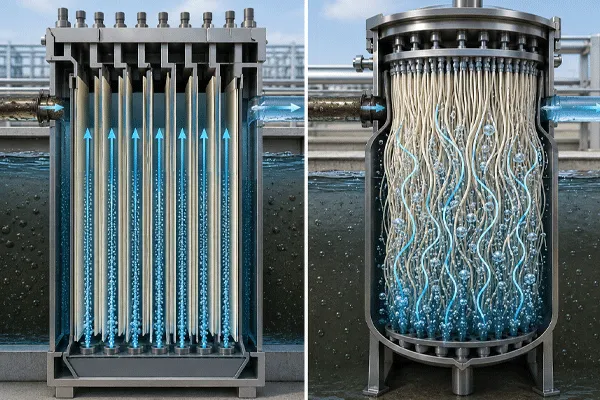
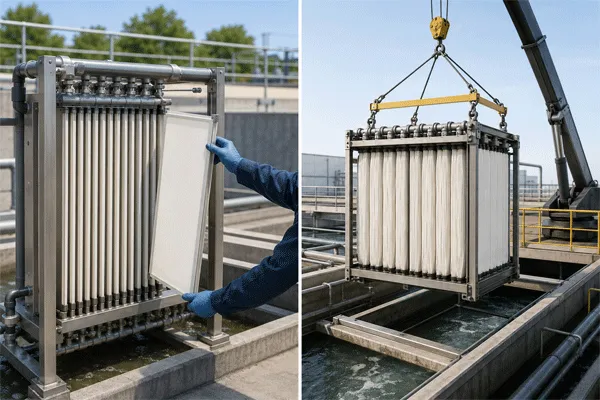
Beide Anlagen sind untergetaucht, werden auf der Permeatseite durch Saugkraft angetrieben und nutzen die Luftspülung, um die Kuchenbildung zu begrenzen. Die Unterschiede zeigen sich in vier Punkten.
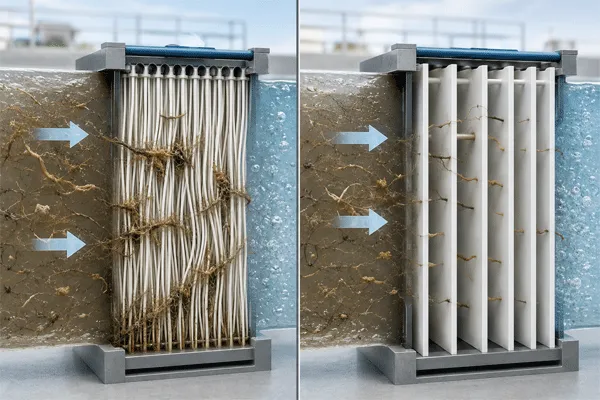
Strömungsweg und hydraulische Begrenzung. In einem Flachmembranmodul strömt das Permeat durch eine Membran in einen Abstandhalter und tritt oben am Modul über eine Düse aus, wobei die Zufuhrseite über einen definierten Kanal zwischen den Modulen zum Tank hin offen ist. In einem Hohlfasermodul ist die Zufuhrseite der Raum zwischen Tausenden von Fasern innerhalb eines Bündels, dessen Geometrie weitaus weniger genau definiert ist. Die Strömungsverteilung in einem Faserbündel hängt von der Packungsdichte ab und lässt sich anhand eines Datenblatts schwerer überprüfen als ein Kanalabstand, den man messen kann.
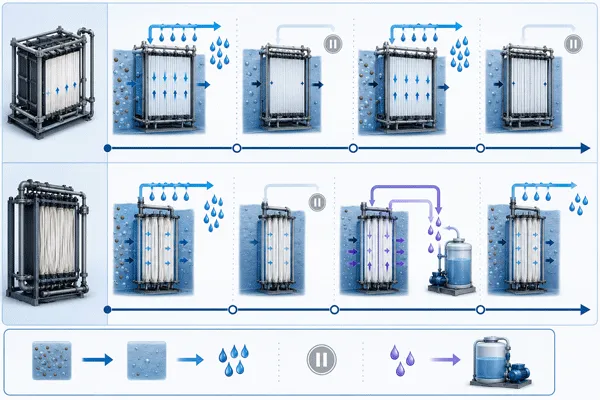
Rückflussfähigkeit. Hohlfasern können in der Regel einen umgekehrten Permeatfluss aufnehmen, sodass eine Rückspülung als routinemäßiger physikalischer Reinigungsschritt möglich ist. Flachmembranen sind dazu im Allgemeinen nicht in der Lage, da die Membran auf einer Seite abgestützt ist und ein Gegendruck die Delaminierung begünstigen könnte. Flachmembransysteme setzen stattdessen auf Relaxation: Die Filtration wird gestoppt, die Spülluft strömt weiter, und die Kuchenschicht löst sich ohne Rückfluss. Überprüfen Sie dies anhand des jeweiligen Moduls, anstatt davon auszugehen, da eine kleine Anzahl von Flachmembran-Konstruktionen einen begrenzten Rückfluss zulässt.
Dieser Unterschied wirkt sich auf die hydraulische Auslegung aus. Ein rückwaschfähiges System benötigt eine Rückwaschpumpe, einen auf das Rückwaschvolumen ausgelegten Permeat-Pufferspeicher und eine Steuerungssequenz, die den Durchfluss berücksichtigt. Ein auf Relaxation basierendes System benötigt beides nicht, gewinnt jedoch pro Zyklus weniger zurück und läuft daher in der Regel mit einem niedrigeren Auslegungsfluss, um dies auszugleichen.
Reaktion auf dickflüssige und viskose Mischflüssigkeit. Mit steigendem MLSS-Wert nimmt auch die Schlammviskosität zu, wodurch die Spülluft die Flüssigkeit weniger effektiv über die Membranoberfläche befördert. Der definierte Kanal zwischen den Flachmembranplatten hält einen Querstrompfad offen, selbst bei Viskositäten, bei denen der Durchfluss durch ein dichtes Faserbündel ungleichmäßig wird. Dies ist die physikalische Grundlage des Arguments für Flachmembranen bei hohem MLSS, und es handelt sich um einen realen Effekt, nicht um ein Marketingargument. Ein Marketingargument ist hingegen jede konkrete Angabe eines MLSS-Höchstwerts ohne Bezugnahme auf die damit einhergehende Spülrate.
Ausfallmodus. Eine beschädigte Hohlfaser schafft einen direkten Weg vom Mischfluid zum Permeat, was sich unmittelbar auf die Trübung des Permeats auswirkt. Das Gleiche gilt für eine beschädigte Flachmembran; allerdings sind die Membranen einzeln zugänglich, sodass ein defektes Panel innerhalb einer Kassette lokalisiert und ausgetauscht werden kann. Das Auffinden einer einzelnen gebrochenen Faser in einem Bündel aus Tausenden ist eine ganz andere Herausforderung, die in der Regel durch das schrittweise Isolieren und Prüfen der Module und nicht durch eine Sichtprüfung bewältigt wird.
Flachmembran (MBR) vs. Hohlfasermembran: Wie trifft man die richtige Wahl?
Die Tabelle „Variable für Variable“
| Betriebsgröße |
Flachblech |
Hohlfaser |
Der Betrag, der vom Lieferanten eingefordert werden soll |
| MLSS-Toleranz |
Höher; der offene Kanal zwischen den Platten sorgt für einen Durchflussweg bei erhöhter Viskosität |
Niedriger; die Strömungsverteilung innerhalb des Bündels verschlechtert sich mit steigender Viskosität |
Die MLSS-Obergrenze wird zusammen mit der ihr zugrunde liegenden Auswaschungsrate angegeben, nicht isoliert betrachtet |
| Screening-Anforderung |
Eine gröbere Öffnung ist in der Regel akzeptabel; der Spalt zwischen den Platten gibt dabei die Grenze vor. |
Es ist eine feinere Öffnung erforderlich; eine Überbrückung der Faser durch Haare und faseriges Material ist die Ausfallursache. |
Die vom Lieferanten garantierte Apertur in mm sowie die Angabe, ob es sich um eine 1D- oder 2D-Rasterung handelt |
| Mechanische Reinigung während des Betriebs |
Entspannung nur in den meisten Ausführungen; kein Rückfluss |
Entspannung plus Rückspülung |
Ob das Modul einen Rückfluss zulässt und bei welcher Druckgrenze |
| Netto- vs. Bruttofluss |
Brutto- und Nettowerte liegen näher beieinander, da die Relaxation zwar Zeit kostet, aber kein Permeat entsteht. |
Die Rückspülung verbraucht sowohl Permeat als auch Zeit, wodurch sich die Lücke vergrößert |
Nettofluss bei Referenztemperatur, mit dem Zyklus, der ihn erzeugt |
| Packungsdichte |
Geringere Membranfläche pro Einheit des Tankvolumens |
Größere Fläche pro Einheit des Tankvolumens |
Effektive Fläche pro Modul und Grundfläche des Moduls, sodass die Fläche pro m³ des Tanks berechnet werden kann |
| Spülluft |
Im Allgemeinen höher pro Einheit der Membranfläche |
Im Allgemeinen geringer pro Einheit der Membranfläche |
Nm³/h pro Modul und pro m² Membranfläche, sowie Dauerbetrieb oder zyklischer Betrieb |
| Energie pro m³ Permeat |
Das hängt vom erzielten Durchsatz ab, nicht allein vom Format. |
Das hängt vom erzielten Durchsatz ab, nicht allein vom Format. |
Gesamtleistung der angeschlossenen Gebläse in kW geteilt durch den Auslegungs-Permeatdurchfluss, von beiden Anbietern bei gleicher Betriebsleistung |
| Zugang zur manuellen Reinigung |
Die Platten können einzeln vor Ort oder nach dem Anheben besprüht oder abgewischt werden. |
Die Bündel werden chemisch gereinigt; manuelle Eingriffe sind begrenzt und mit einem höheren Risiko verbunden |
Das empfohlene Verfahren zur mechanischen Reinigung und die Frage, ob diese ohne Ausbau der Kassette durchgeführt werden kann |
| Bruchgefahr |
Blechschäden durch Aufprall oder Fremdkörper; lokal begrenzt |
Faserbruch durch Abrieb, aggressive Reinigung oder Handhabung; verteilt |
Das Verfahren zur Prüfung der Integrität und das Kriterium zur Identifizierung eines defekten Bauteils |
| Ersetzungsgranularität |
Einzelne Blätter lassen sich oft innerhalb einer Kassette austauschen |
In der Regel wird das gesamte Modul ausgetauscht |
Die kleinste austauschbare Einheit und ihr Preis |
| Tanktiefe und Förderhöhe |
Die Höhe der Verkleidung bestimmt die erforderliche Tiefe des Tanks |
Die Faserlänge gibt den Ausschlag; es gibt mehr Gestaltungsmöglichkeiten |
Erforderliche Eintauchtiefe und die verfügbare statische Förderhöhe an der Permeatdüse |
| Wiederherstellung der Bewuchsresistenz nach Vernachlässigung |
Der physische Zugang erhöht die Chancen, ein stark verschmutztes Gerät wieder instand zu setzen. |
Die chemische Rückgewinnung ist der wichtigste Weg; ein verfestigter Kuchen lässt sich schwerer rückverarbeiten. |
Prozentualer Flussrückgewinnungsgrad nach der Rückgewinnungsreinigung und die Anzahl der Zyklen, über die er gemessen wurde |
Bei den meisten Projekten haben zwei Zeilen dieser Tabelle ein größeres Gewicht als die übrigen. Die Anforderungen an die Siebung bestimmen eine vorgelagerte Investitionsposition und eine dauerhafte Instandhaltungsmaßnahme. Die Granularität des Austauschs bestimmt eine Lebenszykluskostenposition, die im achten Jahr eines Finanzmodells erscheint und in einem Ausschreibungsvergleich in der Regel nicht berücksichtigt wird.
Flachmembran (MBR) vs. Hohlfasermembran: Wie trifft man die richtige Wahl?
Das Missverständnis, das die meisten Formatvergleiche verzerrt: Der Fluss ist nicht formatübergreifend vergleichbar
Der Designfluss in LMH sieht aus wie eine gängige Einheit und verhält sich auch so, weshalb Ingenieure ihn in verschiedenen Datenblättern miteinander vergleichen. Drei Faktoren machen diesen Vergleich jedoch unmöglich.
Erstens unterscheiden sich Bruttofluss und Nettofluss, und in Datenblättern wird selten angegeben, welcher Wert gemeint ist. Der Nettofluss berücksichtigt die für die Relaxation benötigte Zeit und bei rückwaschfähigen Modulen auch das durch die Rückspülung verbrauchte Permeat. Ein Hohlfasermodul, für das der Bruttofluss angegeben wird, und ein Flachmembranmodul, für das der Nettofluss angegeben wird, können je nach Art der Auslassung näher beieinander liegen als sie es tatsächlich sind – oder weiter auseinander.
Zweitens ist der Fluss temperaturabhängig, und die Permeabilität ändert sich mit der Viskosität. Ein Wert ohne Referenztemperatur und ohne Korrekturmethode ist für die Auslegung an einem Standort, an dem die Mischflüssigkeit im Winter bei 12 °C fließt, nicht verwendbar.
Drittens – und das wird am häufigsten übersehen – ist der Fluss nur in Verbindung mit der zugehörigen Spülluftrate aussagekräftig. Ein hoher Auslegungsfluss, der durch eine hohe Spülrate aufrechterhalten wird, bedeutet nicht, dass es sich um ein besseres Modul handelt; es handelt sich vielmehr um einen anderen Punkt auf derselben Kompromisskurve, und die zusätzliche Spülluft schlägt sich in den Betriebskosten nieder. Der Vergleich von Flux-Werten ohne Berücksichtigung der ihnen zugrunde liegenden Belüftung entspricht dem Vergleich zweier Angebote auf einer Achse eines zweiachsigen Problems.
Für eine Spezifikation empfiehlt es sich, den Nettofluss bei einer festgelegten Referenztemperatur zu verlangen, wobei der Filtrationszyklus definiert und die Spülluftdurchsatzrate für denselben Betriebspunkt angegeben sein muss. Anschließend werden beide Angebote auf die Energie pro Kubikmeter Permeat normiert. Diese eine abgeleitete Zahl beendet die meisten Diskussionen über das Format, da sie die beiden Positionen der Anbieter in einen vergleichbaren Wert umwandelt.
Die Entscheidung anhand der Quelle lesen, nicht anhand des Katalogs
Die Entscheidung fällt in der Regel, sobald vier Standortbedingungen bekannt sind.
- Schlammeigenschaften und Auslegung der MLSS. Wenn die Prozessauslegung einen erhöhten MLSS-Wert erfordert oder wenn der Zulauf zähflüssigen oder schlecht konditionierten Schlamm liefert, ist der offene Kanal einer Flachblechanordnung die risikärmere Lösung. Liegt der Auslegungs-MLSS in einem moderaten Bereich und verhält sich der Schlamm gut, wird die Packungsdichte zum stärkeren Argument, und die Hohlfaser gewinnt an Bedeutung.
- Faser- und Haaranteil im Zulauf. Kommunale Abwässer und Abwässer aus der Lebensmittelverarbeitung enthalten Stoffe, die Brücken zwischen den Fasern bilden. Wenn eine Feinsiebung mit der vom Hohlfaserhersteller vorgeschriebenen Maschenweite vor Ort nicht zuverlässig gewährleistet und aufrechterhalten werden kann, ist das Argument der Siebung für sich genommen ausschlaggebend.
- Verfügbares Tankvolumen. Wenn der Membrantank durch vorhandenen Beton begrenzt ist, spielt die Fläche pro Volumeneinheit eine entscheidende Rolle, und Hohlfasermembranen nutzen den Raum besser aus. Wenn ausreichend Volumen zur Verfügung steht, ist der Vorteil geringer, als es im Datenblatt den Anschein hat.
- Wer reinigt es und wie oft ist diese Person vor Ort? Eine Anlage mit einem fest angestellten Bediener und Zugangsmöglichkeiten für Hebevorrichtungen kann realistisch gesehen eine physische Reinigung der flachen Blechpaneele durchführen, was die Grenzen dessen erweitert, wie viel Vernachlässigung das System überstehen kann. Eine Anlage, die wöchentlich von einem Auftragnehmer besucht wird, ist besser mit einem System bedient, dessen routinemäßige Reinigung automatisiert ist, was Module mit Rückspülfunktion in einer kontrollierten Abfolge begünstigt.
- Ob eine Wiederverwendung erfolgt. Wenn das Permeat in eine Umkehrosmose-Stufe eingespeist wird, gewinnt die Überwachung der Permeatintegrität gegenüber beiden Formatargumenten an Bedeutung, da eine Beschädigung die Umkehrosmose-Elemente erreicht, bevor jemand die Trübungsaufzeichnung auslesen kann. Das Verfahren zur Integritätsprüfung sollte daher vor der Festlegung des Formats festgelegt werden.
Im Gegensatz zu den unter Modulanbietern üblichen Vergleichen zur Befürwortung bestimmter Formate, bei denen eine Geometrie als allgemein überlegen dargestellt wird, liefert diese Abfolge für verschiedene Standorte unterschiedliche Ergebnisse – und genau das ist das richtige Ergebnis. Keines der beiden Formate ist abstrakt betrachtet überlegen.
Flachmembran (MBR) vs. Hohlfasermembran: Wie trifft man die richtige Wahl?
Banott-Flachblatt-MBR-Module: veröffentlichte Parameter
Die entsprechende Hohlfaserserie wird mit effektiven Membranflächen von 3 m² (MBRIII3C), 10 m² (MBRIII10C) und 20 m² (MBI120C) angegeben, wodurch sich die Fläche pro Modul innerhalb dieser Serie direkt vergleichen lässt.
Die PET-Gewebeverstärkung in den Flachlakenmodulen verdient für einen Fachleser eine kurze Erläuterung, da sie die Schicht ist, die die mechanische Belastung aufnimmt. Sie sorgt dafür, dass ein Laken einer kontinuierlichen Spülung und mechanischen Reinigung standhält, ohne dass die Membranschicht selbst der Belastung ausgesetzt ist, und sie ist auch der Grund dafür, dass die Rückflussgrenzen überprüft und nicht einfach als gegeben angenommen werden sollten.
Die Abmessungen der Filterplatten, die effektive Fläche pro Platte, die Porengröße, der Auslegungsdurchfluss, die maximale Stapelkapazität pro Kassette, der Spülluftbedarf, die Siebmaschenweite und das CIP-Protokoll werden für die Serie der flachen Filterplatten nicht veröffentlicht und werden auf Anfrage auf der Grundlage einer angegebenen Zulaufanalyse bereitgestellt. Die Preisgestaltung erfolgt auf Angebotsbasis; es werden keine Listenpreise veröffentlicht.
Der von Banott beschriebene Planungsansatz geht von den Zulaufdaten und den geforderten Abwasserstandards aus und nicht von einer Katalognummer. Das Unternehmen beschreibt sein Ingenieurteam für Wasseraufbereitung als ein Team mit fast zwei Jahrzehnten Erfahrung in der Membrantrenntechnologie und deren technischer Anwendung. Für ein Planungsbüro bedeutet dies in der Konzeptphase konkret, dass Anfrage Beide Formate sollten auf denselben Zulauf und denselben Abflusszielwert ausgelegt werden; anschließend sollten die beiden hinsichtlich des Energieverbrauchs pro Kubikmeter Permeat und nicht anhand der Modulspezifikationen verglichen werden.
Eine Spezifikationssprache, die beide Formate für Gebote zulässt
Wenn ein Auftraggeber einen Vergleichswettbewerb über verschiedene Formate hinweg wünscht, muss die Ausschreibung so formuliert sein, dass beide Formate berücksichtigt werden, ohne dass eines davon durch eine beiläufige Klausel ausgeschlossen wird.
- Legen Sie Kriterien für die Prüfung der Permeatqualität und -integrität fest, nicht die Membrangeometrie.
- Geben Sie den Nettofluss bei einer festgelegten Referenztemperatur unter Berücksichtigung des definierten Filterzyklus an und legen Sie die Spülluftdurchsatzrate am gleichen Betriebspunkt fest.
- Geben Sie den Energiebedarf an der Grenze der Membranbehälterbatterie in kW und in kWh pro Kubikmeter Permeat bei Auslegungsdurchfluss an, damit sich die Angebote von selbst normalisieren.
- Legen Sie die Sieböffnungsgröße fest, für die jeder Bieter eine Garantie übernimmt, und machen Sie den Siebbereich zu einem vom Bieter anzugebenden Parameter statt zu einem festen, vom Kunden vorgegebenen Design, da die Anforderungen je nach Format variieren.
- Bitte geben Sie die kleinste austauschbare Einheit und deren Richtpreis an, zusammen mit einer Zusage bezüglich der Verfügbarkeitsdauer.
- Verlangen Sie das Reinigungsprotokoll in schriftlicher Form, in dem Chemikalien, Konzentrationen, Einwirkzeiten und Häufigkeiten aufgeführt sind, und betrachten Sie alle Angaben zur Lebensdauer der Membranen als davon abhängig.
- Legen Sie das Verfahren für die physische Reinigung und Inspektion fest, einschließlich der Zugangswege, der Hebevorgänge und des dafür benötigten Platzbedarfs, und gleichen Sie dies mit dem gezeichneten Anlagenplan ab.
Punkt 7 wird am häufigsten erst spät entdeckt. Ein Modul, für das eine Hebehöhe erforderlich ist, über die das Gebäude nicht verfügt, stellt ein Konstruktionsproblem dar, das erst bei der Installation festgestellt wird – und in der Entwurfsphase nur dann erkannt wird, wenn jemand danach fragt.
Was dieser Vergleich offen lässt
Durch die Auswahl des Formats wird der Kreis der in Frage kommenden Anlagen eingegrenzt, und es bleiben drei Fragen offen, die einen größeren Einfluss auf die Anlage haben werden als die Entscheidung zwischen diesen Optionen.
Das Verschmutzungsverhalten bei einem bestimmten Zulauf lässt sich nicht anhand der Bauform vorhersagen. Ein Zulauf mit einem hohen Gehalt an kolloidalen organischen Stoffen oder FOG-Rückständen führt bei beiden Geometrien zu Problemen, und aussagekräftiger sind die über wiederholte Reinigungszyklen gemessenen Flux-Erholungswerte als die in Datenblättern angegebenen Eigenschaften.
Die Strategie zur Steuerung der Spülbelüftung – kontinuierlich, zyklisch oder durchflussproportional – hat in vielen Anlagen einen größeren Einfluss auf die Betriebskosten als die Anlagenkonfiguration, und die Entscheidung darüber wird in der Regel erst nach der Bestellung der Module getroffen, was in der falschen Reihenfolge ist.
Die Hydraulik des Membranbehälters – insbesondere die Schlammrückführungsrate und die Vermeidung einer lokalen Konzentration des MLSS im Behälter – entscheidet darüber, ob die Module mit der im Auslegungsplan vorgesehenen Mischflüssigkeit versorgt werden. Ein gut ausgewähltes Modul in einem Behälter mit schlechter Durchmischung erbringt eine unterdurchschnittliche Leistung, was wie ein Membranproblem aussieht, aber keines ist.
FAQ
F: Ist ein Flachblatt bei hohem MLSS immer besser?
A: Es ist toleranter, und der Grund dafür ist eher geometrischer als kommerzieller Natur: Ein offener Kanal zwischen den Platten hält den Durchfluss auch bei Viskositäten aufrecht, bei denen die Verteilung innerhalb eines dichten Faserbündels ungleichmäßig wird. Die Einschränkung besteht darin, dass jede MLSS-Obergrenze im Zusammenhang mit der dafür erforderlichen Spülluftmenge betrachtet werden muss, da ein allein genannter Wert nichts über den Energiebedarf aussagt, der zu ihrer Erreichung erforderlich ist.
F: Können flache MBR-Membranen rückgespült werden?
A: Bei den meisten Konstruktionen erfolgt keine Rückspülung, da die Folie einseitig abgestützt ist und der Gegendruck dazu führen könnte, dass sich die Schichten voneinander lösen. Die Entspannung bei weiterhin strömender Spülluft ist der übliche physikalische Reinigungsschritt. Einige wenige Konstruktionen lassen einen begrenzten Rückstrom zu; daher sollte der Druckgrenzwert für das jeweilige Modul überprüft werden, anstatt ihn als Eigenschaft des Formats zu betrachten.
F: Welches Format verbraucht weniger Energie?
A: Weder noch, da dies eine Eigenschaft des Formats ist. Der Energieverbrauch hängt vom erreichten Durchfluss und der zur Aufrechterhaltung dieses Durchflusses erforderlichen Spülluft ab. Daher ist der Vergleich nur dann aussagekräftig, wenn er in kWh pro Kubikmeter Permeat bei gleicher Auslastung, gleichem Zulauf und gleichem Abwasserziel erfolgt. Bitten Sie beide Bieter um diese Zahl und die ihr zugrunde liegenden Annahmen.
F: Inwiefern unterscheiden sich die beiden Verfahren?
A: Hohlfasern erfordern in der Regel eine feinere Maschenweite, da sich Haare und faseriges Material zwischen den Fasern festsetzen und durch die Rückspülung nicht entfernt werden. Flachkanäle vertragen gröberes Material. Behandeln Sie die erforderliche Maschenweite als vom Membranlieferanten garantierten Wert und prüfen Sie, ob sich die Anforderung auf ein- oder zweidimensionales Sieben bezieht, da ein 2-mm-Stabgitter und ein 2-mm-Lochblech nicht dasselbe Material durchlassen.
F: Kann ein einzelnes Blatt ausgetauscht werden, oder muss das gesamte Modul ersetzt werden?
A: Bei Flachblattkassetten lassen sich einzelne Blätter in der Regel austauschen, während Hohlfasermodule meist als Einheit ausgetauscht werden. Dieser Unterschied muss im Lebenszykluskostenmodell berücksichtigt werden, nicht nur im technischen Vergleich, da er sich darauf auswirkt, wie ein Teilausfall finanziell gehandhabt wird.
F: Welche Parameter für Flachbleche veröffentlicht Banott?
A: Membranmaterial und Trägermaterial (PVDF mit PET-Gewebe), Durchflussrichtung von außen nach innen sowie drei Modulausführungen: kompakt, integriert und Standard. Die Abmessungen der Membranplatten, die effektive Fläche, die Porengröße, der Auslegungsdurchfluss, die Stapelkapazität, der Spülluftbedarf, die Siebmaschenweite und das CIP-Protokoll werden auf Anfrage auf der Grundlage einer angegebenen Zulaufanalyse bereitgestellt.












 09:44
09:44