Banott Engineering Team | Water & Wastewater Engineering | Published September 3, 2026
Slaughterhouse effluent carries high FOG, blood, and nitrogen loads that will foul an MBR fast if pretreatment is skipped. The reliable sequence is screening, DAF, equalization, biological nitrogen removal, then MBR — in that order, not as optional add-ons.
معالجة مياه الصرف الصحي من المسالخ: DAF + المعالجة البيولوجية + MBR
Why This Waste Stream Breaks Standard Assumptions
Abattoir and meat-processing effluent does not behave like municipal sewage. Blood contributes a BOD load several times higher per liter than domestic wastewater. Fat, oil, and grease (FOG) coats screens, clogs diffusers, and — if it reaches the membrane surface — binds to the membrane skin in a way that ordinary backwash cycles do not remove. Ammonia from blood and manure residue pushes nitrogen loading well above what a conventional activated sludge basin sized for BOD alone can handle.
None of this means MBR is the wrong technology for slaughterhouse plants. It means the train in front of the membrane has to do real work, not token work. Skip that step and you are not testing whether MBR works for meat processing — you are testing how fast a membrane fouls when it is asked to filter raw fat.
Step 1: Characterize the Influent Before Choosing Anything
Pull actual samples from your plant, not textbook averages. Slaughterhouse influent varies enormously by species processed (poultry vs. red meat), whether hide/feather removal مياه الصرف الصحي is combined with the main stream, and how much blood is collected separately for rendering versus washed to drain.
At minimum, get lab numbers for:
- COD and BOD5 (raw, not diluted by wash-down water)
- FOG (fat, oil, grease) — this single number determines your DAF sizing
- TSS
- Total Kjeldahl nitrogen and ammonia
- Flow variability — slaughterhouses run in batches, so peak hourly flow can run 2–3x the daily average during kill-floor operation
This data set is what an engineering team actually designs against. Vague requests like “we need an MBR for a slaughterhouse” without these numbers produce oversized or undersized quotes either way.
Step 2: Screen and Skim Before Anything Else
Coarse screening (typically 3–6 mm) removes hide fragments, bone chips, and feathers before any liquid-phase treatment. This is not the fouling-control step — it is protecting downstream pumps and DAF equipment from mechanical damage. Skipping it does not save money; it moves the cost to pump maintenance within months.
Step 3: Dissolved Air Flotation (DAF) Removes the Fat Load
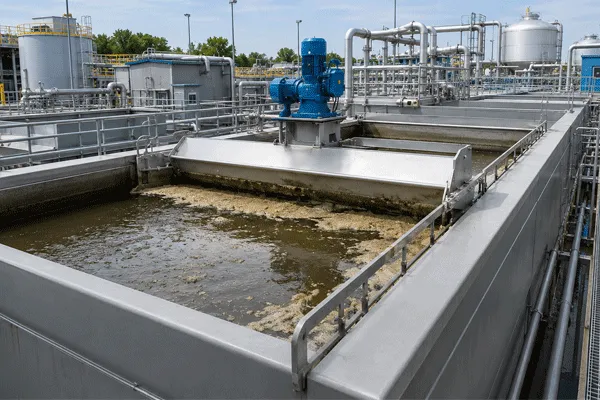
DAF is where most of the FOG and a meaningful share of suspended solids and BOD come out of the stream, typically with a chemical coagulant/flocculant dose ahead of the flotation cell. This is the step that decides whether the MBR downstream has a fighting chance.
A common mistake — and this is the edge case worth naming directly — is treating DAF as optional because “the biological stage will handle the fat anyway.” Biological treatment does not remove FOG efficiently; it coats biomass, reduces oxygen transfer in the aeration basin, and eventually migrates onto the membrane surface as an oily film that standard maintenance cleaning does not fully strip. Plants that cut DAF to save capital cost consistently see it show up later as membrane replacement cost, which is a worse trade.
| |
With DAF pretreatment |
Without DAF pretreatment |
| Fouling risk on MBR |
Lower — bulk of FOG already removed |
Higher — fat film accumulates on membrane surface |
| Aeration basin oxygen transfer |
Stable |
Degraded by surface fat layer |
| Membrane cleaning frequency |
Follows normal CIP schedule |
Requires more frequent, more aggressive chemical cleaning |
| Capital cost |
Higher upfront (DAF unit + chemicals) |
Lower upfront, higher lifecycle cost |
معالجة مياه الصرف الصحي من المسالخ: DAF + المعالجة البيولوجية + MBR
Step 4: Equalize Flow and Load
Kill-floor operations are batch-driven — heavy discharge during processing hours, near zero overnight. An equalization tank sized to your actual flow variability (from Step 1) buffers this so the biological stage and the MBR see a steadier load instead of hourly spikes that can hydraulically overload the membrane skid.
Step 5: Biological Treatment for BOD and Nitrogen Removal
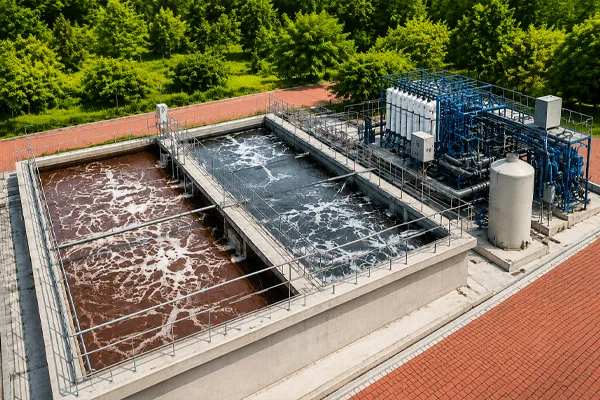
With FOG already reduced by DAF, the biological stage — typically an anoxic/aerobic configuration ahead of the MBR — can focus on what it does well: BOD reduction and nitrification/denitrification for the ammonia load characteristic of blood-heavy effluent. Sizing this stage against the diluted, post-DAF load rather than raw influent numbers is what keeps the aeration basin footprint reasonable.
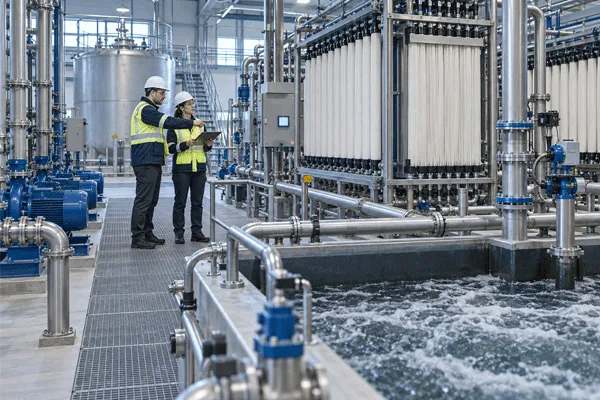
Step 6: MBR Filtration as the Final Barrier
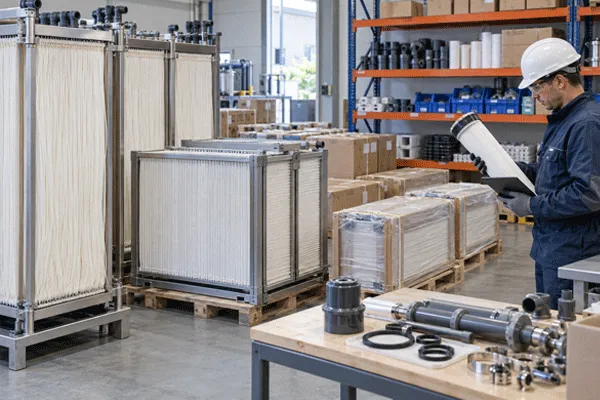
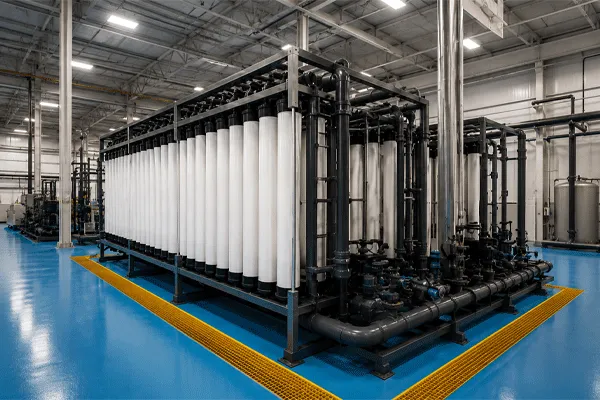
This is where غشاء separation replaces a secondary clarifier, holding back biomass and suspended solids to produce a clear, low-turbidity permeate. Banott’s hollow fiber membrane MBR line covers three effective membrane area sizes for compact wastewater configurations:
| الطراز |
المساحة الفعالة للغشاء |
الإعدادات |
| MBRIII3C |
3 أمتار مربعة |
Submerged, compact |
| MBRIII10C |
10 أمتار مربعة |
مغمور |
| MBI120C |
20 مترًا مربعًا |
مغمور |
Design flux, transmembrane pressure range, aeration scour rate, and CIP protocol are project-specific and depend on the post-DAF, post-biological load your plant actually delivers to the membrane — these figures are not published as generic numbers because a slaughterhouse influent that has passed effective pretreatment behaves differently from one that has not. That is a deliberate choice rather than a gap: a flux number quoted without knowing your actual post-pretreatment TSS and FOG is not a number you can plan a plant around. This sequencing reflects field practice documented by the Banott Water Treatment Engineering Team, which reports close to two decades of work in ultrafiltration membrane separation and industrial water treatment engineering.
Step 7: Handle Sludge and Evaluate Reuse
DAF float (skimmed fat and solids) and biological sludge are two separate waste streams with different disposal or rendering value — DAF float from meat processing sometimes has value to renderers, which changes the economics of the whole pretreatment stage. On the permeate side, MBR effluent quality is generally clean enough to evaluate for non-potable reuse (wash-down water, cooling) if your plant has a use for it, though this depends on your specific discharge and reuse permit conditions.
Where This Differs From Conventional Activated Sludge Without Membranes
Compared with a conventional activated sludge system relying on a secondary clarifier instead of membrane filtration, the MBR stage holds a smaller footprint for the same treatment capacity and produces a more consistent effluent quality regardless of settling performance in the final clarifier — which matters for slaughterhouse plants where FOG carryover can otherwise upset clarifier settling on a bad day. The trade-off is that the membrane stage is less forgiving of upstream pretreatment failures than a clarifier is, which is the whole reason Steps 2–4 above are not optional.
معالجة مياه الصرف الصحي من المسالخ: DAF + المعالجة البيولوجية + MBR
What Determines Cost Here
Public pricing for this scale of system is not published — a slaughterhouse MBR train is engineered against your specific influent and discharge target, and pricing reflects that, not a catalog number. The only publicly stated price references in this space are for small integrated RO units (300–3,000 GPD, for makeup or process water, not wastewater) and standard 4040/8040 RO membrane element formats — neither applies directly to a slaughterhouse-scale MBR wastewater train. Expect a quote request as the next step after your influent data is available, not a listed price.
الأسئلة الشائعة
Q: Can I skip DAF if my slaughterhouse is small and low-volume?
A: Low volume reduces the size of the DAF unit needed, not the need for it. FOG concentration in slaughterhouse wastewater is a function of process, not throughput — a small plant’s effluent can still carry a high enough fat load to foul an MBR without DAF ahead of it.
Q: Does MBR eliminate the need for a rendering or grease trap contract?
A: No. DAF float still needs to go somewhere — either to a renderer, a licensed grease hauler, or a disposal contract. MBR handles the liquid stream after DAF and biological treatment; it does not process the fat itself.
Q: How does nitrogen removal change if we combine kill-floor and processing-area wastewater?
A: Combining streams usually raises the nitrogen and BOD load per unit volume compared to processing-area wastewater alone, which changes the biological stage sizing. This is exactly why Step 1’s characterization needs to reflect your actual combined-stream influent, not a generic slaughterhouse average.
Q: Is a poultry farm biological + MBR reference the same as a slaughterhouse project?
A: No. Farm wastewater (manure, wash-down from livestock housing) and abattoir/kill-floor effluent have different FOG and blood content profiles even when both use biological treatment plus MBR, so a farm reference does not substitute for slaughterhouse-specific process validation.












 11:07
11:07