Banott Water Treatment Engineering Team | Water Treatment Engineering | Published September 15, 2026
A 4040 element has a nominal 4-inch housing diameter and a 40-inch length; an 8040 element carries the same 40-inch length in an 8-inch housing. The size code tells a buyer nothing about rejection rate or permeate flow on its own — those numbers only mean something once you know the feed concentration, pressure, and recovery rate a supplier tested against.
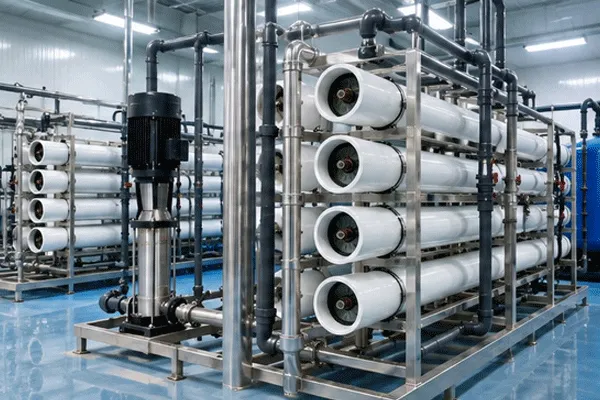
4040 vs 8040 RO Membrane: Specs and Test Conditions
What “4040” and “8040” Actually Describe
The numbers are a housing convention, not a performance rating. Read left to right, the first two digits give the nominal diameter in inches and the last two give the nominal length in inches:
- 4040: approximately 4″ (101–102 mm) diameter × 40″ (1,016 mm) length
- 8040: approximately 8″ (200–203 mm) diameter × 40″ (1,016 mm) length
Because the length is fixed at 40 inches in both cases, an 8040 element isn’t simply “twice the size” of a 4040 — the cross-sectional area of an 8-inch housing is roughly four times that of a 4-inch housing, which is why 8040 elements carry substantially more wound membrane area and produce correspondingly more permeate per element, not just double.
This nomenclature is shared across the reverse osmosis industry rather than owned by any single manufacturer, which is exactly why two elements with the same size code can still perform differently. The housing standard is interchangeable; the غشاء inside it is not.
Why Two Datasheets on the Same Nominal Size Can Disagree
This is the part that trips up buyers comparing quotes from different suppliers. A rejection percentage or a permeate flow number only holds meaning relative to the feed conditions used to generate it. Change any one of these variables and the same membrane will report a different number on paper, even though nothing about the physical element has changed:
- Feed concentration.Most brackish water elements are benchmarked against a standard sodium chloride solution, commonly cited around 2,000 mg/L. A membrane tested at a lower concentration will show a higher apparent rejection rate.
- Applied pressure.Test pressure is typically fixed near 225 psi (about 1.55 MPa) for standard brackish water elements, but low-energy variants are sometimes tested closer to 150 psi. Comparing a low-energy element’s flow figure to a standard element’s figure without noting the pressure gap overstates the difference between them.
- Feed temperature.Nearly all published test conditions normalize to 25°C (77°F). Permeate flow rises with temperature, so a real-world figure taken at a warmer influent will read higher than the datasheet number regardless of which element is installed.
- Recovery rate.Standard test conditions are usually run at 15% recovery. A system operator running a higher recovery rate in the field will see a different permeate-to-reject ratio than the datasheet implies, and comparing two elements tested at different recovery rates is not a fair comparison.
- Average vs. minimum rejection.Datasheets frequently list two different rejection figures: an average taken after a short stabilization period, and a guaranteed minimum the manufacturer will stand behind. Comparing one supplier’s average number against a competitor’s minimum number makes the second membrane look worse than it is.
None of these variables are hidden — they’re usually printed in small type below the performance table. The mistake is treating the headline flow or rejection number as portable across datasheets without checking whether the small print underneath actually matches.
Common Buying Mistake: Matching GPD Without Matching Recovery
A distributor comparing two 8040 quotes side by side will often pick the one with the higher permeate flow rate (GPD) figure and assume it’s the more productive element. If the higher number was tested at a different recovery rate or a lower feed concentration than the competing quote, the comparison isn’t valid until both figures are normalized to the same test basis. Ask for the full test-condition line, not just the flow number, before using it to rank suppliers.
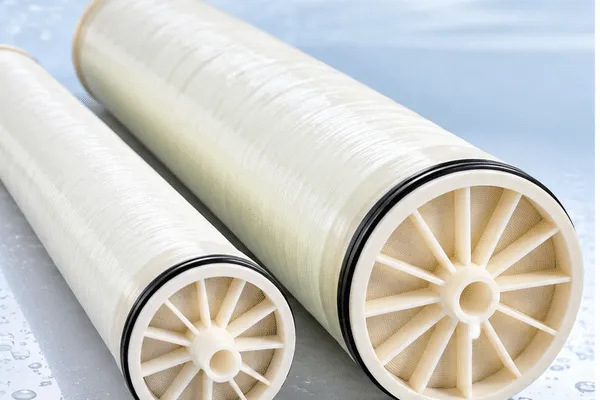
4040 vs 8040 RO Membrane: Specs and Test Conditions
Test-Basis Checklist Before Comparing Any Two Quotes
| What to check |
Why it changes the number |
Typical range seen across published RO element datasheets |
| Feed NaCl concentration |
Lower feed concentration inflates apparent rejection |
~2,000 mg/L for standard brackish water elements |
| Applied feed pressure |
Lower test pressure lowers reported flow |
~150–225 psi depending on element class |
| Feed temperature |
Higher temperature raises flow |
Normalized to 25°C (77°F) |
| Recovery rate |
Higher recovery shifts permeate-to-reject ratio |
~15% for standard test conditions |
| Rejection basis |
Average and minimum rejection are not the same figure |
Average typically 0.1–0.5 percentage points above minimum |
4040 vs 8040: Physical and Application Comparison
| المعلمة |
4040 |
8040 |
| Nominal diameter |
~4 in (101–102 mm) |
~8 in (200–203 mm) |
| Nominal length |
40 in (1,016 mm) |
40 in (1,016 mm) |
| Relative membrane area per element |
Baseline |
Roughly 4–4.5× a 4040 element |
| Typical pressure vessel loading |
1–6 elements per vessel, common in compact skids |
6–7 elements per vessel, common in industrial trains |
| Where it’s typically specified |
Small commercial RO, pilot units, tight-footprint retrofits |
Municipal and industrial plants, containerized systems, larger process water trains |
| Replacement logistics |
Lighter, easier to hand-carry and swap without lifting equipment |
Heavier per element; vessel access and lifting need to be planned into the layout |
Exact membrane area and permeate flow per element still depend on the specific membrane type inside the housing (standard brackish water, low-energy, or seawater), which is why the ranges above are described as typical rather than fixed.

4040 vs 8040 RO Membrane: Specs and Test Conditions
Where Banott’s RO Membrane Series Fits
Banott’s RO Membrane Series is offered in the standard 4040 and 8040 formats described above, targeted at industrial and commercial applications requiring stable permeate quality. Element-level performance figures for the current lineup, including salt rejection percentage, permeate flow rate, active membrane area, and the specific test conditions used to generate them, are not published on the current product pages and are available on enquiry through the sales and engineering contact channel. The same applies to pricing: Banott’s small RO machine line publishes a capacity range on its product page, but neither the small RO units nor the 4040/8040 industrial elements carry a listed selling price, so a project-specific quote is required.
If your project needs a datasheet that can be attached to a tender submission or an internal spec sheet, request the test-condition line along with the performance numbers, not just the flow and rejection figures on their own, for the reasons covered above.
Choosing Between 4040 and 8040 for a Given Project
- Start from your required daily production volume, not the element size. A small commercial application (a few thousand GPD) rarely justifies the vessel footprint an 8040 train needs; a municipal or industrial train sized in the hundreds of m³/day range will need more 8040 elements per vessel than an equivalent 4040 configuration would allow in a practical footprint.
- Check available floor space and ceiling height, since 8040 vessels are longer, heavier when loaded, and require more room around the rack for element replacement.
- Confirm whether the application calls for a standard brackish water, low-energy, or seawater-class membranebefore comparing 4040-to-4040 or 8040-to-8040 quotes; mixing membrane classes in a comparison defeats the purpose of matching the housing size in the first place.
- Request the full test-condition line from every supplier being compared, not only the headline rejection and flow numbers, using the checklist above.
- Ask about replacement element lead time and stock availabilityfor the specific format before finalizing a design, since a plant built around 8040 vessels but supplied by a vendor who only stocks 4040 elements creates an ongoing sourcing problem.
How This Compares to Buying Loose Elements from a Generic Trading Supplier
A trading company selling loose 4040 or 8040 elements sourced from multiple factories can usually match a headline price. What that comparison typically leaves out is consistency of the test basis across repeat orders and whether the same engineering team that sold the element can help size the surrounding train, aeration, or pretreatment stage if the influent shifts partway through a project. Sourcing the RO stage from the same manufacturer supplying the rest of a treatment train, where that’s practical for the project, removes one interface a buyer would otherwise have to reconcile independently.
Trade-Offs Worth Weighing
Standardized housing sizes make elements from different manufacturers physically interchangeable in the same pressure vessel, which is genuinely useful for buyers who want a backup supply option. The trade-off is that physical interchangeability says nothing about performance interchangeability: swapping in a different manufacturer’s 8040 element mid-project without re-checking its test-condition line can quietly change your system’s expected permeate flow or salt passage, even though it fits the same vessel without modification.
الأسئلة الشائعة
Q: Is an 8040 element simply twice the capacity of a 4040?
A: No. Because the cross-sectional area of an 8-inch housing is roughly four times that of a 4-inch housing at the same 40-inch length, an 8040 element typically carries closer to four to four-and-a-half times the membrane area and permeate output of a 4040 element, not double.
Q: Why do two suppliers quote different rejection percentages for what looks like the same element size?
A: The size code only describes the housing. Rejection and flow figures depend on the feed concentration, pressure, temperature, and recovery rate used during testing, plus whether the figure quoted is an average or a guaranteed minimum. Different test conditions produce different numbers even for comparable membrane chemistry.
Q: Does Banott publish per-element rejection and flow figures for its 4040/8040 RO membranes?
A: Not on the current product pages. These figures, along with pricing, are available on request through Banott’s sales and engineering contact channel.
Q: Can I mix 4040 and 8040 vessels in the same treatment train?
A: Yes, this is common where a plant has a small polishing or side stream alongside a larger main train, but each vessel size needs its own sizing calculation rather than scaling one configuration directly onto the other.
Q: What’s the minimum information I should request before comparing two RO membrane quotes?
A: The element format (4040 or 8040), membrane class (standard brackish, low-energy, or seawater), and the full test-condition line behind the quoted rejection and flow numbers, not just the headline figures.












 10:16
10:16