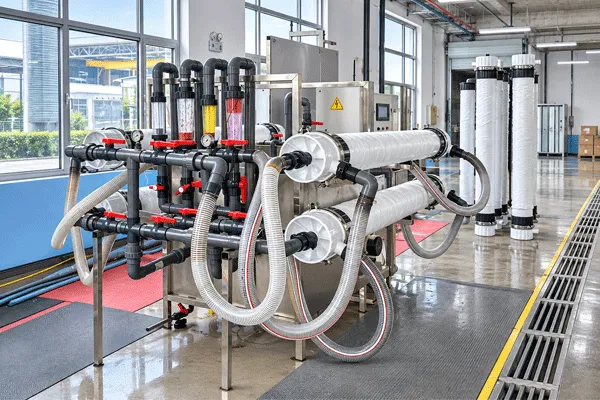
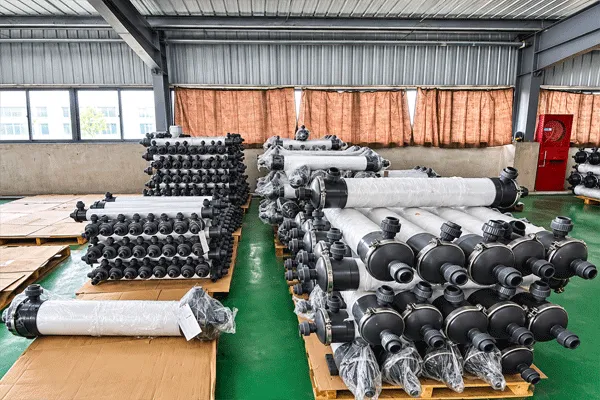
In membrane filtration equipment, some of the most important manufacturing details are found where the hollow fibers connect to the membrane header. These connections form part of the membrane curtain assembly and must be considered carefully during manufacturing, installation, and maintenance.
At Qingdao Banott Environmental Technology Co., Ltd., we focus on membrane product manufacturing and engineering support for industrial and municipal water treatment applications.
In this factory photo update, we take a closer look at the physical details of our hollow fiber membrane curtain assemblies, including fiber arrangement, header connections, bonding regions, and the supporting pipe structure.
The photographs provide a close-up view of the membrane components that are not always visible when viewing a complete MBR membrane module.
Hollow Fiber Membrane Curtain Details: A Closer Look at Fiber-to-Header Connections
Hollow Fiber Membrane Curtain Structure and Connection Details
A hollow fiber membrane curtain consists of numerous flexible membrane fibers connected to collection headers. The fibers provide the filtration surface, while the headers support the fiber bundles and form part of the permeate collection arrangement.
In a typical submerged membrane bioreactor (MBR), treated water passes through the membrane walls under an appropriate pressure difference. The permeate is then collected through the membrane’s internal flow path.
This makes the fiber-to-header connection an important part of the overall membrane assembly.
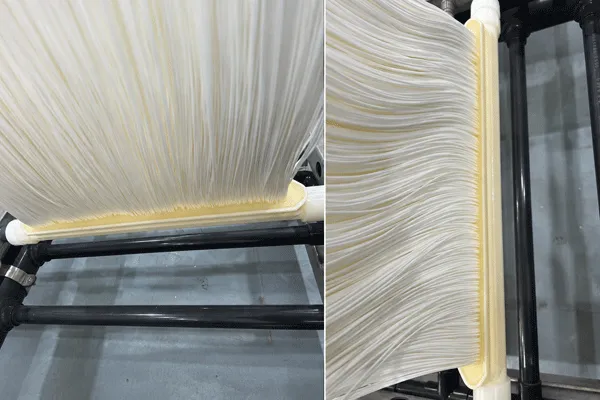
The first photograph shows white hollow fiber membranes arranged closely together along a light-colored header. A pale yellow bonding region is visible where the fibers enter the header structure.
The connection area deserves particular attention because the membrane fibers must remain properly positioned while maintaining the intended separation between the filtration and collection sides.
Important design considerations include:
- Fiber positioning and distribution.
- Header dimensions and connection geometry.
- Compatibility between fibers and bonding materials.
- Mechanical support at the fiber connection area.
- Sealing integrity of the completed assembly.
- Compatibility with the intended operating conditions.
These considerations help guide membrane curtain design and manufacturing. Actual structural integrity and sealing performance must be verified through appropriate inspection and testing.
A Closer Look at the Fiber-to-Header Bonding Area
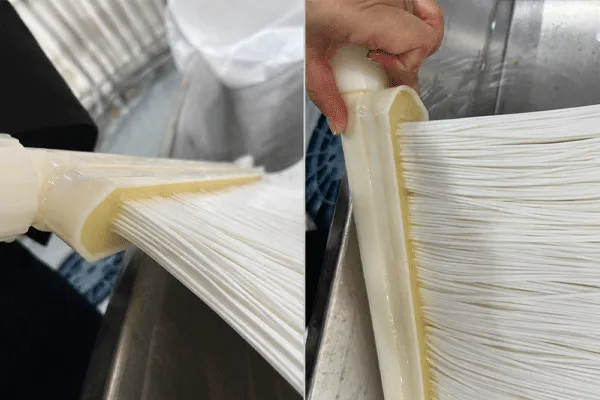
The second and third photographs offer a detailed view of the region where the membrane fibers meet the collection header.
The images show closely arranged white membrane fibers entering a light-colored header. A smooth bonding material is visible around the connection.
In hollow fiber membrane manufacturing, this type of connection is commonly described as a fiber potting or encapsulation region.
Potting is used to secure membrane fibers within a header and help establish the required separation between liquid flow paths. The exact material, processing method, and sealing arrangement depend on the membrane design.
The photographs show the external appearance of this connection, but they do not establish the specific bonding material or manufacturing formula used.
Why Is the Fiber-to-Header Connection Important?
The connection has several important functions.
Mechanical support: The header holds the fiber bundle in the intended position and provides structural support at the connection.
Separation integrity: The completed connection must prevent unwanted bypass between the membrane feed side and the permeate collection path.
Assembly compatibility: The header must connect correctly with the surrounding membrane frame and permeate piping.
Operational reliability: The connection must remain suitable for the hydraulic and mechanical conditions specified for the membrane module.
For submerged MBR applications, the design must also account for membrane movement, aeration conditions, operating pressure, and cleaning requirements.
These factors make the header connection an important detail when evaluating hollow fiber membrane products for long-term wastewater treatment applications.
Membrane Fiber Arrangement and Structural Consistency
The fourth and fifth photographs provide another perspective on the membrane curtain structure.
The white hollow fiber bundles are arranged alongside the header, with their flexible structure clearly visible.
In membrane curtain manufacturing, fiber positioning should be controlled according to the approved product design.
A suitable arrangement helps ensure that the fibers can be accommodated within the intended membrane dimensions and supporting structure.
For engineering buyers, the main considerations include:
| Structural Detail |
Engineering Consideration |
| Hollow fiber arrangement |
Consistency with the intended membrane design |
| Fiber-to-header connection |
Mechanical support and separation integrity |
| Bonding region |
Material compatibility and appropriate sealing |
| Header dimensions |
Connection with membrane frames and piping |
| Fiber bundle length |
Compatibility with installation dimensions |
| Supporting pipe arrangement |
Suitable positioning and mechanical support |
| Maintenance access |
Practical inspection and membrane replacement |
For membrane replacement projects, even small dimensional differences can affect how a new membrane curtain fits an existing frame.
This is why buyers should confirm the membrane element dimensions, connection arrangement, effective filtration area, and installation requirements before ordering replacement products.
The visual appearance of a membrane curtain is useful for understanding its construction, but it cannot replace the technical specifications and inspection requirements needed for project approval.
Hollow Fiber Membrane Curtain Details: A Closer Look at Fiber-to-Header Connections
Connecting Membrane Curtains to Complete MBR Systems
A membrane curtain forms one part of a larger membrane filtration assembly.
In a complete submerged MBR installation, membrane elements are integrated with support frames, permeate collection piping, aeration equipment, pumps, and control systems.
The final configuration depends on the wastewater characteristics, required treatment capacity, installation space, and operating conditions.
Banott provides PVDF Hollow Fiber MBR Membrane Modules for municipal and industrial wastewater treatment projects.
Our membrane portfolio includes different module sizes and configurations, allowing customers to select products according to their engineering requirements.
For an existing treatment facility, the replacement membrane must be compatible with the original frame and associated equipment.
For a new project, the engineering team should evaluate the membrane configuration together with the overall treatment process.
Banott’s Engineering & System Integration capabilities support equipment configuration, system layout, piping coordination, and integration with broader water treatment solutions.
What Should EPC Contractors Check When Purchasing Hollow Fiber Membrane Curtains?
For EPC contractors and water treatment engineering companies, the quality of a membrane curtain cannot be assessed only by its appearance.
A close examination of the membrane fiber and header connection provides useful structural information, but a complete product evaluation also requires technical documentation and relevant inspection records.
Before purchasing hollow fiber membrane curtains, buyers should confirm:
- Membrane material and product model.
- Effective membrane filtration area.
- Membrane fiber dimensions and configuration.
- Header dimensions and connection types.
- Design flux and operating pressure range.
- Recommended aeration conditions.
- Cleaning requirements.
- Compatible supporting frame dimensions.
- Applicable integrity inspection requirements.
- Packaging and storage instructions.
For replacement projects, buyers should also provide drawings or photographs of the existing membrane assembly.
This information can help the manufacturer determine whether a standard membrane module is suitable or whether a different configuration requires engineering review.
Banott: Membrane Manufacturing and Engineering Support
Banott is a manufacturer and engineering-oriented supplier of membrane filtration equipment and integrated water treatment systems.
Our main product range includes:
- Hollow Fiber MBR Membrane Modules.
- Flat Sheet MBR Membranes.
- Hollow Fiber UF Membranes.
- RO Membranes.
- EDI Modules.
- Integrated Wastewater Treatment Systems.
- Pure Water and Ultrapure Water Treatment Systems.
We serve EPC contractors, municipal wastewater facilities, environmental engineering companies, industrial plant owners, system integrators, and international equipment distributors.
These close-up photographs provide a practical view of the fiber arrangement and header connection details associated with membrane curtain construction.
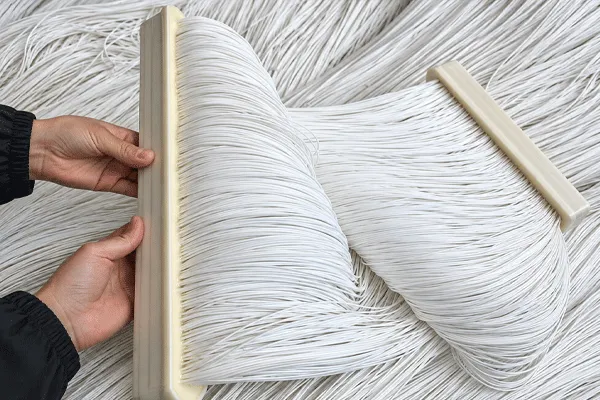
Hollow Fiber Membrane Curtain Details: A Closer Look at Fiber-to-Header Connections
They also illustrate why component-level engineering is important when selecting membrane filtration equipment for a complete treatment system.
Looking for hollow fiber membrane curtains or replacement MBR membrane modules?
Contact Banott with your membrane specifications, installation dimensions, treatment capacity, and project requirements.
Our team can help you evaluate suitable membrane products and discuss integration requirements for your water or wastewater treatment project.
Contact Banott for Membrane Equipment and Technical Support











 09:11