Fresh water can be scarce while the ocean sits nearby. Yet pumping untreated seawater directly into a standard RO system can cause high energy use, scaling, fouling, and poor product water. A properly designed seawater desalination membrane system solves these problems step by step.
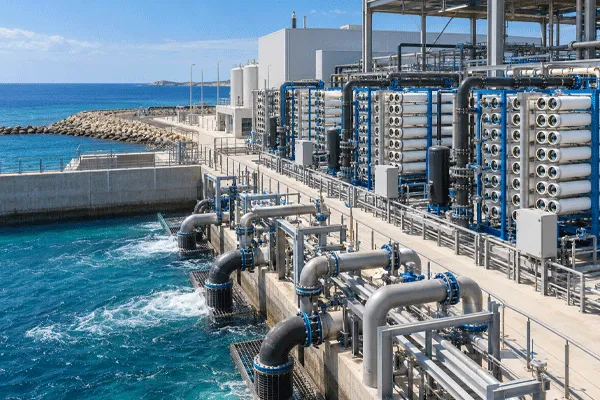
A seawater desalination membrane is a high-rejection reverse osmosis membrane designed to separate dissolved salt from seawater under high pressure. In a seawater RO system, pretreatment protects the membrane, pressure drives water through the active membrane layer, rejected salts leave as concentrate, and permeate is treated further to produce fresh water for municipal or industrial use.
Seawater Desalination Membrane Guide: How Reverse Osmosis Membranes Turn Seawater into Fresh Water
Article Outline
- What is a seawater desalination membrane?
- How does reverse osmosis desalinate seawater?
- How is a seawater RO membrane different from a brackish water membrane?
- What does a complete seawater desalination process include?
- Why is pretreatment critical for membrane performance?
- How should salt rejection, water flux, and operating pressure be evaluated?
- How does energy recovery reduce desalination energy consumption?
- What causes membrane fouling and scaling?
- How should engineers select a membrane system?
- How are small and large-scale seawater desalination projects different?
- When should a seawater RO membrane be cleaned or replaced?
- Frequently asked questions
What Is a Seawater Desalination Membrane?
A seawater desalination membrane is a type of reverse osmosis membrane engineered for feed water with a much higher salt concentration than ordinary tap water or most brackish water sources.
Ocean water contains roughly 35,000 ppm of dissolved salts on average, although the exact composition of seawater changes by location. The U.S. Geological Survey classifies water between 10,000 and 35,000 ppm dissolved salts as highly saline and notes that ocean water is around the upper end of that range.
Because of this high salinity, seawater requires much higher pressure than ordinary low-salinity RO applications.
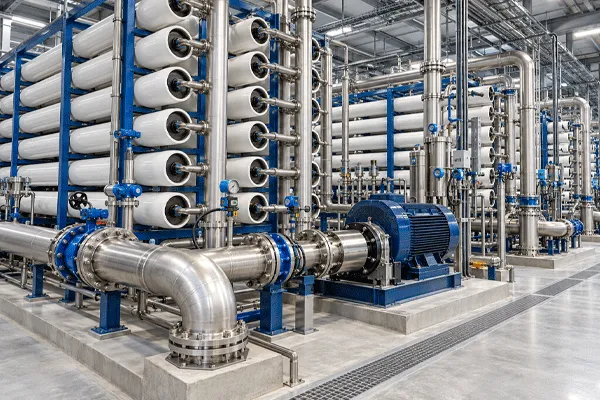
A typical membrane element contains a large spiral-wound membrane area packed inside a pressure vessel. The active layer is usually a thin-film composite polyamide structure designed to allow water transport while strongly limiting the passage of dissolved ions.
In simple terms:
Seawater
   ↓
High Pressure
   ↓ RO Membrane
 ↙          ↘
Fresh        Concentrated
Permeate     Brine
The permeate becomes desalinated water, while the rejected salt leaves the membrane system in a concentrated brine stream.
How Does Reverse Osmosis Desalinate Seawater?
Natural osmosis moves water through a semi-permeable barrier toward the side with the higher dissolved-solute concentration.
Reverse osmosis does the opposite.
A high-pressure pump applies enough pressure to the seawater side to overcome osmotic pressure. Water then moves across the semipermeable membrane, while most dissolved salts remain in the feed and concentrate streams.
USGS describes reverse osmosis as forcing saline water through a semi-permeable membrane so that water is separated from dissolved salt.
The process can be summarized as:
Feed Water → Pressure → Membrane Separation → Product Water + Concentrate
Does RO Work Because Salt Is Bigger Than the Membrane Pores?
That explanation is common, but it is too simple.
People often talk about membrane pores, yet modern thin-film composite RO membranes do not behave like an ordinary screen or cartridge filter with clearly defined holes.
A more accurate engineering explanation is that water and dissolved species interact differently with the dense active membrane layer. Water molecules transport through that layer much more readily than most dissolved ions.
This is why reverse osmosis membrane technology can achieve very high salt rejection even though RO should not be understood simply as mechanical particle sieving.
How Is a Seawater Reverse Osmosis Membrane Different from a Brackish Water RO Membrane?
A seawater reverse osmosis element and a brackish-water element may look similar from the outside.
Both may use standard 4040 or 8040 physical formats.
But size does not tell you the required pressure, salt rejection, membrane chemistry, or application.
That distinction matters.
Banott’s current RO product information notes that 4040 and 8040 describe standard physical formats, while actual flow and rejection performance must be evaluated using the membrane type and its test conditions.
Main Differences
| Factor |
Brackish Water RO |
Seawater RO |
| Feed salinity |
Lower |
Much higher |
| Osmotic pressure |
Lower |
Higher |
| Required pressure |
Lower |
Higher |
| Membrane selection |
BWRO-specific |
SWRO-specific |
| Main application |
Well/process water |
Seawater desalination |
| Energy demand |
Lower |
Higher |
| Pretreatment importance |
High |
Very high |
For comparison, DuPont publishes brackish-water membrane test data at around 2,000 ppm NaCl and 15.5 bar, while several small commercial SWRO elements are tested at approximately 32,000 ppm NaCl and 55 bar. These are standardized test conditions, not universal plant operating values.
This illustrates why a standard brackish-water RO membrane should not automatically be used for a high-salt seawater project.
What Does a Complete Seawater Desalination Process Include?
The desalination process is much more than the membrane itself.
A reliable system normally includes:
Seawater Intake
      ↓
Screening
      ↓
Pretreatment
      ↓
Cartridge Filtration
      ↓
High-Pressure Pump
      ↓
SWRO Membrane System
      ↓
Energy Recovery
      ↓
Permeate
      ↓
Post-Treatment
      ↓
Fresh Water
The U.S. Department of Energy identifies intake, pretreatment, reverse osmosis, energy recovery, and post-treatment as major unit operations in modern seawater desalination systems. Pretreatment technologies may include strainers, media filters, microfiltration, ultrafiltration, coagulation, and cartridge filtration.
Post-Treatment Also Matters
RO permeate is low in dissolved mineral content.
Depending on the final application, product water may require:
- Remineralization
- pH adjustment
- Disinfection
- Boron control
- Storage
- Final polishing
If the target is municipal drinking water, stabilization and disinfection are especially important.
If the target is industrial process water, further RO, EDI, or polishing may be required.
So the final water quality target should determine the entire treatment train.
Why Is Pretreatment Critical for Membrane Performance?
Seawater contains much more than salt.
It may also contain:
- Suspended solids
- Algae
- Microorganisms
- Colloids
- Organic matter
- Fine sand
- Calcium and magnesium salts
- Silica
- Other foulants
If these materials reach the membrane surface without proper control, the plant can suffer from higher pressure drop, reduced flux, increased salt passage, and more frequent cleaning.
This is called membrane fouling.
Seawater Desalination Membrane Guide: How Reverse Osmosis Membranes Turn Seawater into Fresh Water
Common Pretreatment Options
Depending on seawater quality, pretreatment may include:
- Coarse screening
- Coagulation
- Dissolved air flotation
- Multimedia filtration
- Ultrafiltration
- Cartridge filtration
- Scale-control dosing
- pH adjustment
For challenging coastal water, hollow fiber UF can provide a strong physical barrier before the reverse osmosis unit.
This can improve feed stability and help protect the downstream membrane system.
From our engineering perspective, pretreatment design should be based on local source conditions rather than copied from another desalination project.
A calm beach-well intake can behave very differently from an open-ocean intake exposed to algae, storms, seasonal turbidity, and biological loading.
How Should Salt Rejection, Water Flux, and Operating Pressure Be Evaluated?
Three of the most important parameters in an RO design are:
- Salt rejection
- Water flux
- Operating pressure
But none should be considered alone.
Salt Rejection
Salt rejection describes how effectively the membrane limits salt passage.
Commercial SWRO membranes can achieve very high rejection under specified laboratory conditions. For example, DuPont’s published small SWRO element data show stabilized salt rejection values of approximately 99.4% to 99.7% under defined feed concentration, temperature, pressure, and recovery conditions.
That does not mean every membrane in every seawater desalination plant will always produce exactly that result.
Actual product water quality changes with:
- Feed salinity
- Temperature
- Pressure
- Recovery
- Membrane age
- Fouling
- Element position
- Boron concentration
- pH
Water Flux
Water flux describes the amount of permeate produced per unit of membrane area.
Higher flux can reduce the total membrane area needed.
But pushing flux too high may increase fouling potential and reduce long-term stability.
The objective is not simply maximum production per membrane element.
It is stable production over the intended operating life.
Operating Pressure
Seawater has much higher osmotic pressure than most brackish water.
SWRO therefore needs a high-pressure pump.
DuPont’s published seawater test conditions commonly use about 55 bar for standard 32,000 ppm NaCl testing, while some seawater elements are designed for maximum feed pressures as high as 83 bar. Actual design pressure depends on salinity, temperature, recovery, element selection, and target permeate quality.
How Does Energy Recovery Reduce Seawater RO Energy Consumption?
Pressure creates one of the largest energy demands in reverse osmosis desalination.
But the concentrate leaving the membrane array still contains significant hydraulic pressure.
Throwing away that pressure wastes energy.
An energy recovery device captures part of that pressure and transfers it back into the incoming seawater stream.
The U.S. Department of Energy describes energy recovery as recycling energy from high-pressure brine to help boost seawater pressure before RO.
A simplified arrangement looks like:
High-Pressure Pump
       ↓
SWRO Membranes
   ↙           ↘
Permeate      High-Pressure Brine
                    ↓
              Energy Recovery
                    ↓
             Incoming Seawater
Modern pressure-exchanger technology can transfer pressure very efficiently, which is why energy recovery has become a central part of many larger reverse osmosis desalination plant designs.
For EPC projects, the decision to include an energy recovery device depends on:
- Plant capacity
- Recovery
- Electricity cost
- Operating hours
- Required footprint
- High-pressure pump arrangement
For small seawater desalination equipment, the economics and equipment layout may lead to a different design than a municipal plant.
What Causes Membrane Fouling and Scaling?
Even a high-quality reverse osmosis membrane will perform poorly if operating conditions are wrong.
There are several main fouling mechanisms.
Particulate Fouling
Fine solids accumulate on the membrane surface.
Better intake design, clarification, UF, and cartridge filtration can reduce this risk.
Biological Fouling
Microorganisms attach to wetted surfaces and form biofilms.
This can increase differential pressure and reduce membrane performance.
Organic Fouling
Natural organic compounds can accumulate on the membrane and change flux.
Scaling
As water passes through the membrane, dissolved salts become more concentrated in the brine.
If sparingly soluble salts exceed their solubility limits, mineral scale can form.
Why Recovery Matters
Higher water recovery produces more fresh water from a given feed volume.
That sounds attractive.
However, increasing recovery also concentrates salts more strongly in the reject stream and can increase scaling risk.
The best recovery is therefore not always the highest possible number.
It is the recovery that balances:
- Freshwater production
- Scaling risk
- Energy use
- Brine management
- Membrane stability
How Should Engineers Select Membranes for Seawater Desalination?
Membrane selection should begin with project data, not a catalog model number.
Before choosing membranes for seawater desalination, an EPC contractor should confirm:
Feed Conditions
- Salinity / TDS
- Temperature
- pH
- Boron
- Turbidity
- SDI where applicable
- Organic loading
- Biological risk
Product Water Requirements
- Required TDS
- Chloride
- Boron
- Conductivity
- Drinking-water or industrial specification
Hydraulic Requirements
- Daily production
- Peak production
- Recovery
- Feed pressure
- Vessel configuration
Site Conditions
- Intake method
- Electrical supply
- Space
- Chemical availability
- Operator capability
- Brine-disposal method
The membrane then becomes one part of the overall desalination system.
High Rejection vs. Lower Energy
Some projects prioritize maximum permeate quality.
Others prioritize lower energy consumption.
A lower-energy seawater membrane may operate at reduced pressure, but engineers still need to verify whether its permeate quality meets the project requirement.
Similarly, a high-rejection membrane may be valuable when stricter product-water specifications are required.
The correct decision depends on total plant performance—not one datasheet value.
Seawater Desalination Membrane Guide: How Reverse Osmosis Membranes Turn Seawater into Fresh Water
How Are Small and Large-Scale Seawater Desalination Systems Different?
The same basic membrane desalination principle can serve very different capacities.
Small Seawater RO Systems
Small systems may be used for:
- Islands
- Resorts
- Offshore facilities
- Ships and yachts
- Farms near coastal areas
- Remote construction sites
- Emergency supply
Compact 4-inch membrane elements can be practical where flow is moderate and equipment space is limited.
DuPont, for example, lists 4-inch SWRO elements for marine and smaller desalination systems.
Large-Scale Seawater Desalination
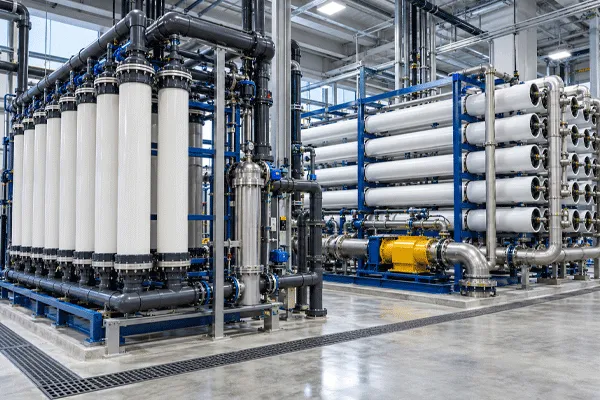
A large-scale seawater desalination facility may contain hundreds or thousands of 8-inch membrane elements installed in parallel pressure vessels.
The engineering challenge expands to include:
- Intake infrastructure
- Large pretreatment trains
- High-pressure pumping
- Energy recovery
- Membrane staging
- CIP systems
- Brine discharge
- Automated monitoring
- Redundancy
- Post-treatment
For these projects, membrane price is only one part of the lifecycle cost.
Energy, cleaning, replacement frequency, pump efficiency, and downtime often matter more.
When Should a Seawater RO Membrane Be Cleaned or Replaced?
Membranes slowly change during operation.
The important question is whether the change comes from reversible fouling, scaling, membrane damage, or normal aging.
Operators should monitor normalized:
- Permeate flow
- Salt passage
- Differential pressure
- Feed pressure
- Product conductivity
A rising pressure drop can point to fouling.
Increasing salt passage can indicate membrane damage, aging, poor sealing, or other operating problems.
DuPont notes that extreme operating conditions can reduce permeate flow, increase salt passage, and damage element components.
Cleaning Before Replacement
Chemical cleaning may restore performance when deposits are reversible.
The cleaning chemistry depends on the foulant.
Operators should not repeatedly clean membranes without identifying the cause. Frequent cleaning may signal poor pretreatment or an unsuitable operating window.
Membrane Replacement
Membrane replacement becomes necessary when acceptable flow and rejection cannot be restored economically.
Replacement planning should consider:
- Normalized performance history
- Product-water specification
- Cleaning response
- Physical condition
- Energy cost
- Plant downtime
A seawater RO membrane should be replaced based on performance, not simply because a calendar date has arrived.
What Role Does Membrane Technology Play in Water Scarcity?
Many coastal regions have abundant seawater but limited conventional fresh water.
Desalination creates another potential water supply by separating dissolved salt from seawater.
USGS notes that desalination is increasingly used where freshwater is limited and can provide water not only for municipal use but also for agriculture, boilers, pharmaceuticals, semiconductor production, and other industrial applications.
This does not mean seawater desalination has no environmental or economic challenges.
Projects must consider:
- Energy use
- Intake effects
- Brine discharge
- Chemical consumption
- Capital cost
- Membrane life
However, continuous improvement in membrane technology, pumps, automation, fouling control, and energy recovery is making SWRO more efficient.
For many coastal projects, it can become an important part of a diversified water strategy.
How Does Banott Approach RO Membrane and Desalination Projects?
For a seawater or high-salinity project, supplying an RO membrane alone is not enough.
The overall design needs to consider raw-water analysis, pretreatment, required production, membrane configuration, pressure vessels, high-pressure pumps, chemical dosing, CIP cleaning, instrumentation, and automatic controls.
Banott currently supplies industrial RO membrane products in standard 4040 and 8040 formats and provides engineering support for membrane configuration and complete RO system integration. Exact performance values should be confirmed against the specific membrane datasheet and its defined test conditions before a seawater project is specified.
As an engineering-oriented provider of UF membranes, RO membranes, EDI modules, pure-water plants, and integrated water-treatment systems, our approach is to evaluate the entire project.
That can include:
- Seawater pretreatment
- Hollow fiber UF
- Cartridge filtration
- SWRO configuration
- High-pressure pumps
- Energy recovery
- CIP
- PLC / SCADA controls
- Skid-mounted construction
- Containerized system design
- Commissioning documentation
For EPC contractors and system integrators, this reduces interface risk between individual equipment packages.
Frequently Asked Questions About Seawater Desalination Membranes
What membrane is used for seawater desalination?
Most modern membrane-based seawater plants use specialized seawater reverse osmosis membranes, commonly based on thin-film composite polyamide technology. They are designed for high salt loading and high-pressure operation.
Can a brackish water RO membrane be used for seawater?
It should not be assumed that it can.
Seawater has much higher salinity and osmotic pressure than brackish water. Membrane selection must be based on feed salinity, design pressure, rejection requirements, and manufacturer specifications.
What salt rejection can a seawater RO membrane achieve?
Commercial SWRO elements can exceed 99% salt rejection under defined test conditions. Some published commercial element data show stabilized rejection around 99.4–99.7%. Actual plant performance depends on feed conditions, recovery, temperature, pressure, fouling, and membrane age.
Why does seawater RO need high pressure?
Seawater has high osmotic pressure because of its high dissolved salt concentration. The applied pressure must exceed this osmotic force and provide enough driving pressure to move water through the membrane.
What is the purpose of energy recovery in SWRO?
The brine leaving the membrane still carries high hydraulic pressure. Energy-recovery equipment captures much of that pressure and transfers it to incoming seawater, reducing the amount of new pumping energy required.
How long does a seawater RO membrane last?
There is no fixed life for every application. Membrane life depends on pretreatment, seawater quality, operating pressure, fouling, scaling, cleaning practices, recovery, and product-water requirements. Operators should use normalized performance trends to plan cleaning and replacement.
Final Thoughts: The Membrane Is the Core, but the System Determines Performance
A seawater desalination membrane is the core separation barrier in an SWRO plant, but successful desalination depends on much more than choosing a high-rejection element.
The system must protect the membrane.
Pretreatment controls particles and biological loading.
The high-pressure pump provides the driving force.
The reverse osmosis membrane separates water from dissolved salt.
Energy recovery reduces wasted hydraulic energy.
Post-treatment prepares the permeate for its final use.
And monitoring keeps performance stable over time.
For EPC contractors, municipal water projects, industrial users, island developments, marine projects, and system integrators, the best membrane is therefore the one that fits the complete process design.
As a manufacturer and engineering-oriented water-treatment provider, we can support membrane selection and integrated RO system design according to feed water salinity, required capacity, target product-water quality, installation conditions, automation needs, and project delivery requirements.
Key Things to Remember
- Seawater contains roughly 35,000 ppm dissolved salts on average.
- Reverse osmosis is a major membrane desalination technology used to separate salt from seawater.
- Seawater RO membranes operate under much higher pressure than typical brackish-water membranes.
- A 4040 or 8040 size code describes physical dimensions, not whether a membrane is suitable for seawater.
- SWRO membranes can provide very high salt rejection under specified test conditions.
- Actual membrane performance depends on pressure, salinity, temperature, recovery, fouling, and membrane condition.
- Pretreatment is essential for long-term membrane stability.
- UF can be used as a strong pretreatment barrier before seawater RO.
- Higher water recovery can increase scaling and concentrate-management challenges.
- Energy recovery devices reduce the energy lost in high-pressure brine.
- Membrane fouling may be particulate, biological, organic, or scale related.
- Cleaning should address the actual foulant rather than follow a one-size-fits-all procedure.
- Membrane replacement should be based on normalized performance and product-water requirements.
- Small seawater desalination systems and large municipal plants use the same basic RO principle but require very different engineering.
- A reliable seawater desalination system should be designed around source-water analysis and target water quality, not membrane specifications alone.












 08:09