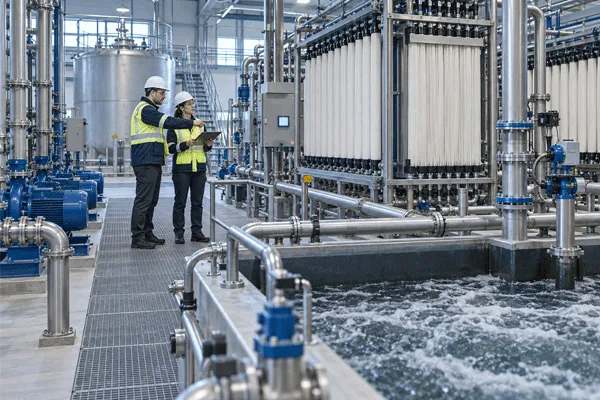
Falling water output and rising pressure can disrupt production and increase costs. Leave deposits untreated, and a small problem may lead to costly replacement. Membrane cleaning helps remove buildup, recover useful capacity, and keep your treatment plant running reliably.
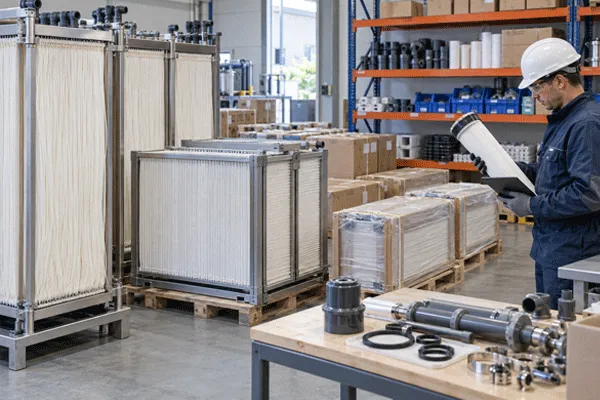
Membrane cleaning is the removal of scale, organic matter, particles, and biological deposits from filtration surfaces using approved physical or chemical methods. In a reverse osmosis system, it commonly involves circulating a suitable cleaning chemical through the elements under controlled conditions. The correct method depends on the foulant, equipment design, and manufacturer’s limits.
This guide explains when to clean, how to choose a suitable approach, and how to check the results. We also cover the differences between RO, UF, and MBR systems so you can plan maintenance with greater confidence.
What Is Membrane Cleaning? RO Cleaning Methods and Chemical Selection
Article outline
- What does cleaning remove?
- When is cleaning required?
- Which cleaning methods suit RO, UF, and MBR?
- How do you select chemicals?
- What happens during CIP?
- Which mistakes cause damage?
- How do you measure recovery?
- How can you reduce repeat fouling?
- What engineering support should you request?
- Часто задаваемые вопросы
1. What Does Membrane Cleaning Remove?
Water carries more than the substances shown on a basic quality report. Fine particles, dissolved minerals, oils, and microorganisms can accumulate on the membrane surface. These deposits restrict flow or block feed channels. Membrane fouling describes unwanted buildup; scaling refers specifically to mineral deposits that form when dissolved salts come out of solution.
The likely cause depends on your feedwater and treatment stages. A food factory may face fats and proteins. A textile plant may handle dyes and complex organic matter. A municipal reuse plant may receive changing biological loads. These are starting points for investigation, not proof of a particular deposit.
| Deposit type |
Possible source |
Useful checks |
| Mineral scale |
Hardness salts or concentrated dissolved minerals |
Full water analysis and recovery settings |
| Organic deposits |
Oils, proteins, dyes, or natural organic matter |
Organic load and upstream treatment |
| Биологический рост |
Microorganisms and available nutrients |
Biofilm evidence and biological control |
| Fine particles |
Silt, corrosion products, or treatment carryover |
Turbidity, filtration records, and solids analysis |
Removing deposits can improve output, but cleaning cannot repair every failure. A damaged seal, oxidized active layer, or broken fiber needs a different response.
2. When Is RO Membrane Cleaning Required?
Use operating trends to decide when cleaning is needed. A cold-water period can lower production without new fouling. Changes in feed salinity or operating pressure can also affect output. Normalized data correct these effects so you can compare today’s operation with a reliable baseline.
DuPont’s FilmTec guidance identifies the following cleaning triggers. These are product-specific reference points, not universal limits for every installation. Check the manual supplied with your equipment.
| Normalized operating measure |
FilmTec reference trigger |
| Расход пермеата |
Decrease of 10% |
| Соляной проход |
Increase of 5–10% |
| Перепад давления |
Increase of 10–15% |
Before confirming that membrane cleaning is required, check sensors, valves, pretreatment, and recovery settings. Keep records for each stage where possible. Your cleaning frequency should follow actual condition and the approved maintenance plan, rather than a fixed monthly rule.
3. Which Membrane Cleaning Methods Suit RO, UF, and MBR?
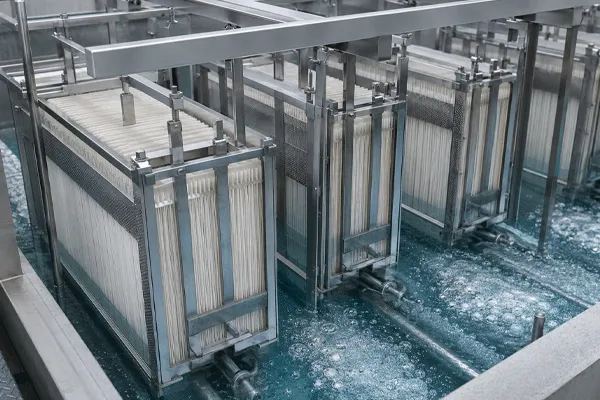
The cleaning method must match the equipment. UF and MBR units often use physical cleaning methods, such as backwashing, air scouring, or relaxation. Relaxation means briefly stopping filtration to help release deposits. The available methods depend on the module design; they are not interchangeable across all products.
For example, Hydranautics’ HYDRAsub guidance covers operating routines for its submerged hollow-fiber MBR products. A flat sheet design may require a different routine. Always check the instructions for the specific membrane module before setting flow direction, air rate, or backwash pressure.
| Технологии |
Typical maintenance approach |
Main design question |
| Ультрафильтрация с использованием полых волокон |
Backwash and approved chemical-assisted cleaning |
What reverse-flow conditions are allowed? |
| Hollow fiber MBR |
Air scouring, relaxation, and approved cleaning |
How are sludge conditions and filtration balanced? |
| Flat sheet MBR |
Air scouring and model-specific cleaning |
Does the design permit backwashing? |
| Spiral-wound RO |
Flushing and controlled chemical circulation |
What flow, pressure, pH, and temperature limits apply? |
Standard spiral-wound RO elements should not receive a UF-style backwash. Their construction and hydraulic limits differ. For these units, chemical cleaning normally uses a dedicated circulation loop.
What Is Membrane Cleaning? RO Cleaning Methods and Chemical Selection
4. How Do You Choose the Right Cleaning Chemical?
Start with deposit identification. Buying the strongest product available is not a sound selection method. The right cleaning chemical must address the foulant while remaining compatible with the active layer, seals, piping, and other wetted parts. Ask for written compatibility information for your exact model.
The table below is a selection guide, not a dosing recipe. Mixed deposits may need a planned sequence using different cleaning chemicals.
| Approach |
Potential application |
Important limit |
| Alkaline cleaning |
Organic deposits and some biological material |
Check permitted pH and temperature together |
| Acid cleaning |
Certain mineral scales and metal deposits |
Some scales need specialist treatment |
| Formulated cleaning product |
Mixed or difficult deposits |
Confirm ingredients and written compatibility |
| Enzyme cleaning |
Selected protein or organic deposits |
Use only with application-specific approval |
Terms such as high pH cleaning and caustic cleaning describe broad approaches, not complete procedures. A caustic cleaning solution still needs an approved concentration, exposure time, and operating temperature.
5. What Happens During a Membrane CIP Cleaning Procedure?
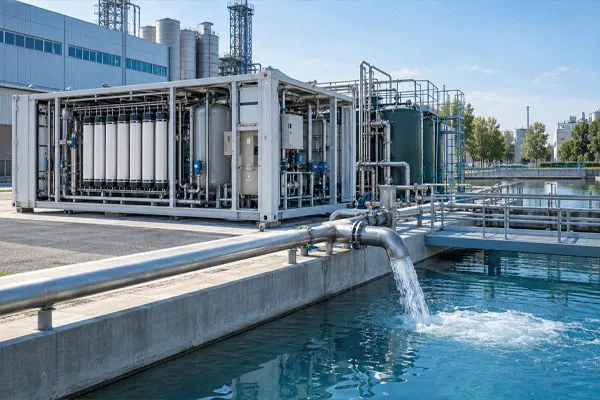
Membrane CIP means cleaning in place. The elements usually remain installed while a separate loop circulates the cleaning solution. Typical equipment includes a cleaning tank, pump, filter, instruments, and suitable connections. Good access makes the work easier to control and document.
The following cleaning procedure is an overview. The manufacturer’s approved instructions must define the actual settings and sequence. Hydranautics provides detailed circulation, soaking, and rinsing guidance for its composite polyamide products.
- Record the starting condition. Save flow, pressure, conductivity, temperature, and relevant alarms.
- Isolate the section. Separate it from production and sensitive downstream equipment.
- Prepare the solution. Use approved water and fully dissolve the specified chemicals.
- Introduce and circulate it. Follow the permitted flow direction and hydraulic limits.
- Soak where specified. Monitor conditions during the approved exposure period.
- Drain and rinse. Remove spent liquid through the designated waste route.
- Restart and verify. Return gradually to service and test water quality.
Record pH, temperature, time, and observations throughout the cleaning process. Do not rely on color alone to judge completion. For multi-stage equipment, ask whether separate stage cleaning is required to maintain suitable flow and avoid moving deposits into another section.
6. Which Cleaning Mistakes Can Damage the Membrane?
One common mistake is copying a procedure from a different product. The membrane material matters, but so do adhesives, support layers, seals, and housing components. A cleaner tolerated by one UF product may be unsuitable for an Обратноосмотическая мембрана element.
Polyamide RO products are particularly sensitive to oxidant exposure. Also, permitted pH limits can change with temperature. Check the combined operating envelope before cleaning; a value that is acceptable at one temperature may be unsuitable at another. Protect the permeate side of the membrane from excessive backpressure during cleaning and shutdown.
Avoid these preventable errors:
- Guessing chemical concentration.
- Mixing incompatible chemicals or skipping intermediate rinses.
- Using uncalibrated temperature or pH instruments.
- Repeating an unsuccessful treatment without reviewing the cause.
- Returning equipment to production before rinse acceptance checks.
- Sending used cleaning liquid to a biological process without assessing its impact.
For EPC projects, include handling instructions, waste arrangements, and operator responsibilities in the handover documents. Clear procedures reduce uncertainty during a shutdown.
7. How Do You Measure Membrane Performance After Cleaning?
A successful restart does not automatically prove successful cleaning. Compare normalized output, pressure drop, and product quality with the pre-cleaning record and the accepted baseline. Higher flow accompanied by worse salt rejection may signal damage rather than useful recovery.
The example below shows how to report results clearly. These figures are illustrative, not results from one of our customer projects. They demonstrate the difference between recovering lost output and returning fully to baseline.
| Measure |
Accepted baseline |
Before cleaning |
After cleaning |
| Normalized product flow |
20 m³/h |
17 m³/h |
19 m³/h |
| Flow relative to baseline |
100% |
85% |
95% |
| Lost flow recovered |
— |
— |
66.7% |
The plant regained 2 m³/h of the 3 m³/h it had lost. That equals 66.7% recovery of lost flow, while final output reached 95% of baseline. Evaluate the effectiveness of the cleaning alongside water quality, energy use, and the time until the next decline. These measures make supplier discussions more useful than a simple “cleaned successfully” report.
What Is Membrane Cleaning? RO Cleaning Methods and Chemical Selection
8. How Can You Reduce Cleaning Frequency and Support Long-Term Membrane Operation?
To reduce cleaning frequency, investigate what brings deposits into the system. Review feedwater changes, upstream solids removal, chemical dosing, and operating targets. A repeated problem should trigger a root-cause review. Another cleaning cycle may restore capacity temporarily while leaving the main cause untouched.
A useful published example comes from DuPont’s Shafdan wastewater reuse demonstration. The installation combined submerged UF pretreatment with 35 fouling-resistant RO elements. DuPont reported stable operation at 85% recovery after ten months and a 50% reduction in cleaning. This is the supplier’s case study, not our project or a promised result for other plants.
The practical lesson is to assess the whole treatment line. Ask your team:
- Did feedwater quality change before performance declined?
- Did an upstream filter or dosing system fail?
- Are operators working within the agreed production targets?
- Do the same symptoms return after each shutdown?
- Would better monitoring reveal the problem earlier?
9. What Engineering Support Should You Request for Your Membrane System?
As a manufacturer and engineering-oriented water treatment provider, we view maintenance as part of system design. Our product scope includes hollow fiber MBR and UF products, flat sheet MBR units, RO equipment, EDI modules, small RO machines, and complete water and wastewater treatment plants.
For your project, we recommend defining maintenance requirements alongside capacity and outlet water quality. A compact skid or containerized plant still needs room for access, safe chemical handling, sampling, and replacement work. For ultrapure water applications, agree how cleaning activities will remain separate from downstream EDI and distribution equipment.
When requesting a proposal, include:
| Information to provide |
Why it helps |
| Feedwater analysis and seasonal changes |
Supports treatment and fouling assessment |
| Required flow and daily operating hours |
Defines capacity and maintenance windows |
| Existing product model and arrangement |
Establishes compatibility and access needs |
| Operating trends and past cleaning records |
Helps identify recurring problems |
| Discharge or reuse targets |
Defines acceptance testing |
| Site layout and utility details |
Supports practical equipment integration |
We can discuss customized treatment configurations for industrial, municipal, and reuse projects. Send your water analysis, required capacity, and current operating problem so we can define an appropriate scope covering equipment, automation, documentation, commissioning support, and spare parts.
10. Frequently Asked Questions About RO Membrane Cleaning
How often should an RO system be cleaned?
There is no single interval for every plant. Follow the product manual and normalized operating trends. A sudden need for more frequent cleaning deserves investigation. Check whether feedwater, pretreatment, operating settings, or biological conditions have changed.
Can one cleaner remove every type of deposit?
Usually not. Mineral scale, organic matter, and biological deposits respond differently. Mixed fouling may require more than one approved treatment step. Select chemicals from evidence about the deposit and confirm compatibility before use.
Can cleaning restore membrane performance completely?
Sometimes, but full recovery is not guaranteed. Results depend on deposit type, severity, exposure history, and physical condition. Cleaning may remove reversible fouling; it cannot reliably reverse oxidation, structural damage, or every form of long-standing scale.
Is a higher chemical concentration more effective?
Not necessarily. Increasing strength can exceed compatibility limits without solving the underlying problem. Review chemical selection, circulation, temperature, and contact time within the approved procedure before considering any change in concentration.
Does clear rinse water mean production can restart?
Clear water alone is not enough. Use the specified rinse acceptance checks, which may include pH, conductivity, and chemical-specific testing. Confirm that product water meets the requirements of its intended use before releasing it downstream.
When should an element be replaced instead of cleaned again?
Consider replacement when integrity or product quality remains unacceptable, or when verified cleaning no longer restores enough useful capacity. Check seals, instruments, and operating conditions first. Compare the cost of another cleaning attempt with replacement, downtime, and lost production.
Основные выводы
- Diagnose the deposit before choosing a cleaner.
- Use normalized data and product-specific limits to decide when to clean.
- Match the method to RO, UF, or MBR construction.
- Control chemical strength, temperature, flow, and exposure time.
- Assess recovery using both output and water quality.
- Address recurring causes rather than relying on repeated cleaning.
- Plan maintenance access, documentation, and support when selecting treatment equipment.











 11:11
11:11