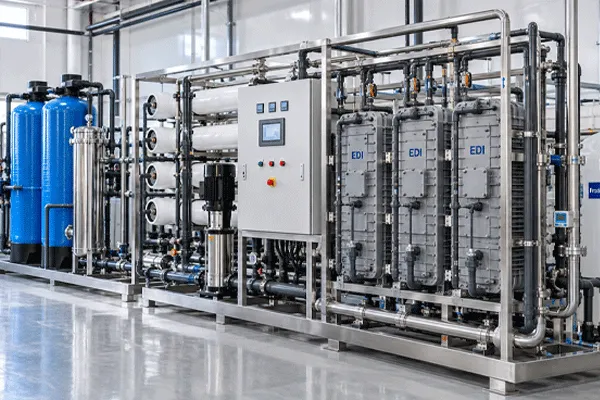
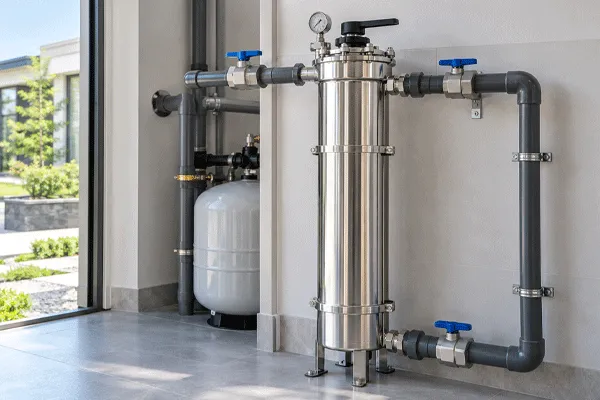
Проекты по получению воды высокой чистоты могут закончиться неудачей, если после обратного осмоса в воде остаются ионы, смола требует частой регенерации или качество воды ухудшается. Этот риск возрастает в проектах фармацевтической, полупроводниковой, котельной и лабораторной отраслей. Система очистки воды с помощью электродеионизации (EDI) позволяет получать стабильную воду высокой чистоты за счет непрерывной деионизации и сокращения объема использования химических веществ.
Система очистки воды методом EDI использует электричество, ионообменную смолу, ионообменные мембраны и электрическое поле для удаления ионов из воды. Обычно она устанавливается после системы обратного осмоса для доочистки пермеата обратного осмоса до воды высокой чистоты или сверхчистой воды, предназначенной для использования в качестве технологической воды, питательной воды для котлов и в критически важных производственных процессах.
План статьи
- Что такое электродеионизация в области водоочистки?
- Как работает система EDI?
- Что удаляется из воды при электродеионизации?
- Почему система обратного осмоса (RO) обычно устанавливается перед системой очистки воды методом EDI?
- EDI и традиционные системы на основе ионообменных смол: в чём разница?
- Из каких основных частей состоит система электродеионизации?
- Где используется вода EDI в промышленной водоочистке?
- Какое качество подаваемой воды требуется для модуля EDI?
- Как спроектировать систему очистки воды методом EDI?
- Каковы основные моменты эксплуатации и технического обслуживания установок EDI?
- Часто задаваемые вопросы об электродеионизации, ионообмене и воде высокой чистоты
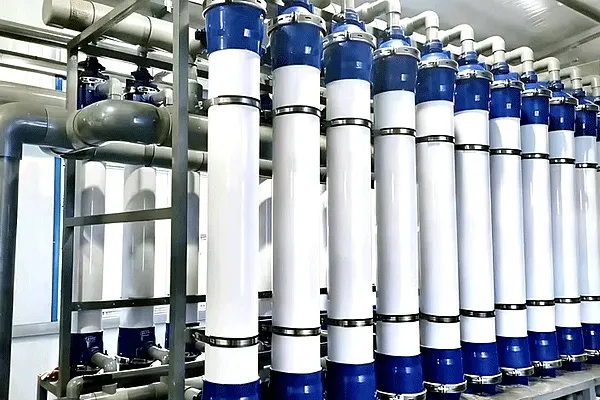
Что такое система очистки воды методом электродеионизации (EDI)?
Что такое электродеионизация в водоочистке?
Электродеионизация — это технология очистки воды, используемая для удаления растворённых ионов из воды. Она сочетает в себе ионообменную смолу, ионообменные мембраны и питание постоянным током. Проще говоря, EDI — это непрерывный процесс деионизации воды, не требующий частой химической регенерации, которая применяется во многих традиционных системах на основе смол.
В типичной технологической схеме очистки воды система EDI устанавливается после этапов предварительной очистки и обратного осмоса (RO). Система обратного осмоса удаляет большинство солей, органических веществ, твердых частиц и многих других загрязнений из воды. Затем система EDI проводит доочистку пермеата, полученного в результате обратного осмоса, для получения высококачественной воды с очень низкой проводимостью и высоким удельным сопротивлением.
Это важно для покупателей в сегменте B2B, поскольку вода высокой чистоты является обязательным условием во многих отраслях. Фармацевтические компании, производители полупроводников и электроники, электростанции, лаборатории, заводы по производству продуктов питания и напитков, а также предприятия по производству высокоточной химии — все они нуждаются в стабильном качестве воды. Как производитель инженерных систем водоподготовки, мы рассматриваем EDI не как отдельное устройство, а как часть полноценной линии по производству чистой или сверхчистой воды.
Как работает система EDI?
Система EDI работает за счет перемещения ионов через слои смолы и мембран под действием электрического поля. Вода протекает через камеры, заполненные ионообменной смолой. Когда ионы попадают в слой смолы, смола способствует их улавливанию и переносу. Затем электрическое поле прогоняет катионы и анионы через селективные мембраны в поток концентрата.
Основной процесс легко представить:
| Шаг |
Что происходит |
Простое значение |
| 1. Пермеат обратного осмоса поступает |
Питательная вода с низким содержанием соли поступает в модуль EDI |
EDI в первую очередь нуждается в чистой воде |
| 2. Ионобменная смола |
Вода проходит через смолу |
Смола способствует перемещению заряженных частиц |
| 3. Подано постоянное напряжение |
Постоянный ток создает электрическое поле |
Ионы начинают двигаться |
| 4. Мембраны отделяют ионы |
Ионообменные мембраны регулируют движение ионов |
Чистая вода и разделение потоков отходов |
| 5. Выход воды из изделия |
Деионизированная вода выходит из модуля |
Производится вода высокой чистоты |
В ходе этого процесса электрод способствует созданию электрической силы. Катион движется в сторону отрицательного электрода, а анион — в сторону положительного электрода. Именно таким образом система удаляет ионы из воды и поддерживает активность смолы в процессе работы.
Компания DuPont описывает EDI как непрерывный процесс без использования химикатов, при котором ионизированные и ионизируемые вещества удаляются из питательной воды с помощью постоянного тока. Компания ELGA также описывает электродеионизацию как технологию, основанную на использовании электричества, ионообменных мембран и смолы для удаления ионизированных веществ из воды.
Что удаляется из воды при электродеионизации?
Электродеионизация позволяет удалять из воды в основном растворенные ионы и ионизируемые соединения. К ним могут относиться ионы натрия, хлорида, кальция, магния, нитрата, сульфата, кремнезема в ионной форме, а также слабоионизированные вещества. Кроме того, после надлежащей предварительной очистки этот процесс может способствовать снижению содержания некоторых заряженных органических кислот и ионных соединений, связанных с углекислым газом.
Однако система EDI не предназначена для самостоятельного удаления всех загрязняющих веществ. Она не заменяет предварительную очистку, активированный уголь, ультрафильтрацию, обратный осмос или стерилизацию в тех случаях, когда эти этапы необходимы. EDI лучше всего использовать в качестве этапа доочистки после обратного осмоса (RO).
К числу типичных целей относятся:
- Низкая проводимость
- Высокое удельное сопротивление
- Низкое содержание ионных примесей
- Вода стабильного качества
- Снижение потребности в химической регенерации
- Непрерывное производство воды высокой чистоты
Особого внимания заслуживает углекислый газ. CO₂ может проходить через систему обратного осмоса (RO), а затем ионизироваться в воде, увеличивая ионную нагрузку на модуль EDI. По этой причине в некоторых системах перед модулем EDI применяются такие меры, как дегазация, регулирование pH или тщательное проектирование системы обратного осмоса. Грамотное проектирование защищает модуль EDI, а не возлагает на него задачу решения всех проблем, возникающих на предыдущих этапах.
Почему система обратного осмоса (RO) обычно устанавливается перед системой очистки воды методом EDI?
Системы обратного осмоса (RO) и электродеионизации (EDI) наиболее эффективно работают в комплексе. Система обратного осмоса удаляет большую часть растворённых солей и многие загрязнения ещё до этапа EDI. Затем система EDI доочищает воду, прошедшую обратный осмос, до уровня высокой или ультравысокой чистоты.
The U.S. EPA explains that reverse osmosis and nanofiltration are membrane separation processes that use pressure and semi-permeable membranes to remove contaminants from water. Treated water that passes through the membrane is called permeate or product water.
A common water treatment train looks like this:
Raw Water
→ Pretreatment
→ Cartridge Filter / UF
→ RO System
→ EDI System
→ UV / Polishing
→ Pure Water Tank
→ Point of Use
This design protects the EDI module. If raw water goes directly into EDI, the resin and membrane can foul, scale, or overload quickly. RO lowers the ion load first. That makes EDI operation more stable and reduces operational cost over time.
EDI vs Traditional Ion Exchange Resin Systems: What Is Different?
Traditional ion exchange resin systems use resin beds to exchange ions in water. When the resin becomes exhausted, it must regenerate with acid, caustic, or salt solutions. This can create chemical storage needs, wastewater from regeneration, and more operator handling.
EDI also uses resin, but in a different way. The resin is continuously regenerated inside the module by electrical current and water splitting. This is why EDI is often called continuous electrodeionization. A ScienceDirect review describes continuous electrodeionization as a combination of electrodialysis and ion exchange using resins and membranes, with chemical-free, self-regenerating operation.
| Артикул |
Traditional Ion Exchange Resin Systems |
EDI Water Treatment |
| Main method |
Resin exchange |
Resin + membrane + electric field |
| Regeneration |
Chemical regeneration needed |
Continuous electrical regeneration |
| Использование химических веществ |
Acid, caustic, or salt often needed |
Much lower chemical handling |
| Operation style |
Batch or service/regeneration cycles |
Continuous process |
| Наилучшее применение |
Many softening and deionization cases |
High-purity water after RO |
| Поток отходов |
Chemical regeneration wastewater |
Concentrate stream |
This is a key reason many modern pure water systems use RO + EDI instead of old mixed-bed systems. It improves safety, reduces chemical handling, and supports more stable water production.
What Are the Main Parts of an Electrodeionization System?
An electrodeionization system includes several working parts. Each part has a clear role. If one part is poorly selected, water quality can suffer.
Key components include:
- EDI module: the core device where ion removal happens
- Ion exchange resin: helps capture and move ion species
- Ion exchange membranes: guide ions into the concentrate stream
- Electrode chamber: provides the electrical driving force
- Power supply: delivers direct current to the module
- Feed pump: controls flow into the system
- Concentrate loop: carries removed ions away
- PLC control system: monitors flow, pressure, voltage, current, and alarms
- Instrumentation: conductivity, resistivity, pressure, flow, and temperature sensors
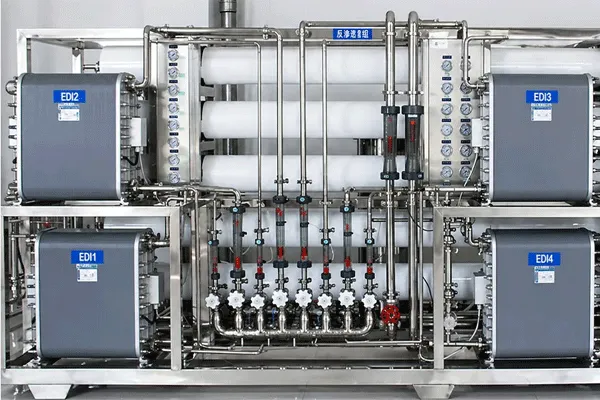
The module is often filled with ion exchange resins between membranes. Water using this flow path can pass through a controlled channel where ions move out of the product stream. This is the heart of enhanced water purity.
For EPC contractors, the EDI module is only one part of the full system. Piping, valves, control logic, cleaning access, instrument selection, and skid layout also matter. As a water treatment technology provider, we design EDI units with RO, UF, dosing, storage, and distribution systems as one project.
Что такое система очистки воды методом электродеионизации (EDI)?
Where Is EDI Water Used in Industrial Water Treatment?
EDI water is used where high-purity water quality must stay stable. Typical applications include pharmaceutical water, semiconductor rinse water, electronics manufacturing, boiler feedwater, laboratory water, hydrogen production support, precision cleaning, and high-grade process water.
EUROWATER lists typical EDI applications such as boiler feedwater at heat and power plants, process water in the electronic industry, pharmaceutical industry, hospitals, and laboratories.
Common industries include:
| Промышленность |
EDI Application |
Почему это важно |
| Фармацевтический |
Purified water production |
Supports clean process standards |
| Полупроводник |
Ultra pure water and rinsing |
Reduces ion contamination |
| Power plant |
Boiler feedwater |
Helps reduce scaling and corrosion |
| Electronics |
Технологическая вода |
Protects product quality |
| Laboratory |
Вода высокой чистоты |
Supports accurate testing |
| Продукты питания и напитки |
Ingredient and process water |
Improves consistency |
| Chemical plant |
Технологическая вода |
Controls impurity levels |
In some projects, EDI also supports water conservation. With the right pretreatment and recovery design, a plant can reuse water, reduce chemical demand, and improve efficient water operation. That is a major benefit for industrial parks, EPC contractors, and factories with rising water demand.
What Feed Water Quality Does an EDI Module Need?
Feed water quality decides how long an EDI module can run. EDI needs clean RO permeate, not raw water. The feed water should have low hardness, low CO₂ load, low chlorine, low organics, low particles, and controlled temperature.
Important feed water points include:
- Low conductivity after RO
- Low hardness to reduce scaling
- Low free chlorine to protect membrane and resin
- Low iron and manganese
- Low silica load where possible
- Stable pH
- Low suspended solids
- Proper temperature range
- Correct pressure and flow
The EDI module can remove ions from the water, but it cannot protect itself from poor upstream design. If the reverse osmosis system has poor salt rejection, EDI will carry too much work. If carbon filters fail and oxidants pass downstream, membrane damage may occur. If antiscalant selection is wrong, scaling may form.
This is why we always ask for a water analysis before quoting a complete system. A good proposal should include raw water data, target product water quality, pretreatment design, RO recovery, EDI capacity, automation logic, and commissioning support.
How Do You Design an EDI Water Treatment System?
A good EDI water treatment design starts with the required water quality. For example, a boiler project may focus on low conductivity and silica control. A pharmaceutical project may need purified water quality and sanitary system design. A semiconductor project may need very high resistivity and polishing after EDI.
The design process usually includes:
- Review raw water analysis.
- Confirm product water standard.
- Select pretreatment.
- Design RO system and recovery rate.
- Select EDI capacity and module model.
- Add UV, polishing, or sterilization if needed.
- Design storage and distribution.
- Add PLC / SCADA automation.
- Prepare drawings and manuals.
- Provide installation and commissioning support.
For a complete water purification system, EDI is often connected with RO, UF, dosing, cartridge filters, UV, TOC control, mixed-bed polishing, or EDI post-treatment depending on the application. The goal is not to sell more equipment. The goal is to reach stable water quality with the lowest practical risk.
What Are the Operation and Maintenance Points for EDI Units?
EDI units are easier to operate than many chemical resin regeneration systems, but they still need proper care. Operators should monitor flow, pressure, voltage, current, conductivity, resistivity, and temperature. When values drift, the system is giving early warning.
Daily checks may include:
- Давление в подающей линии
- Поток продукции
- Расход концентрата
- Voltage and current
- Product water conductivity
- Удельное сопротивление
- Качество пермеата при обратноосмотической очистке
- История сигналов тревоги
- Leakage around the skid
- Valve position
The most common EDI problems are not inside the EDI device first. They often start upstream. Poor RO performance, dirty cartridge filters, chlorine breakthrough, scaling tendency, high CO₂, and unstable feed water all reduce EDI performance. Good pretreatment keeps EDI stable.
Why Choose an Engineering-Oriented EDI Water Systems Manufacturer?
Many buyers compare only module price. That is risky. EDI is part of a water treatment train, and the whole train must work. EPC contractors, water treatment companies, industrial plant owners, and system integrators need more than a catalog. They need engineering support.
As a professional manufacturer and engineering-oriented provider of water and wastewater treatment systems, we support:
- Мембраны MBR с полыми волокнами
- Ультрафильтрационные мембраны с полыми волокнами
- Плоские MBR-мембраны
- Мембраны обратного осмоса
- Модули EDI
- Небольшие установки обратного осмоса
- Установки по очистке чистой воды
- Очистные сооружения сточных вод
- Комплексные системы мембранной фильтрации
- Контейнерные очистные сооружения
- Системы на салазках
- Complex EPC water treatment projects
For global B2B customers, we help with design, manufacturing, PLC / SCADA automation, technical documents, commissioning, spare parts, and long-term cooperation. If you need pure water, high purity water, wastewater treatment, reuse water, or ultra-pure water systems, the early design stage is the best time to discuss.
Practical Case: RO + EDI for High-Purity Industrial Process Water
Imagine a semiconductor support facility or electronics plant that needs stable high-purity process water. The raw water contains minerals, dissolved salts, and organic matter. A simple filter cannot deliver the water quality needed for rinsing or precision production.
A suitable system may include:
| Process Stage |
Цель |
| Мультимедийный фильтр |
Remove larger particles |
| Фильтр с активированным углем |
Reduce chlorine and organics |
| Softener or antiscalant dosing |
Protect RO membrane |
| Картриджный фильтр |
Final particle protection before RO |
| RO system |
Remove most salts and contaminants |
| EDI system |
Polish RO permeate into high-purity water |
| UV / polishing |
Control microbes or trace impurities |
| Pure water tank |
Store stable product water |
| Distribution loop |
Send water to use points |
This design can produce reliable process water while reducing the need for traditional chemical regeneration. The final system depends on raw water quality, target resistivity, product water flow, local standards, and client process requirements.
Что такое система очистки воды методом электродеионизации (EDI)?
What Questions Should Buyers Ask Before Buying an EDI System?
Before buying an EDI system, ask direct questions. Clear answers show whether the supplier understands real engineering.
Ask these:
- What feed water quality does the EDI module require?
- What RO system recovery and salt rejection do you design for?
- What product water resistivity can the system reach?
- How do you handle carbon dioxide?
- What is the concentrate flow?
- What voltage and current range should operators monitor?
- What alarms are included in the PLC system?
- What spare parts should be stocked?
- What commissioning support do you provide?
- Can you provide drawings, manuals, and electrical diagrams?
A reliable supplier should answer with data, not vague promises. For EPC projects, clear documentation saves time. For plant owners, it reduces risk. For distributors, it makes after-sales service easier.
FAQs About Electrodeionization, Ion Exchange, and High-Purity Water
What is EDI system in water treatment?
An EDI system in water treatment is a continuous deionization system that uses resin, ion exchange membranes, and direct current power to remove ion species from RO permeate. It is commonly used to produce high-purity water and ultrapure water.
Does EDI replace reverse osmosis?
No. EDI usually works after reverse osmosis. RO removes most salts and contaminants first. EDI then polishes the RO permeate to reach lower conductivity and higher resistivity.
What is the difference between EDI and ion exchange?
Ion exchange uses resin to remove ions and often needs chemical regeneration. EDI uses ion exchange resin plus membranes and electricity to regenerate continuously during operation, reducing the need for chemical regeneration.
What water quality can EDI produce?
EDI can produce high-purity water with low conductivity and high resistivity when the feed water is properly treated. Final quality depends on RO performance, feed water chemistry, EDI design, and system operation.
Can EDI remove carbon dioxide?
EDI can remove some ionized carbon dioxide species after they form bicarbonate or carbonate, but dissolved CO₂ can increase EDI load. Many systems need CO₂ control before EDI for stable performance.
Where is EDI water used?
EDI water is used in pharmaceutical production, semiconductor manufacturing, electronics, boiler feedwater, laboratories, chemical plants, food and beverage production, and other applications needing high-quality water.
Основные выводы
- Electrodeionization uses resin, membrane layers, and direct current to remove ion species from water.
- An EDI system is usually installed after RO as a polishing step.
- EDI reduces or removes the need for traditional chemical regeneration.
- The technology is widely used for high-purity water, ultrapure water, boiler feedwater, pharmaceutical water, and process water.
- Feed water quality is critical. Poor RO permeate can damage or overload the EDI module.
- EPC contractors should select a supplier that can provide full system design, PLC automation, technical documentation, commissioning, and spare parts.
- A complete water treatment system works best when RO, EDI, pretreatment, storage, and distribution are designed together.











 17:25