Reliable ultrafiltration equipment starts with well-prepared membrane components and careful module assembly. For industrial water treatment projects, inconsistent component positioning or unsuitable module connections can create installation difficulties and affect long-term operation.
At Qingdao Banott Environmental Technology Co., Ltd., hollow fiber UF membrane production involves equipment-assisted processing, component handling, and manual assembly operations. This factory update shares a closer look at our production workshop and the manufacturing activities behind our industrial ultrafiltration membrane modules.
Produção de membranas de ultrafiltração de fibra oca: por dentro da oficina de montagem de módulos da Banott
Inside Banott’s UF Membrane Production Workshop
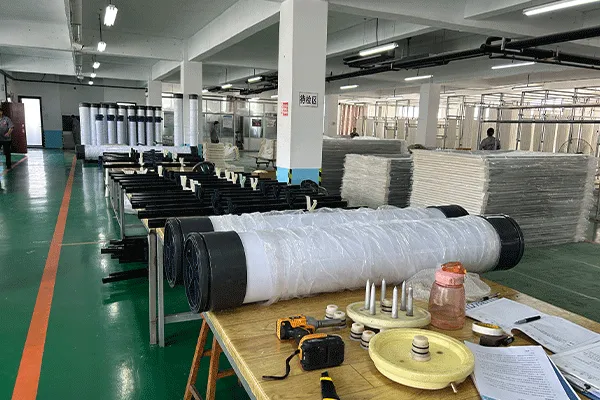
Our production workshop is equipped with dedicated workstations and equipment for handling and assembling hollow fiber UF membrane modules.
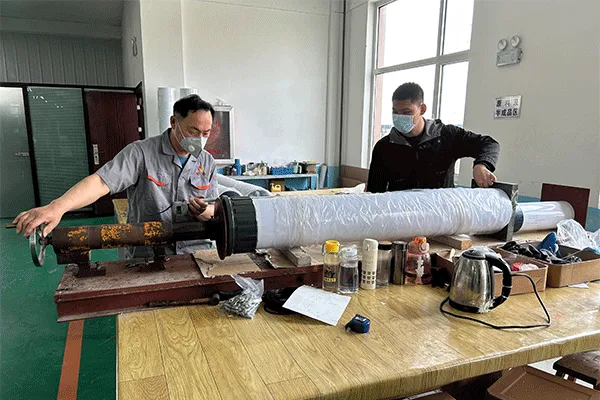
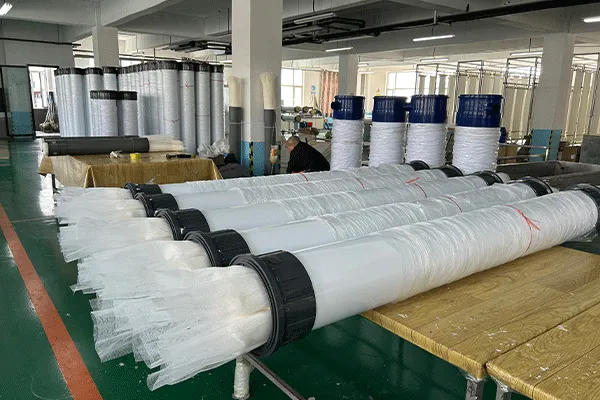
The photographs show long cylindrical membrane modules positioned on production tables and assembly equipment. Workers carry out hands-on operations around the module bodies and their end components, while other units are arranged nearby for subsequent handling.
These activities form part of the manufacturing environment required to prepare membrane modules for industrial water treatment applications.
Unlike simply displaying finished products, the production workshop provides a closer view of how individual components are handled and brought together into complete membrane assemblies.
For international buyers, understanding the manufacturing environment is useful when evaluating a membrane supplier. It provides additional context for discussing product configuration, manufacturing requirements, customization, and long-term supply.
Cylindrical UF Membrane Module Assembly
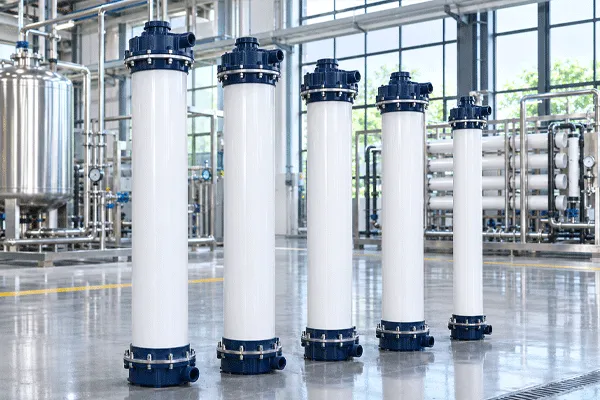
The photographs show hollow fiber UF membrane modules with elongated cylindrical structures, white membrane sections, and dark-colored end fittings.
These components form the physical structure of pressurized hollow fiber ultrafiltration modules.
During module assembly, the membrane components and associated structural parts must be positioned according to the intended product configuration. The relationship between the membrane section, end components, and connection structure is important for subsequent installation.
The visible production activities include:
- Handling and positioning cylindrical membrane modules.
- Working with module end components and connection parts.
- Using dedicated equipment to support module processing and assembly.
- Arranging completed or partially assembled units on work surfaces.
- Preparing membrane modules for further production and handling.
The exact assembly sequence and technical requirements depend on the specific UF membrane model.
Equipment-Assisted Processing and Manual Assembly
The workshop photographs show both production equipment and manual operations.
One image features a long cylindrical UF membrane module positioned on a mechanical processing machine. Other photographs show workers handling and adjusting membrane components on dedicated worktables.
This combination of equipment-assisted operations and manual handling is important in membrane module manufacturing.
Equipment provides support for positioning and processing, while workers carry out tasks that require attention to component alignment, physical condition, and assembly details.
During these operations, manufacturers need to consider several aspects:
- Correct positioning of membrane components.
- Consistent module dimensions.
- Suitable fitting of end components.
- Protection of membrane fibers during handling.
- Compatibility between the module structure and its connection arrangement.
These manufacturing considerations help ensure that the finished product matches its specified mechanical configuration.
The photographs provide a view of the equipment and assembly activities in the workshop; they do not establish specific machine functions or confirm individual inspection results.
Produção de membranas de ultrafiltração de fibra oca: por dentro da oficina de montagem de módulos da Banott
Membrane Component Handling and Production Organization
Hollow fiber UF membrane modules contain delicate filtration components inside a larger module structure. Appropriate handling is therefore important throughout production.
The photographs show workers supporting and positioning long modules across worktables, with additional components and tools arranged nearby.
Some modules also show exposed white fiber bundles at one end. These visible details illustrate why careful handling is necessary when working with membrane assemblies.
Unsuitable pulling, impact, or contact with sharp objects may damage membrane fibers or other components.
A well-organized production environment should therefore consider:
- Appropriate support for long membrane modules.
- Protection of exposed membrane sections.
- Suitable working space for assembly operations.
- Organized storage of module components.
- Careful movement between workstations.
- Identification of different product configurations.
For international projects, these considerations also connect to packaging, transportation, storage, and installation requirements.
Why Does UF Membrane Module Assembly Matter for Water Treatment Projects?
A hollow fiber UF membrane is not an independent filtration element once it becomes part of an industrial module. Its housing, end components, seals, and connections must work together with the complete treatment system.
For EPC contractors and water treatment engineering companies, product compatibility is an important purchasing consideration.
When selecting a UF membrane module, buyers should review:
| Critério de avaliação |
Importance |
| Material da membrana |
Compatibility with feed water and cleaning conditions |
| Dimensões do módulo |
Installation space and equipment arrangement |
| Área da membrana |
Basis for filtration system design |
| Connection structure |
Compatibility with existing piping |
| Flow configuration |
Matching the intended filtration process |
| Pressão de funcionamento |
Compatibility with system design |
| Requisitos de manutenção |
Long-term operation and replacement planning |
Banott’s industrial hollow fiber UF membrane range supports different membrane materials, module sizes, and filtration configurations.
Published product options include PES, PVDF, RPVDF, PAN, and RPES, with inside-out and outside-in operation as well as cross-flow and dead-end filtration. Available module sizes range from 4 inches to 12.5 inches. OEM and ODM services are also supported.
The actual specifications of each model should be confirmed through its technical datasheet and project requirements.
Produção de membranas de ultrafiltração de fibra oca: por dentro da oficina de montagem de módulos da Banott
Banott’s Hollow Fiber UF Membrane Manufacturing Capabilities
Qingdao Banott Environmental Technology Co., Ltd. is a manufacturer and engineering-oriented provider of membrane products and integrated water treatment solutions.
Our product portfolio covers:
- Hollow Fiber UF Membranes.
- Hollow Fiber MBR Membranes.
- Membranas MBR planas.
- Membranas de osmose inversa.
- Módulos EDI.
- Small RO Machines.
- Pure Water Treatment Plants.
- Wastewater Treatment Plants.
- Integrated Membrane Filtration Systems.
Our hollow fiber UF membrane modules are designed for industrial water purification, municipal water treatment, RO pretreatment, and wastewater reuse applications.
Trabalhamos com empreiteiros EPC, empresas de engenharia de tratamento de água, proprietários de instalações industriais, integradores de sistemas e distribuidores internacionais.
Beyond membrane product supply, our engineering support includes customized configurations, product selection, technical documentation, equipment integration, commissioning preparation, and long-term technical cooperation.
The production photographs in this update offer a practical view of the equipment and manual operations involved in our UF membrane module manufacturing environment.
Supporting Your Industrial UF Membrane Projects
Selecting a suitable UF membrane involves more than comparing product appearance or nominal filtration capacity. The membrane material, module dimensions, connection structure, feed-water conditions, and downstream process all need to be considered.
Whether you are developing a new industrial water purification plant, upgrading an existing filtration system, or sourcing replacement hollow fiber UF membrane modules, Banott can help review your requirements.
To support an accurate product recommendation, please share:
- Required treatment capacity.
- Feed-water characteristics.
- Required filtrate quality.
- Preferred membrane material, if specified.
- Existing module model or installation dimensions.
- Connection and operating requirements.
- Project application and destination market.
Contact Banott to discuss hollow fiber UF membrane products, customized module configurations, and engineering support for your next water treatment project.











 14:37