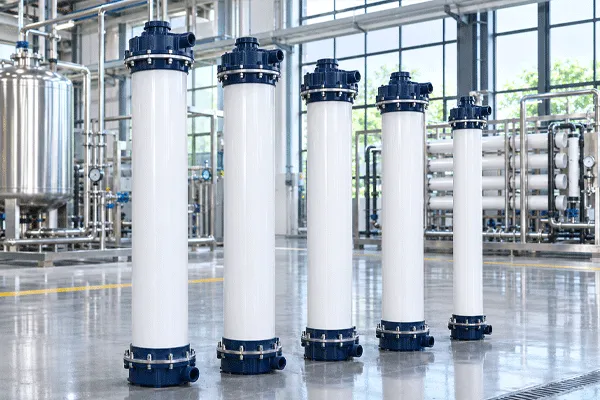
Choosing an ultrafiltration membrane module involves more than comparing pore sizes or filtration capacity. Fiber structure, module dimensions, connection design, and material compatibility all affect installation and long-term operation. Understanding these details helps engineers select a suitable UF module for industrial water treatment and RO pretreatment projects.
A seven-bore hollow fiber UF membrane module uses a multi-channel fiber structure to provide multiple internal flow passages within each membrane fiber. Combined with a pressurized PVDF module design and a nominal pore size of 0.01 μm in the illustrated configuration, it supports the removal of suspended solids, colloids, bacteria, and other fine particles from water.
This article examines the module’s structural design, technical characteristics, connection components, and practical selection considerations for water treatment engineers, EPC contractors, and industrial buyers.
Modulo a membrana UF a fibra cava da 7 bore: caratteristiche progettuali e scelta del pretrattamento RO
1. Why Should You Look Beyond Pore Size When Selecting a UF Membrane Module?
Pore size is an important specification, but it does not tell the whole story of membrane performance. Two UF membrane modules with similar nominal pore sizes may have different fiber structures, effective membrane areas, housing dimensions, connection arrangements, and operating requirements.
For engineering projects, these differences matter. A membrane module must fit the existing equipment layout, match the required filtration process, and operate under the available pressure and cleaning conditions. An incorrect selection can create installation difficulties, uneven flow distribution, or unnecessary maintenance costs.
When evaluating an industrial hollow fiber UF membrane module, buyers should consider several factors together:
- Membrane material and fiber structure.
- Nominal pore size and filtration accuracy.
- Effective membrane area.
- Module diameter and overall length.
- Feed and filtrate connection dimensions.
- Operating pressure and design flux.
- Requisiti di pulizia e manutenzione.
- Compatibility with existing equipment.
At Banott, we focus on matching membrane products with actual engineering requirements rather than recommending a module based on one specification alone.
2. What Is a Seven-Bore Hollow Fiber Membrane Structure?
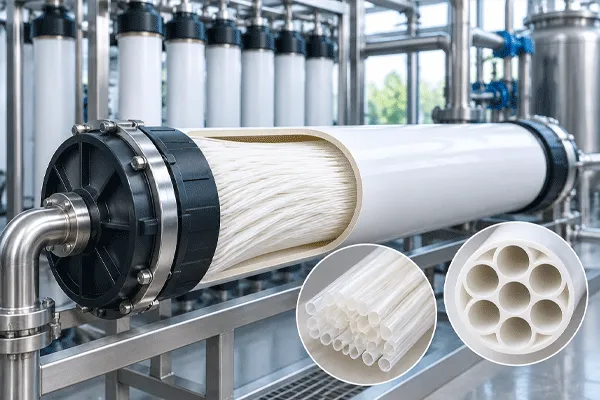
One of the most distinctive features shown in this product design is its seven-bore membrane technology.
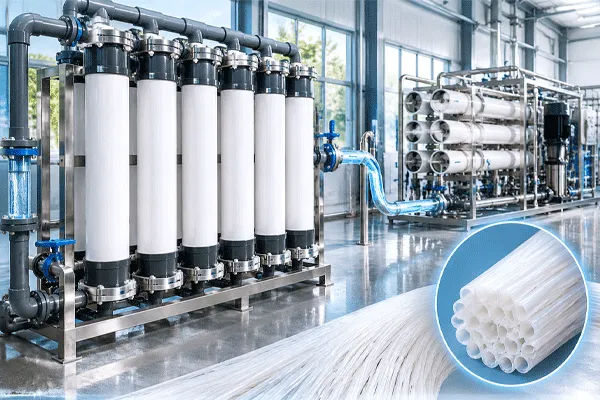
Unlike a conventional hollow fiber with a single central lumen, a seven-bore fiber contains seven internal channels within one membrane filament. The cross-sectional illustration shows these channels arranged in a compact multi-channel structure.
This design gives the membrane fiber a distinctive geometry. The internal channels provide multiple passages within the same filament, while the surrounding membrane wall serves as the filtration barrier.
The product graphic highlights three structural characteristics:
- Seven-bore design: Seven internal channels are formed within one membrane fiber.
- Multi-channel structure: Multiple passages are arranged within a single filament.
- Precisely formed channels: Consistent channel geometry is an important manufacturing consideration.
Why does this matter to buyers?
The internal structure is part of the module’s engineering design. It affects how the fiber is constructed and must be considered alongside membrane wall properties, dimensions, mechanical strength, and hydraulic performance.
However, channel count alone does not establish filtration capacity or service life. Buyers should request actual membrane performance data, including design flux, operating pressure, and integrity test results, when comparing different multi-channel membrane products.
3. What Do the UF Membrane Module Dimensions Mean for Installation?
Module dimensions directly affect equipment compatibility, rack arrangement, piping connections, and available installation space.
The supplied product illustration shows a cylindrical membrane module with the following dimensional references:
| Parametro |
Illustrated Dimension |
| Module length |
1,527.5 mm |
| Module outer diameter |
200 mm |
| Materiale della membrana |
Modified PVDF |
| Dimensione nominale dei pori |
0.01 μm |
| Filtration configuration |
Outside-in / Inside-out options |
These dimensions describe the illustrated product configuration rather than every module in the Banott product range.
For example, a module with a 200 mm diameter and approximately 1,527.5 mm length requires sufficient vertical or horizontal installation clearance, depending on the system arrangement. Engineers should also allow space for end connections, clamp removal, inspection, and future replacement.
When replacing an existing UF module, check more than the outside diameter. Important compatibility points include:
- Overall module length.
- Connection position and diameter.
- Feed and filtrate port arrangement.
- Mounting support and spacing.
- Available installation and maintenance clearance.
- Hydraulic compatibility with the existing system.
Banott offers different industrial UF module dimensions, including 4-inch to 12.5-inch product sizes. Customized specifications and replacement options are available according to project requirements.
Modulo a membrana UF a fibra cava da 7 bore: caratteristiche progettuali e scelta del pretrattamento RO
4. Which Components Support UF Membrane Module Installation?
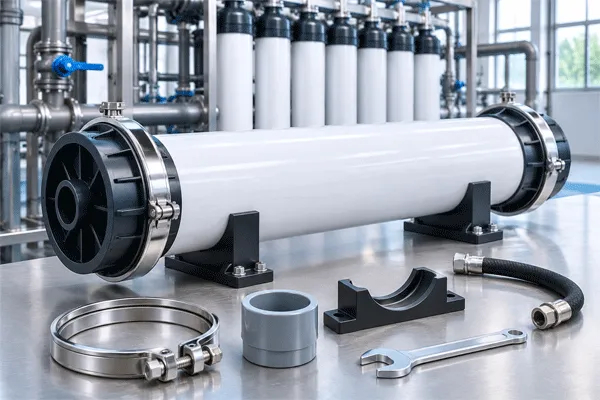
A membrane module is not an isolated filtration element. Its connection components help secure the module and connect it to the surrounding equipment.
The product illustration identifies several supporting components:
| Componente |
Funzione principale |
| Coupling Clamp |
Secures compatible connecting sections |
| Connector |
Provides a connection between designated ports or pipe sections |
| Saddle |
Supports the module or associated pipe arrangement |
| Wrench |
Assists with installation and tightening |
These components are particularly important during equipment assembly and replacement. Correct connections help maintain a secure installation and reduce the risk of leakage caused by improper fitting.
For project buyers, it is useful to confirm the accessory list before placing an order. Not every project uses the same connection arrangement, and accessory requirements may vary according to the module model and equipment design.
A complete technical inquiry should therefore identify the module model, connection dimensions, required fittings, installation orientation, and whether the customer needs replacement accessories.
[Image Placeholder – UF Membrane Module Components]
5. What Does a 0.01 μm Nominal Pore Size Mean?
The illustrated PVDF UF membrane module specifies a nominal pore size of 0.01 μm. This represents a fine filtration rating used for separating small suspended particles and colloidal materials from water.
During ultrafiltration, water passes through the membrane wall while larger particles are retained. Depending on membrane characteristics and operating conditions, the process can help remove:
- Suspended solids.
- Colloidal particles.
- Fine sediment.
- Many bacteria.
- Algae.
- Other particulate impurities.
For industrial applications, this filtration capability helps improve water clarity and reduce particulate loading on downstream equipment.
However, a nominal pore size should not be treated as a guarantee that every contaminant will be removed. Actual rejection performance depends on membrane integrity, pore distribution, feed-water characteristics, and operating conditions.
It is also important to distinguish UF from reverse osmosis. UF primarily targets particulate and microbial contamination. It does not provide significant removal of dissolved salts, so additional RO treatment may be needed when a project requires reduced conductivity or dissolved solids.
Banott’s wider industrial UF membrane range includes different nominal pore size options and membrane configurations. The appropriate specification should be confirmed against the selected model’s technical datasheet.
6. Is Modified PVDF Suitable for Industrial UF Applications?
The illustrated membrane module uses modified PVDF (polyvinylidene fluoride) as its membrane material.
PVDF is widely used in industrial membrane filtration because of its mechanical properties and chemical resistance characteristics. In this product design, the graphic also highlights hydrophilic modification, which is intended to improve the membrane’s interaction with water and help manage fouling.
The product’s stated advantages include:
High anti-fouling and hydrophilic characteristics
Modified PVDF is designed to provide improved surface wettability. This can help reduce the tendency of certain contaminants to adhere to the membrane surface, although actual fouling depends on the feed water and operating conditions.
Stable water flux
The membrane design targets stable filtration performance. Maintaining stable flux still requires appropriate design loading, pretreatment, and regular cleaning.
Chemical compatibility
The product graphic highlights compatibility with chemical cleaning. However, this does not mean unlimited resistance to all chemicals. The allowable pH, chemical concentration, temperature, and contact time must be confirmed for the selected module.
Mechanical reliability
The membrane and housing must withstand the pressure and mechanical conditions specified for the application.
Banott also offers other membrane materials, including PES, PAN, RPVDF, and RPES, across its industrial hollow fiber UF product range.
The best material depends on the raw water chemistry, operating temperature, cleaning method, and required filtration performance.
For a more detailed comparison, see our article: Membrana UF a fibra cava: PVDF vs PES e modalità di flusso.
7. How Do Filtration Direction and Pressure Configuration Affect Module Selection?
The illustrated pressurized UF membrane module supports outside-in and inside-out configuration options.
These are two different hydraulic arrangements, and buyers should confirm which configuration applies to the specific module they are purchasing.
Outside-in filtration
Feed water enters the space around the hollow fibers. Water passes through the membrane wall and enters the internal channels, while retained particles remain on the feed side.
Inside-out filtration
Feed water enters the internal channels of the hollow fibers and passes outward through the membrane wall. The filtered water is collected on the outside of the fibers.
The correct configuration depends on feed-water quality, fiber geometry, pretreatment requirements, and the manufacturer’s validated module design.
For pressurized installations, engineers should also verify the operating pressure range, maximum allowable pressure, pressure drop, and backwashing requirements.
These values are essential when matching a membrane module with feed pumps, valves, piping, and control equipment.
Do not assume that a module designed for one flow direction can automatically operate in the other direction. The internal sealing and connection arrangements must support the selected flow path.
8. Why Is a Hollow Fiber UF Membrane Used for RO Pretreatment?
Reverse osmosis membranes require suitable feed water to maintain stable operation. Suspended solids, colloids, and other particulate contaminants can increase fouling risks and create additional cleaning requirements.
A UF membrane module provides a physical filtration barrier before the RO stage. It helps reduce particulate loading and improve the consistency of the incoming water.
A typical treatment arrangement may follow this sequence:
Raw Water → Preliminary Filtration → Pressurized UF Membrane Module → UF Filtrate Tank → RO System
The main benefits of this arrangement include:
- Reduction of suspended solids and turbidity.
- Removal of many colloidal particles.
- Improved consistency of RO feed water.
- Reduced particulate fouling potential.
- Support for more stable downstream operation.
The product illustration specifically presents the module for RO pretreatment, highlighting its high packing density and stable filtration performance.
For EPC contractors and industrial plant owners, however, the UF stage should be designed around the actual RO feed-water requirements. Turbidity, SDI, recovery rate, water temperature, and chemical conditions should all be evaluated.
UF also cannot replace every type of pretreatment. Dissolved hardness, iron, manganese, organics, and other contaminants may require additional treatment depending on their form and concentration.
A properly designed UF-RO combination therefore starts with raw-water analysis and a complete process assessment.
[Image Placeholder – Hollow Fiber UF Membrane for RO Pretreatment]
9. Which Applications Can Use Pressurized Hollow Fiber UF Membranes?
The product illustration highlights several application areas for this membrane module. Its potential uses extend across municipal, industrial, and commercial water treatment.
| Applicazione |
Role of UF Membrane |
| RO Pretreatment |
Reduces suspended solids and colloidal loading before RO |
| Drinking Water Purification |
Improves water clarity and helps remove particulate contamination |
| Industrial Wastewater Reuse |
Provides membrane filtration for suitable treated wastewater |
| Food & Beverage Process Water |
Supports process-water filtration and pretreatment |
| Surface Water Treatment |
Helps remove algae, turbidity, and suspended particles |
| Groundwater Treatment |
Provides particulate filtration according to source-water conditions |
For drinking water projects, engineers should assess microbiological requirements and the complete treatment barrier. UF alone should not be assumed to provide all required drinking-water treatment.
For food and beverage facilities, the design should also consider hygiene requirements, cleaning chemicals, and compatibility with the production process.
In wastewater reuse projects, feed-water characteristics can vary significantly. Appropriate upstream treatment and cleaning arrangements are therefore essential.
Banott supplies hollow fiber UF membrane products for industrial water purification, municipal applications, and wastewater reuse. Our broader membrane portfolio also includes MBR, RO, and EDI products for integrated treatment processes.
10. What Should Buyers Confirm Before Ordering a UF Membrane Module?
For EPC contractors, system integrators, distributors, and industrial buyers, a clear technical specification can reduce procurement errors and improve equipment compatibility.
Before requesting a quotation, prepare the following information:
| Information Required |
Perché è importante |
| Fonte dell'acqua di alimentazione |
Helps identify pretreatment and material requirements |
| Portata richiesta |
Determines the required membrane area and module quantity |
| Dimensione nominale dei pori |
Defines the intended filtration rating |
| Materiale della membrana |
Must match water chemistry and cleaning conditions |
| Dimensioni del modulo |
Ensures compatibility with the existing rack or equipment |
| Filtration direction |
Determines the correct hydraulic connections |
| Flusso di progettazione |
Helps evaluate expected production capacity |
| Pressione di esercizio |
Ensures compatibility with pumps and system design |
| Connection specifications |
Prevents installation and piping mismatches |
| Cleaning requirements |
Supports long-term operation and maintenance |
| Integrity test requirements |
Defines quality verification before commissioning |
For replacement projects, also provide photographs of the existing membrane, model numbers, connection drawings, and equipment nameplates where available.
Banott supports customized membrane specifications and OEM/ODM requirements. Our team can review the application and help identify a suitable module configuration based on the information provided.
Modulo a membrana UF a fibra cava da 7 bore: caratteristiche progettuali e scelta del pretrattamento RO
11. How Can Banott Support Your Hollow Fiber UF Membrane Project?
At Qingdao Banott Environmental Technology Co., Ltd., we focus on membrane manufacturing and engineering-oriented water treatment solutions.
Our industrial hollow fiber UF membrane portfolio covers different materials, module dimensions, pore sizes, and filtration configurations. This allows us to support customers developing new filtration systems as well as those replacing existing membrane products.
Our support can include:
- Industrial hollow fiber UF membrane supply.
- Customized membrane module specifications.
- OEM and ODM manufacturing.
- Product technical documentation.
- Module connection and installation guidance.
- UF and RO pretreatment equipment integration.
- Technical support during project preparation and commissioning.
Whether you are an equipment distributor sourcing membrane modules, an EPC contractor preparing a water treatment tender, or an industrial plant upgrading its filtration equipment, our team can help evaluate your requirements.
Visit our Modulo di membrana UF a fibra cava industriale page to explore the available product configurations.
Contact Banott with your water analysis, required flow rate, existing equipment dimensions, and project application. We can help you identify a suitable hollow fiber UF membrane module for your next water treatment project.
Domande frequenti
What is a seven-bore hollow fiber UF membrane?
It is a hollow fiber membrane design with seven internal channels within one filament. The multi-channel cross-section is a structural feature that should be evaluated together with the membrane material, wall structure, and validated operating data.
What is the nominal pore size of the illustrated PVDF UF membrane module?
The supplied product graphic specifies a nominal pore size of 0.01 μm. Other UF module configurations may have different pore size ratings.
What are the dimensions of this hollow fiber UF membrane module?
The product illustration shows an approximate module size of 200 mm in diameter and 1,527.5 mm in length. Buyers should confirm the exact dimensions and connection positions against the selected model’s datasheet.
Can a PVDF UF membrane module be used before an RO system?
Yes. UF is commonly used as RO pretreatment to reduce suspended solids, colloids, and turbidity. The suitability of a specific module depends on feed-water conditions and the RO system’s inlet requirements.
Does a UF membrane remove dissolved salts?
No. Ultrafiltration mainly removes suspended particles, colloids, and many microorganisms. It does not significantly reduce dissolved salts. Reverse osmosis or another suitable desalination process is needed when dissolved-solids removal is required.
Can Banott customize hollow fiber UF membrane modules?
Yes. Banott supports customized module specifications and OEM/ODM requirements. Buyers can provide their required dimensions, membrane material, pore size, filtration configuration, and project conditions for technical evaluation.
Punti chiave da ricordare
- Seven-bore technology uses seven internal channels within one hollow fiber filament.
- The illustrated pressurized UF membrane module uses modified PVDF.
- The illustrated nominal pore size is 0.01 μm.
- The product graphic shows a module diameter of approximately 200 mm and a length of 1,527.5 mm.
- Coupling clamps, connectors, saddles, and installation tools are important connection and assembly considerations.
- Inside-out and outside-in are alternative filtration configurations that must match the selected module design.
- UF membranes are widely used for RO pretreatment, drinking water purification, industrial wastewater reuse, and process-water filtration.
- Proper module selection requires reviewing water quality, flow, pressure, dimensions, connections, and cleaning requirements.
- Banott provides industrial UF membrane products, customization, and engineering support for global water treatment projects.











 11:25