Équipe d'ingénierie en traitement de l'eau de Banott | Publié le 27 août 2026
Un modèle compact Système d'osmose inverse‘Le débit nominal en GPD est une valeur obtenue en conditions d'essai et ne constitue pas une garantie en conditions réelles d'utilisation. Le débit réel diminue lorsque l’eau d’alimentation est plus froide ou plus salée, et varie en fonction du nombre d’heures de fonctionnement quotidiennes. Dans la gamme publiée des petites machines d’osmose inverse (300 à 3 000 GPD), c’est l’adéquation de l’appareil aux conditions réelles d’alimentation — et non la valeur indiquée sur la plaque signalétique — qui détermine le modèle approprié pour un devis.
Dimensionnement des petits systèmes d'osmose inverse : guide de sélection pour des débits de 300 à 3 000 GPD
Le numéro figurant sur la plaque signalétique correspond à un résultat de test, et non à une promesse
Chaque élément d'osmose inverse (RO) disponible sur le marché est évalué selon des conditions de référence fixes : un TDS d'alimentation défini, une température définie (généralement 25 °C dans les protocoles d'essai des fabricants) et une pression d'alimentation définie. Cette valeur figure sur la fiche technique sous la forme “ 300 GPD ” ou “ 3 000 GPD ”. Ces chiffres sont réels, mais ils décrivent des conditions de laboratoire, et non un chantier à Lagos en juillet ou une installation au Kazakhstan en janvier.
Pour un distributeur qui soumissionne sur un marché où il n'est pas présent au quotidien, cet écart a davantage d'importance que pour un revendeur local. C'est l'eau d'alimentation de votre client final — sa salinité, ses variations de température au fil des saisons, ses heures d'utilisation réelles — qui servira de référence pour évaluer l'appareil, et non le chiffre indiqué sur l'emballage.
Trois variables qui influencent votre rendement réel
TDS et pression osmotique de l'alimentation
La séparation par osmose inverse fonctionne à l'encontre de la pression osmotique, qui augmente avec la salinité de l'eau d'alimentation. Si l'on applique la même pression d'alimentation à une eau présentant un TDS plus élevé, la force motrice nette à travers la membrane diminue, ce qui entraîne une baisse du débit de perméat. Une unité d’une capacité nominale de 1 000 GPD avec une eau d’alimentation à 500 ppm ne produira pas 1 000 GPD à partir d’un puits d’eau saumâtre à 2 000 ppm sans pression d’alimentation supplémentaire — et une unité compacte à passage unique ne peut appliquer qu’une pression supplémentaire limitée.
Température de l'alimentation
Une eau plus froide est plus visqueuse, et le débit de perméat à travers une membrane composite à couche mince diminue à mesure que la viscosité augmente. Selon une approximation technique générale applicable aux membranes d’osmose inverse en polyamide, le débit diminue d’environ 2–3% pour chaque degré Celsius en dessous du point de référence de 25 °C, et augmente d’une valeur comparable au-dessus de ce seuil. Une unité dimensionnée selon une courbe d’essai à 25 °C pour un marché où l’eau souterraine est à 15 °C part déjà d’une valeur inférieure à celle indiquée dans la fiche technique.
Cycle de service
Une capacité nominale de “ 3 000 GPD ” correspond généralement à un fonctionnement continu sur 24 heures. La plupart des systèmes compacts utilisés dans le secteur commercial ou l'industrie légère ne fonctionnent pas en continu : ils fonctionnent par cycles, avec un réservoir de stockage et en fonction de la demande. Une unité fonctionnant 10 heures par jour à son débit nominal fournit environ 40% du volume journalier nominal en fonctionnement continu, et non la valeur totale indiquée sur la plaque signalétique. Le sous-dimensionnement par rapport aux heures de fonctionnement réelles est l’une des raisons les plus courantes pour lesquelles un devis “ correctement dimensionné ” s’avère insuffisant sur le terrain.
Tableau des tailles : comment le rendement d'une même unité varie en fonction des conditions
Les chiffres ci-dessous constituent une illustration technique générique montrant comment s'appliquent les facteurs de déclassement, et non une courbe de performance publiée par Banott — Banott n'a publié aucune courbe de correction en fonction de la température ou de la fiche technique (TDS) pour la gamme « Small RO Machine », et tout chiffre de débit spécifique à un projet doit être validé auprès de l'usine en fonction du rapport réel sur l'eau d'alimentation.
| État de l'alimentation |
Par rapport à une référence à 25 °C / faible TDS |
Incidence sur une unité de 1 000 GPD indiquée sur la plaque signalétique |
| 25 °C, faible TDS (référence) |
100% |
Environ 1 000 GPD en continu |
| 15 °C, faible TDS |
~70–75% |
environ 700 à 750 GPD |
| 25 °C, TDS élevé (puits d'eau saumâtre) |
~80–90%, en fonction de la pression |
~800–900 GPD, ou nécessite une pression d'alimentation plus élevée |
| 15 °C, TDS élevé |
~55–65% |
environ 550 à 650 GPD |
| 25 °C, faible TDS, cycle de fonctionnement de 10 heures par jour |
1 001 TP3T au taux horaire, environ 401 TP3T par jour selon la capacité nominale |
~400 GPD/jour (débit réel) |
Considérez ce tableau comme une liste de contrôle pour le dimensionnement, et non comme un tableau de référence : l'idée est que la combinaison de deux facteurs de réduction de puissance — une alimentation à froid et un fonctionnement à temps partiel, par exemple — peut faire chuter le rendement quotidien réel bien en deçà de la moitié de ce que le client voit sur la fiche technique.
Dimensionnement des petits systèmes d'osmose inverse : guide de sélection pour des débits de 300 à 3 000 GPD
Dans quels cas la fourchette de 300 à 3 000 GPD s'applique-t-elle réellement ?
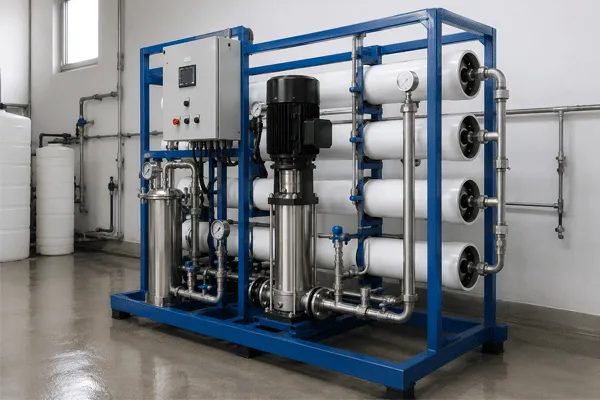
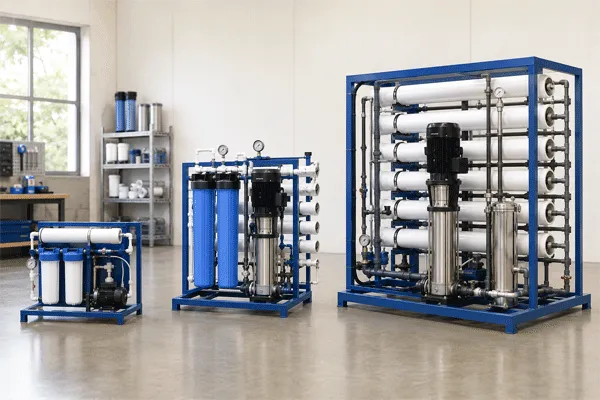
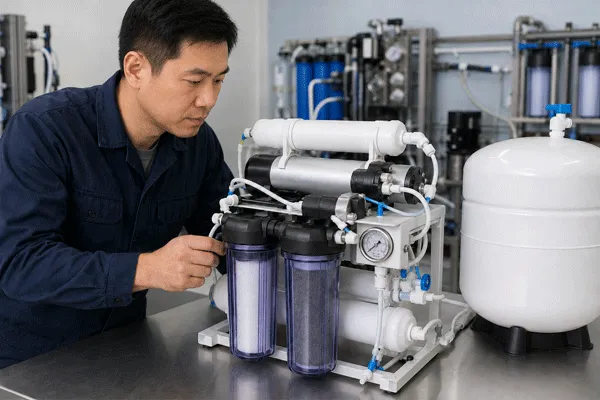
La petite machine d’osmose inverse (RO) de Banott se présente comme une unité compacte et intégrée combinant le prétraitement et l’osmose inverse dans un seul châssis, destinée aux applications commerciales et de l’industrie légère où l’encombrement au sol et la simplicité d’installation priment sur un débit élevé et continu. La plage de capacité indiquée est comprise entre 300 et 3 000 GPD. Au-delà de cette fourchette, la gamme de produits s'oriente vers des systèmes conteneurisés ou sur mesure plutôt que vers des unités compactes prêtes à l'emploi — une distinction qu'il convient de signaler dès le départ au client final, car une usine prévoyant de dépasser quelques milliers de gallons par jour se trompe de catégorie de produit.
Au sein de cette fourchette, un contrôle de taille en cinq étapes permet de garantir la validité d'un devis :
- Consultez le rapport sur l'eau d'alimentation du client : TDS, plage de températures au fil des saisons, dureté et tout risque connu d'encrassement (fer, silice, matières organiques).
- Convertissez le débit requis en un débit équivalent en continu en divisant le volume journalier cible par le nombre réel d'heures de fonctionnement prévues, et non par 24.
- Appliquez un coefficient de déclassement en fonction de la température d'alimentation la plus basse prévue sur le site, et non en fonction d'une moyenne annuelle.
- Vérifiez les caractéristiques techniques (TDS) par rapport à la plage de fonctionnement réelle de l'appareil et indiquez si une pression d'alimentation ou une configuration à deux passages serait nécessaire — cette information n'est pas publiée pour cette gamme et doit faire l'objet d'une demande spécifique auprès du fabricant.
- Dimensionnez en fonction de la puissance réduite, et non de la puissance nominale indiquée sur la plaque signalétique, et prévoyez une marge pour tenir compte de la baisse de performance de la membrane au cours de la période d'exploitation précédant le prochain cycle de nettoyage ou de remplacement.
Ce que publie Banott — et ce qui nécessite une demande directe
Le paramètre confirmé et officiellement annoncé pour cette gamme de produits est la plage de capacité : 300 à 3 000 GPD pour le modèle Compact Integrated Systèmes d'osmose inverse, destinée à un usage commercial et à l'industrie légère dans les espaces où la place disponible pour l'installation est limitée. Aucun prix de vente n'est indiqué pour cette gamme ; le site de Banott invite à demander un devis plutôt que d'afficher les tarifs.
Les informations suivantes ne figurent pas dans la documentation produit actuelle de Banott et doivent être confirmées directement auprès de l’usine avant d’être reprises dans la fiche technique de revente ou le dossier d’appel d’offres d’un distributeur : la liste détaillée des modèles et les paliers de capacité compris entre 300 et 3 000 GPD, la configuration du prétraitement incluse dans le châssis (filtration sur cartouche, adoucissement, dosage d'antiscalant), l'encombrement au sol et les dimensions d'expédition, les exigences en matière d'alimentation électrique, membrane les spécifications relatives à la taille des éléments et au taux de rejet du sel, ainsi que toutes les données de correction liées à la température ou au TDS. Aucune de ces données ne doit être estimée ni calculée à partir de normes générales du secteur lors de l'établissement d'un devis pour un projet spécifique ; elles doivent faire l'objet d'une réponse confirmée par le fabricant sur la base du rapport réel sur l'eau d'alimentation.
L'équipe d'ingénieurs de Banott, qui, selon l'entreprise, travaille depuis près de deux décennies dans le domaine de la séparation par membranes d'ultrafiltration et des applications d'ingénierie du traitement de l'eau, fonde son processus sur les données d'eau entrante fournies par le client plutôt que sur une référence de catalogue — ce qui correspond à la même approche que celle suivie par cette méthode de dimensionnement.
L'erreur de prétraitement qui conduit à sous-estimer chaque devis
L’erreur la plus courante dans le dimensionnement d’un système d’osmose inverse compact ne réside pas dans le calcul de déclassement présenté ci-dessus, mais dans le fait de considérer l’étage de prétraitement intégré comme une constante fixe, quelle que soit la qualité de l’eau d’alimentation. Le prétraitement intégré à une unité compacte est dimensionné pour une plage de caractéristiques d’eau d’alimentation bien définie. Si l’on y fait passer une eau d’alimentation présentant une turbidité ou une teneur en fer supérieure à celle pour laquelle l’unité a été configurée, l’étape de prétraitement s’encrasse plus rapidement, ce qui oblige le système à passer plus souvent en mode nettoyage ou en veille, et le efficace le débit journalier chute bien en dessous des valeurs indiquées dans le tableau de dimensionnement ci-dessus — même si l'étage d'osmose inverse est lui-même correctement adapté au TDS et à la température. Un rapport sur l'eau d'alimentation qui ne mentionne que le TDS et omet la turbidité, le fer et la silice ne constitue pas une base suffisante pour établir un devis, et cette lacune apparaît plusieurs mois après l'installation plutôt qu'au moment de la mise en service.
Dimensionnement des petits systèmes d'osmose inverse : guide de sélection pour des débits de 300 à 3 000 GPD
En quoi cela diffère-t-il des modèles vendus au détail avec une liste des caractéristiques ?
Contrairement aux listes à puces courantes sur les sites de vente en ligne généralistes — où un appareil d'une capacité de 300 GPD est vendu sur membrane le nombre d'étages et les intervalles de remplacement des filtres plutôt que la méthodologie de dimensionnement — un distributeur qui établit un devis pour des clients du secteur commercial ou de l'industrie légère doit s'assurer que les variables relatives au TDS, à la température et au cycle de service sont prises en compte avant la vente, et non découvertes après coup lorsque l'appareil ne fonctionne pas correctement sur site. C’est précisément cette lacune que cette approche de dimensionnement vise à combler, et c’est également là que le soutien technique apporté au distributeur par le fabricant devient partie intégrante de ce qui est réellement revendu, et non plus seulement le matériel.
Les compromis, pour le dire clairement
- Le dimensionnement en fonction de la puissance réduite, et non de la puissance nominale, permet de protéger le devis, mais implique généralement de recommander un modèle plus grand que celui initialement demandé par le client — il convient de l'expliquer dès le départ, car cela a une incidence sur le prix.
- Ce format compact et intégré, qui facilite l’installation, limite également les exigences en matière de qualité de l’eau d’alimentation ou de débit avant que la catégorie de produit elle-même ne devienne inadaptée au projet.
FAQ
Q : La plage de 300 à 3 000 GPD s'applique-t-elle quelle que soit la température d'alimentation ?
R : Non. Cette fourchette correspond à la plage de capacité publiée pour la gamme de produits ; le débit réel sur un site donné dépend de la température de l'eau d'alimentation, de la teneur en TDS et du cycle de fonctionnement, autant de paramètres qui ne sont pas pris en compte par une seule courbe de déclassement publiée pour ce produit. Veuillez vérifier le débit spécifique à votre projet auprès du fabricant en vous référant au rapport sur l'eau d'alimentation.
Q : Existe-t-il une liste de prix publiée pour cette gamme de capacités ?
R : Non. Banott communique publiquement la fourchette de capacités, mais exige une demande de devis spécifique plutôt que de proposer des prix catalogue ; par conséquent, tout prix indiqué par un distributeur doit provenir d'un devis d'usine récent et non d'un projet antérieur.
Q : Quelles données relatives à l'eau d'alimentation un distributeur doit-il recueillir avant de demander un devis ?
R : Au minimum, le TDS, l'amplitude thermique saisonnière, la turbidité, la teneur en fer et en silice, ainsi que le programme quotidien prévu en termes d'heures de fonctionnement. L'absence de données pertinentes pour le prétraitement (turbidité, fer, silice) est une cause fréquente de sous-performance d'une installation dimensionnée après sa mise en service, même si le dimensionnement de l'étage d'osmose inverse était correct.
Q : Est-il possible de faire fonctionner un appareil situé dans le haut de la gamme pendant un nombre d'heures plus important afin de dépasser son rendement journalier nominal ?
R : Le fait de faire fonctionner le système au-delà du cycle de service de référence augmente le risque d'encrassement et la fréquence de nettoyage sans pour autant améliorer le rendement durable ; de plus, la durée de vie prévue des membranes pour cette gamme n'est pas publiée — il convient donc de vérifier ce point auprès du fabricant plutôt que de se baser sur les pratiques générales d'exploitation des systèmes d'osmose inverse.
Q : Au-delà de 3 000 GPD, quelle solution Banott propose-t-elle à la place ?
R : La plage de 300 à 3 000 GPD correspond plus précisément au format compact et intégré des petites stations d’osmose inverse (RO). Les besoins en volumes plus importants relèvent des gammes de produits Banott composées de systèmes conteneurisés et sur mesure, plutôt que de ce format compact sur châssis.











 09:09
09:09