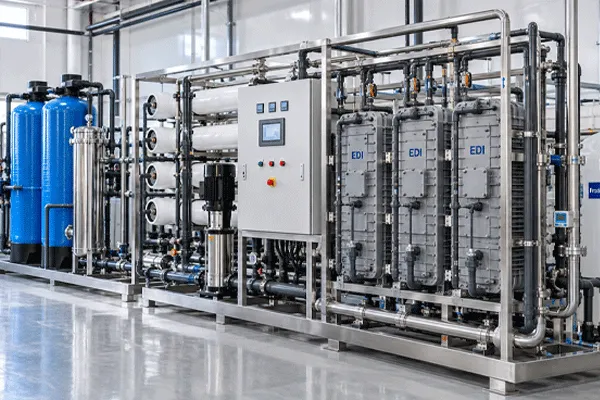
Cloudy water, chlorine smell, sediment, hard-water scale, or concern about microorganisms can make homeowners search for one “best” filter. The problem is that no single technology solves every water problem. The right solution starts with understanding your water, then matching the treatment stages to it.
The best whole house water filter is a system designed for your specific water quality. For many homes, this means combining sediment filtration with carbon and ultrafiltration. Hard water may need a water softener, microbial risks may call for UF or UV, and high dissolved salts may require a reverse osmosis system. Test your water first, then select the treatment technologies that address the contaminants actually present.
Was ist der beste Wasserfilter für das ganze Haus? Ein Leitfaden zu den besten Wasserfiltersystemen für das ganze Haus
Gliederung des Artikels
- What makes a whole house water filter the best choice?
- How does a whole house water filtration system work?
- Which contaminants should your filter remove?
- What are the 5 best whole house water treatment approaches?
- Is ultrafiltration a good whole house filter?
- Do city water and well water need different filtration systems?
- Do you need carbon, a water softener, UV, or RO?
- How should flow rate and water pressure affect filter selection?
- What maintenance and filter replacement are required?
- How do you choose the best system for your home?
- Häufig gestellte Fragen
What Makes the Best Whole House Water Filter?
The best whole house water filter is not simply the product with the most filter stages, the smallest pore size, or the highest price. A good filtration system must solve the actual problems found in your water while still delivering enough water flow for normal use.
This is why we start with a water test when designing a system. The test helps identify sediment, hardness, dissolved minerals, iron, manganese, chlorine, microbial concerns, and other water contaminants that may be present in your water.
The CDC takes the same basic approach: different filters remove different substances, so homeowners should understand their water before choosing a treatment system. A whole-home or point-of-entry system treats water as it enters the building, allowing water from multiple taps to receive treatment.
A useful rule is simple:
Do not buy a filter first and look for a problem later. Test the water first, then design the filter around the problem.
For example, a home supplied with chlorinated municipal water may need sediment, carbon, and ultrafiltration. A private well with iron, hardness, microorganisms, and heavy sediment may need several additional treatment stages.
That difference matters.
How Does a Whole House Water Filtration System Work?
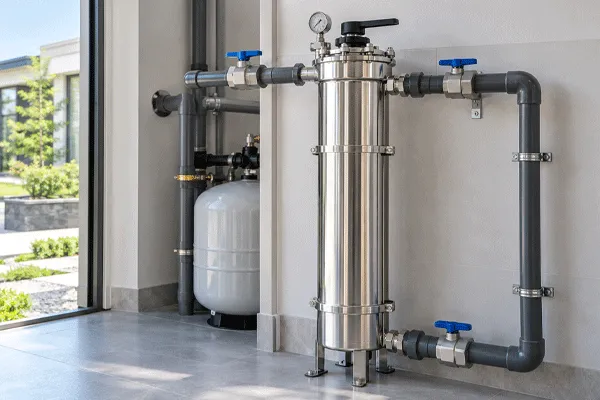
A whole house water filtration system is normally installed on the home’s main water line before water reaches faucets, showers, appliances, and the water heater.
A basic layout may look like this:
Water Source → Sediment Filter → Carbon Filter → UF Membrane → Household Distribution
A more complex system may use:
Raw Water → Pretreatment → Iron Removal → Water Softener → UF → UV → Storage/Distribution
For higher-purity applications:
Pretreatment → UF → Reverse Osmosis → Storage → Final Polishing
Each filter performs a different job.
A sediment filter catches sand, rust, pipe scale, and suspended particles. Carbon filtration helps with chlorine, taste, odor, and selected organic substances. Ultrafiltration provides a much finer physical membrane barrier. A softener reduces hardness. UV targets microorganisms. An RO system removes many dissolved substances.
That is why modern water filtration systems often use multiple stages of filtration rather than expecting one filter media to do everything.
Point-of-Use vs. Whole House Filtration
| Systemtyp |
Where It Treats Water |
Typical Application |
| Faucet filter |
One faucet |
Drinking/cooking |
| Under-sink filter |
One kitchen point |
Drinking water |
| RO under-sink system |
One outlet |
Higher-purity drinking water |
| Whole house filter |
Main incoming line |
Water throughout the home |
| Commercial UF system |
Building inlet |
Villas, hotels, apartments |
| Industrial treatment system |
Process line |
Manufacturing and process water |
A whole house system can therefore improve water from every tap in your home instead of treating only kitchen drinking water.
Which Contaminants Should Your Whole House Filter Remove?
Before selecting a filter for your home, identify the problem.
Many homeowners focus on what water looks or smells like. Those clues can help, but they do not tell the full story. The CDC notes that harmful contaminants may not always change water’s taste, smell, or appearance.
Typical issues include:
- Sand and sediment
- Rust particles
- Trübung
- Chlor
- Unpleasant taste or odor
- Calcium and magnesium hardness
- Eisen und Mangan
- Bakterien
- Parasites
- Gelöste Salze
- Selected heavy metals
- Organic contaminants
No single filter handles all of them equally well.
| Water Problem |
Common Treatment Technology |
| Sand / rust / sediment |
Sediment filter |
| Trübung |
Sediment filtration + UF |
| Chlorine taste and odor |
Aktivkohle |
| Bakterien |
Ultrafiltration / UV / RO |
| Parasites |
Ultrafiltration / RO |
| Hard water |
Water softener |
| High TDS |
Reverse osmosis system |
| Eisen / Mangan |
Oxidation + dedicated filter media |
| Gelöste Salze |
Umkehrosmoseanlage |
| Fine suspended solids |
Ultrafiltration |
The CDC describes ultrafiltration as having a typical pore size around 0.01 micron and identifies it as effective against parasites and bacteria. It does not, however, function as a general chemical-removal process. Reverse osmosis provides much tighter separation and can remove various dissolved substances.
This is exactly why the best water treatment solution is often a treatment train rather than one filter.
What Are the 5 Best Whole House Water Treatment Approaches?
People searching for the “5 best whole house water filters” often expect a list of five brands. From an engineering point of view, it is more useful to compare five treatment approaches.
1. Sediment Filtration
A sediment filter is often the first treatment stage.
It protects downstream equipment from:
- Sand
- Rust
- Pipe scale
- Suspended matter
- Larger particulate impurities
For relatively clean city water, a cartridge may be enough.
For dirty private well water, larger multimedia or automatic backwashing filters may be required.
2. Activated Carbon Filtration
A carbon filter is commonly used when chlorine, odor, or taste is the main concern.
This makes carbon particularly useful for municipal water supplies.
NSF/ANSI 42 covers products certified for aesthetic effects such as chlorine taste and odor reduction, while NSF/ANSI 53 addresses specific contaminant reduction claims related to health effects. Certification does not mean every filter removes every contaminant; buyers should check the exact reduction claim.
3. Ultrafiltration
UF is one of the strongest options when the goal is fine physical filtration without removing most dissolved mineral salts.
A Hohlfaser-UF-Membran can help control:
- Fine sediment
- Trübung
- Schwebstoffe
- Many bacteria
- Parasites
This makes it attractive for whole-house water filtration, commercial buildings, villas, apartments, hotels, and RO pretreatment.
4. Water Softening
A water softener addresses a different problem: hardness.
Hard water is normally caused mainly by dissolved calcium and magnesium. These minerals can cause scale on fixtures, inside pipes, and around heating equipment.
A standard UF filter does not solve hardness.
NSF/ANSI 44 relates specifically to cation-exchange water softeners used to reduce hardness.
5. Reverse Osmosis
A reverse osmosis system provides much stronger dissolved-solids removal.
RO may be appropriate when the source contains high TDS, nitrate, salinity, or other dissolved substances that cannot be removed effectively with basic sediment, carbon, or UF treatment.
For a typical residence, whole house reverse osmosis systems are not automatically the best choice because they require more pressure, pretreatment, storage, wastewater management, and system capacity.
Use RO when the water quality actually requires it.
Was ist der beste Wasserfilter für das ganze Haus? Ein Leitfaden zu den besten Wasserfiltersystemen für das ganze Haus
Is Ultrafiltration a Good Whole House Filter?
For many applications, yes.
Ultrafiltration can be an excellent whole house filter when the main objective is to reduce suspended impurities and microorganisms while maintaining high flow and retaining most dissolved minerals.
A whole-house UF system normally uses a membrane installed on the incoming water line. Water passes through the membrane before it is distributed throughout your home.
Compared with many small cartridge filters, a purpose-built whole-house UF unit can offer:
- Larger treatment capacity
- Fine physical filtration
- High water flow
- Washable membrane options
- Compact stainless steel housing
- Lower operating pressure than RO
- Centralized treatment
- Reduced turbidity
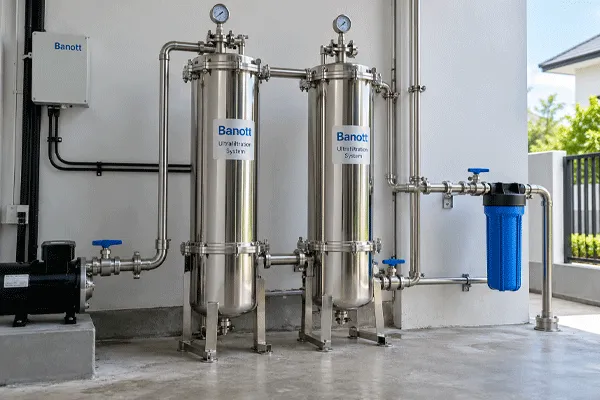
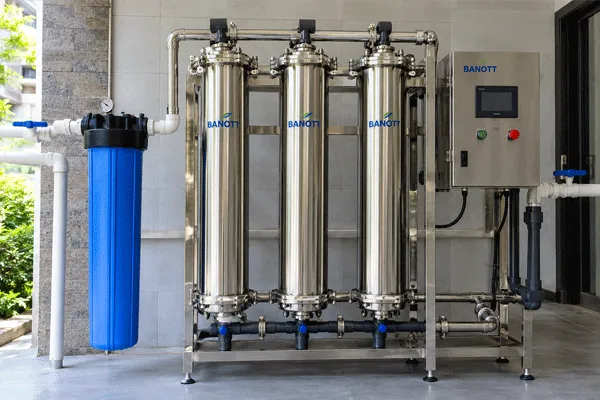
For larger residential properties, Banott designs vertical stainless-steel whole-house UF equipment using washable PVDF membrane elements. Depending on the configuration, these systems can use manual or automatic valves and can be sized for different water usage levels.
For installations with limited space, horizontal compact UF housings can also be used.
When UF Is Not Enough
UF should not be presented as a universal water purifier.
It generally does not solve:
- High hardness
- High TDS
- Salinity
- All dissolved heavy metals
- Chlorine taste by itself
- Every dissolved chemical contaminant
When those problems exist, another treatment technology should be added.
That is good engineering—and it prevents customers from buying the wrong filtration system.
Do City Water and Well Water Need Different Filtration Systems?
Usually, yes.
City Water
Municipal city water has normally already passed through a public treatment process.
Typical homeowner concerns may include:
- Chlor
- Sediment from distribution pipes
- Taste and odor
- Härte
- Feinstaub
- Aging plumbing
A common configuration could be:
Sediment → Carbon → UF
If water hardness is high:
Sediment → Carbon → Softener → UF
One important consideration is chlorine removal. CDC guidance notes that whole-home systems that remove chlorine or other disinfectants can allow more microbial growth in downstream plumbing if maintenance is poor.
So more filtration is not automatically better.
Well Water
If you’re on well water, the treatment challenge is often more complex.
Private well water may contain:
- Sand
- Eisen
- Mangan
- Härte
- Bakterien
- Sulfur odors
- Hohe Trübung
- Nitrat
- Other dissolved minerals
The CDC recommends periodic testing of private wells because water conditions can change.
A typical private well water system might look like:
Well → Oxidation → Sediment/Multimedia Filter → Iron Removal → Softener → UF → UV
But the exact design should follow the water test.
This is especially important because contaminants found in well water vary greatly by region and geology.
Do You Need Carbon, a Water Softener, UV, or an RO System?
Think of each treatment process as a specialist.
Carbon
Use carbon when the concern is mainly:
- Chlor
- Taste
- Odor
- Selected organic compounds
Water Softener
Use a water softener when your water problem is primarily:
- Hard water
- Scale
- Kalzium
- Magnesium
UV
UV is useful when microbial control is the main concern.
NSF/ANSI 55 applies to ultraviolet microbiological water treatment systems.
Umkehrosmose
Use a reverse osmosis system when you need stronger removal of dissolved substances.
This may include applications where the goal is low-TDS drinking water, process water, or higher-purity water.
UF
Use UF when you need strong particulate and microbial barrier filtration with good flow.
Quick Selection Chart
| Your Main Problem |
Recommended Starting Point |
| Visible sediment |
Sediment filter |
| Chlorine smell |
Kohlefilter |
| Hard-water scale |
Water softener |
| Bacteria concern |
UF + optional UV |
| High TDS |
RO |
| Sediment + bacteria |
Sediment + UF |
| Chlorine + sediment + fine particles |
Sediment + carbon + UF |
| Complex well water |
Customized multi-stage system |
If several problems exist, combine technologies.
That is usually the best system.
How Do Water Flow and Pressure Affect the Best System for Your Home?
A filter can remove the right contaminants and still be the wrong filter if it cannot provide enough water.
Whole home systems must handle simultaneous demand from:
- Showers
- Toilets
- Kitchen faucets
- Washing machines
- Dishwashers
- Outdoor taps
- Other household equipment
If five people use water at the same time, peak demand can be much higher than average daily use.
This is why water flow matters.
A whole house filtration system should be sized according to:
- Peak flow requirement
- Number of bathrooms
- Number of occupants
- Available water pressure
- Feed-water turbidity
- Membrane or filter pressure drop
- Future water usage
For UF equipment, membrane area also matters.
If too much water is pushed through too little membrane area, pressure loss and fouling can increase.
When we size a system, we therefore do not simply look at the pipe diameter. We review the whole operating condition.
Typical Engineering Example
Consider a large villa requiring up to 5,000 L/H during periods of high simultaneous demand.
Installing a filter rated for exactly 5,000 L/H under ideal test conditions may provide too little design margin.
The engineering review should also consider:
- Futtertemperatur
- Druck
- Sediment loading
- Expected membrane fouling
- Rückspülung
- Peak demand
This approach produces more stable overall water performance than choosing a system from flow rating alone.
What Maintenance and Filter Replacement Are Required?
Every filter requires maintenance.
A claim such as “install it once and forget it” should make you cautious.
Maintenance may include:
- Sediment cartridge replacement
- Carbon media replacement
- UF flushing
- UF chemical cleaning
- Water softener salt refill
- UV lamp replacement
- Pressure inspection
- Valve inspection
The CDC warns that microorganisms can grow in filters that are not properly maintained. Filters and treatment equipment should therefore be serviced according to the manufacturer’s instructions.
NSF also emphasizes including replacement-filter cost and maintenance requirements when evaluating a home water treatment system.
Was ist der beste Wasserfilter für das ganze Haus? Ein Leitfaden zu den besten Wasserfiltersystemen für das ganze Haus
Common Maintenance Indicators
A filter change may be needed when you notice:
- Higher pressure drop
- Lower flow
- Declining water clarity
- Return of chlorine taste
- Increasing turbidity
- Manufacturer service interval reached
For washable whole-house UF systems, membrane flushing can reduce the frequency of complete membrane replacement.
However, operating conditions still determine actual service life.
There is no universal filter replacement period for every water source.
How Do You Choose the Best Whole House Water Filtration System?
When looking for the best whole house water filtration solution, use a process instead of a product ranking.
Step 1: Get Your Water Tested
If you use municipal water, review the utility’s water-quality information and test for concerns specific to the home.
If you use a private well, laboratory testing is even more important.
Step 2: Define Your Goal
Do you want:
- Better taste?
- Less chlorine?
- Less sediment?
- Microbial protection?
- Hardness reduction?
- Low TDS?
- Better shower water?
- Protection for appliances?
- Higher-quality water for drinking?
Different goals require different technologies.
Step 3: Match Each Problem to a Treatment Stage
Do not add treatment stages simply because they sound advanced.
Zum Beispiel:
Good municipal water + sediment:
Sediment + UF
Municipal water + chlorine + sediment:
Sediment + carbon + UF
Hard municipal water:
Sediment + carbon + softener + optional UF
Microbiologically uncertain well water:
Pretreatment + UF + UV
High-TDS water:
Pretreatment + reverse osmosis
Step 4: Size the System Correctly
Make sure the filtration system for your home supports peak demand without creating an unacceptable pressure loss.
Step 5: Consider Maintenance
The best system is not only effective on day one.
It should remain practical to:
- Clean
- Rückspülung
- Replace
- Monitor
- Dienst
Step 6: Check Verified Performance Claims
NSF standards can help buyers understand whether products have been evaluated for specific performance claims.
NSF/ANSI 42, 53, 55, and 58 apply to different treatment technologies and contaminant-reduction functions. A certification number alone does not mean a product removes everything; always check the exact certified claim.
Why Engineering Matters More Than a “Water Filters We Tested” Ranking
Consumer articles often present “water filters we tested” lists and choose one winner.
That approach can be useful for simple countertop products. It is less useful for a full whole home filtration system.
Two houses on the same street may have different treatment needs because of:
- Internal plumbing
- Water heater condition
- Pipe corrosion
- Well characteristics
- Water consumption
- Required flow
- Behandlungsziele
For larger villas, hotels, farms, apartment buildings, distributors, and commercial projects, we take an engineering approach.
As a manufacturer of hollow fiber UF membranes, RO-Membranen, MBR-Membranen, EDI-Module, small RO equipment, pure-water plants, and integrated treatment systems, we can combine technologies instead of forcing every customer into one standard product.
That may mean a simple UF unit.
Or it may mean:
Pretreatment + Carbon + UF + RO + UV + PLC Control
The right solution depends on the application.
Häufig gestellte Fragen
What is the best whole house water filter for city water?
For many city-water applications, a combination of sediment filtration, carbon, and ultrafiltration provides a useful starting point. Sediment removes particles, carbon helps reduce chlorine taste and odor, and UF provides fine physical membrane filtration. However, you should verify local water conditions before choosing the system.
What is the best whole house water filter for well water?
There is no universal best filter for private well water. Test the well first. Depending on results, the system may require sediment removal, oxidation, iron and manganese filtration, water softening, UF, UV, or RO.
Does a whole house water filter make water safe to drink?
It depends on the system and the contaminants present. A sediment filter alone does not make unsafe water potable. Choose treatment technologies that specifically address the harmful substances identified in your water test.
Do I need reverse osmosis for the entire home?
Usually not unless there is a specific need for strong dissolved-solids removal throughout the home. Whole-house RO can require large membranes, pumps, storage, pretreatment, and concentrate management. In many homes, UF or conventional whole house filtration plus a point-of-use RO system may be more practical.
Can a whole house filter remove hard water?
A normal sediment, carbon, or UF filter does not significantly reduce hardness. If calcium and magnesium cause scale, add a proper water softener or other hardness-control system.
Where are whole house filtration systems installed?
They are normally installed on the home’s main water line before water is distributed to fixtures and appliances. This lets the system treat water before it reaches every tap in your home.
Final Thoughts: There Is No Single Best Filter—Only the Best System for Your Water
The best whole house water treatment system is not defined by how many filters it has.
It is defined by whether it solves your actual water-quality problems while delivering reliable flow and manageable maintenance.
For many properties, whole-house ultrafiltration provides an effective central barrier against fine suspended material and microorganisms. Add carbon when chlorine and odor matter. Add softening for hard water. Add UV for additional microbial control. Add RO when dissolved contaminants require stronger separation.
That approach gives you a system built around the water—not marketing claims.
For residential developments, villas, hotels, farms, distributors, EPC contractors, and commercial projects, we can develop customized whole house water filter, UF, RO, and integrated membrane-treatment systems based on feed-water analysis, capacity, installation space, automation requirements, and target water quality.
Wichtige Punkte, die man beachten sollte
- Get your water tested before buying a whole house filter.
- The best whole house water filter depends on the contaminants present.
- Sediment filters protect downstream equipment from particles.
- Carbon filters are useful for chlorine, odor, and taste.
- Ultrafiltration is effective for fine suspended matter, parasites, and many bacteria.
- A water softener is required when hardness is the main problem.
- Reverse osmosis is more suitable when dissolved salts must be removed.
- City and well water usually require different treatment strategies.
- Flow rate and water pressure matter just as much as filtration accuracy.
- Whole-house water equipment requires regular inspection and maintenance.
- Verified contaminant-reduction claims are more useful than vague “best filter” labels.
- A properly engineered multi-stage treatment system can provide more stable water quality than a one-size-fits-all filter.












 09:53