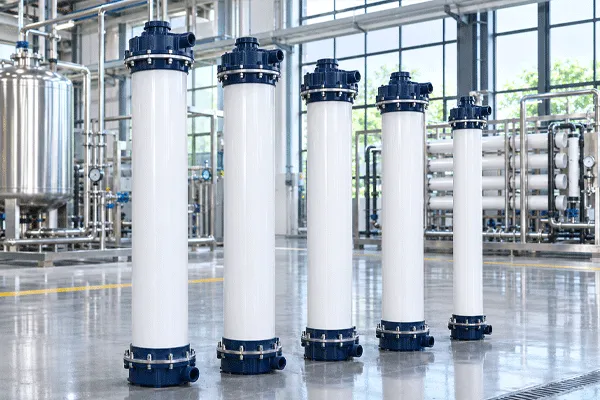
Semiconductor manufacturing depends on extremely clean water. Even small amounts of dissolved ions, silica, or organic impurities can affect wafer cleaning and product quality. A poorly designed purification process can increase operating costs and production risks. A properly integrated EDI system helps maintain stable ultrapure water production.
Electrodeionization (EDI) is an advanced water purification process that combines ion exchange resin, selective membranes, and direct electrical current to remove residual ionic impurities from pretreated water. When integrated with reverse osmosis (RO), EDI helps semiconductor facilities produce high-purity water for demanding manufacturing processes.
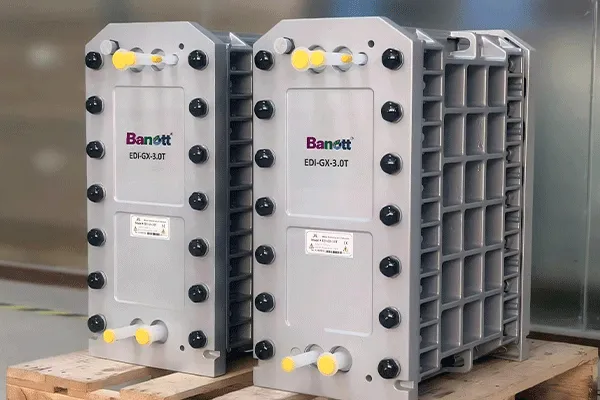
Electrodeionization Water Treatment for Semiconductor Manufacturing: How EDI Supports Ultrapure Water Systems
مخطط المقال
- Why Does Semiconductor Manufacturing Need Electrodeionization Water Treatment?
- Where Does EDI Fit in a Semiconductor Ultrapure Water System?
- How Do Reverse Osmosis and EDI Work Together?
- Which Ions and Impurities Must Be Controlled?
- What Water Quality Parameters Should an EDI System Meet?
- What Final Polishing Technologies Are Needed After EDI?
- How Should EDI Capacity Match Semiconductor Water Demand?
- How Do Automation and Monitoring Maintain Stable Water Quality?
- What Engineering and Commissioning Checks Are Important?
- How Can an Integrated Water Treatment Manufacturer Support Your Project?
1. Why Does Semiconductor Manufacturing Need Electrodeionization Water Treatment?
Water plays an important role in semiconductor production. It is used for wafer rinsing, equipment cleaning, surface preparation, and other manufacturing processes. These applications require water with very low levels of dissolved minerals and other contaminants.
Even small amounts of sodium, calcium, chloride, or silica can leave unwanted residues on sensitive surfaces. Organic compounds and particles may also affect cleaning results. As semiconductor manufacturing becomes more precise, the need for stable ultrapure water (UPW) becomes increasingly important.
A conventional RO system removes most dissolved salts, but some residual ions may remain in the permeate. This is where electrodeionization water treatment becomes valuable. By combining ion exchange and electrical separation, EDI provides an additional purification stage that helps reduce the remaining ionic content.
For semiconductor facilities, the main objectives include:
- Maintaining stable water resistivity.
- Reducing residual dissolved ions.
- Supporting consistent wafer cleaning.
- Controlling silica and other ionic contaminants.
- Reducing dependence on chemical resin regeneration.
- Maintaining continuous water production.
- Protecting sensitive manufacturing processes.
The result is a more controlled water supply that supports product consistency and manufacturing reliability.
2. Where Does EDI Fit in a Semiconductor Ultrapure Water System?
An EDI unit is normally installed after reverse osmosis. It is not designed to replace the complete pretreatment process or remove every type of contaminant from raw water.
Instead, it performs final deionization by removing residual ionic impurities from RO permeate. This makes it an important part of an integrated water purification system.
A typical semiconductor water treatment process may follow this arrangement:
Raw Water
    ↓
Multimedia Filtration
    ↓
Activated Carbon / Dechlorination
    ↓
Ultrafiltration, If Required
    ↓
Cartridge Filtration
    ↓
First-Pass Reverse Osmosis
    ↓
Second-Pass Reverse Osmosis
    ↓
EDI System
    ↓
UV Oxidation
    ↓
Polishing Mixed Bed, If Required
    ↓
Final الترشيح الفائق
    ↓
Ultrapure Water Storage
    ↓
Distribution Loop
    ↓
Semiconductor Manufacturing
The exact process depends on the source water, production capacity, required water specifications, and the sensitivity of the manufacturing process.
Each treatment stage has a different responsibility:
| مرحلة العلاج |
الوظيفة الرئيسية |
| المعالجة المسبقة |
Removes suspended solids and protects downstream equipment |
| UF |
Reduces particles and microorganisms |
| RO |
Removes most dissolved salts and contaminants |
| EDI |
يزيل الشوائب الأيونية المتبقية |
| الأشعة فوق البنفسجية |
Supports microbial and organic control, depending on the UV configuration |
| التلميع النهائي |
Controls remaining trace contaminants |
| حلقة التوزيع |
Maintains water quality during delivery |
At Banott, we approach high-purity water production as a complete engineering process. Our محلول الماء فائق النقاء integrates double-pass RO, continuous EDI, UV oxidation, and additional polishing technologies according to project requirements.
3. How Do Reverse Osmosis and EDI Work Together?
التناضح العكسي and electrodeionization perform different but complementary functions.
RO uses a semipermeable membrane to separate dissolved salts and other contaminants from water. Under pressure, water passes through the membrane while most dissolved substances remain in the concentrate stream.
However, RO permeate may still contain a small amount of dissolved ionic material. EDI provides the additional deionization stage needed to reduce this residual ionic load.
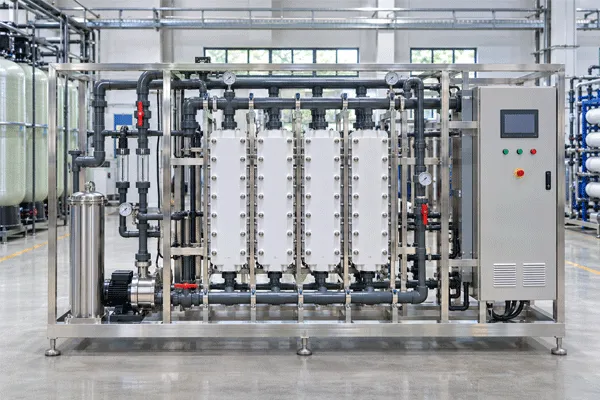
Inside an EDI module, three main components work together:
- Ion exchange resin: Captures dissolved ions and provides conductive pathways.
- Ion exchange membranes: Allow selected cations and anions to migrate.
- Direct-current power: Creates the electrical field that drives ion separation.
The resin helps capture ions from the feed water. Under the electrical potential, positively charged ions move toward the cathode, while negatively charged ions move toward the anode. Selective membranes direct these ions into concentrate channels.
At the same time, water splitting produces hydrogen and hydroxide ions that continuously regenerate the resin.
This is a major advantage of EDI compared with conventional ion exchange, where exhausted resin normally requires acid and caustic regeneration.
For semiconductor applications, the division of work is straightforward:
| التكنولوجيا |
Primary Responsibility |
| RO |
Bulk desalination |
| EDI |
Residual ionic removal |
| الأشعة فوق البنفسجية |
Additional oxidation and microbial control |
| التلميع النهائي |
Additional water quality protection |
Combining RO and EDI creates a more complete purification process than relying on either technology alone.
Electrodeionization Water Treatment for Semiconductor Manufacturing: How EDI Supports Ultrapure Water Systems
4. Which Ions and Impurities Must Be Controlled?
Semiconductor manufacturing requires more than ordinary filtered water. Engineers must consider the different types of contaminants that can affect product quality.
The main concern for EDI is the presence of dissolved ionic substances.
These include:
Positive ions (cations):
- Sodium (Na⁺)
- Calcium (Ca²⁺)
- Magnesium (Mg²⁺)
- Potassium (K⁺)
- Ammonium (NH₄⁺)
Negative ions (anions):
- Chloride (Cl⁻)
- Sulfate (SO₄²⁻)
- Nitrate (NO₃⁻)
- Bicarbonate (HCO₃⁻)
- Silicate species
EDI removes these ionized substances through ion exchange, selective membranes, and electrical separation.
However, not all contaminants behave in the same way. Some organic compounds, particles, microorganisms, and dissolved gases require different treatment technologies.
For example, carbon dioxide can pass through RO membranes in dissolved molecular form and later contribute to the ionic load inside the EDI process. Silica and residual hardness can also create operating problems if their concentrations exceed the selected module’s limits.
The following table summarizes important water quality concerns:
| المعلمة |
Potential Impact |
Possible Treatment Consideration |
| الصلابة |
مخاطر التوسع |
Softening and RO |
| ثاني أكسيد الكربون |
Increased ionic loading |
Degassing or pH adjustment |
| السيليكا |
Scaling and product quality problems |
RO and feed-water control |
| الصوديوم |
Residual ionic contamination |
RO and EDI |
| كلوريد |
Ionic contamination |
RO and EDI |
| جدول المحتويات |
التلوث العضوي |
Activated carbon and UV oxidation |
| الجسيمات |
Fouling and contamination |
UF and final filtration |
| الكائنات الدقيقة |
Water hygiene risks |
UV and sanitary system design |
A reliable design should evaluate the complete feed-water analysis instead of focusing on only one conductivity value.
5. What Water Quality Parameters Should an EDI System Meet?
Water resistivity is one of the most important indicators used to evaluate high-purity water.
As the concentration of dissolved ions decreases, electrical conductivity generally decreases and resistivity increases.
For reference, the theoretical resistivity of pure water at 25°C is approximately 18.2 MΩ·cm. Banott’s ultrapure water solution is designed around this high-purity benchmark.
However, achieving a specific resistivity does not automatically mean that the water meets every semiconductor manufacturing requirement.
Engineers should also consider:
- Silica concentration.
- Sodium and other residual ions.
- Total organic carbon (TOC).
- Particle levels.
- Microbial contamination.
- Dissolved gases.
- Water temperature.
- Product flow and recovery.
Different manufacturing processes may require different specifications. Wafer rinsing, equipment cleaning, and chemical preparation do not always have identical water quality requirements.
A suitable EDI system should therefore be designed around the actual production process.
| Quality Indicator |
Engineering Purpose |
| المقاومة النوعية |
Indicates ionic purity |
| الموصلية |
Measures the ability of water to conduct electricity |
| جدول المحتويات |
Indicates organic contamination |
| السيليكا |
Helps evaluate residual silica loading |
| Particle count |
Monitors particulate contamination |
| Microbial count |
Supports hygienic water management |
| معدل التدفق |
Confirms available water production |
The design team should define these parameters before selecting the treatment equipment.
6. What Final Polishing Technologies Are Needed After EDI?
EDI is an important part of ultrapure water production, but it does not remove every possible contaminant.
For demanding semiconductor applications, additional polishing technologies may be required after the EDI stage.
UV Oxidation
UV oxidation can help break down certain organic compounds and reduce TOC, depending on the selected wavelength and system configuration.
It is commonly integrated into advanced purification systems where organic contamination needs tighter control.
Polishing Mixed Bed
A polishing mixed bed can provide additional ionic removal after EDI. It may be used when the required water specifications are more demanding than the EDI stage alone can reliably achieve.
This does not mean every EDI installation needs a mixed bed. The decision should depend on the actual product-water target and the full process design.
Final Ultrafiltration
Final UF can help remove fine particles and microorganisms before water enters sensitive manufacturing processes.
The membrane configuration, pore characteristics, and operating conditions should match the required filtration performance.
High-Purity Storage and Distribution
Water quality can deteriorate after treatment if the storage tank, piping, or distribution loop introduces contamination.
A properly designed system may include:
- Suitable high-purity piping materials.
- Hygienic storage tanks.
- Controlled recirculation.
- Low-dead-leg piping arrangements.
- Online resistivity and TOC monitoring.
- Proper sanitization procedures.
The goal is not simply to produce high-purity water at the EDI outlet. It is to maintain that quality until the water reaches the manufacturing point of use.
7. How Should EDI Capacity Match Semiconductor Water Demand?
Semiconductor manufacturing facilities may require continuous water production throughout the day. The EDI system must therefore match both the normal demand and changes in production requirements.
Selecting an EDI module based only on its nominal flow rate can lead to problems.
If capacity is too low, the plant may struggle to supply sufficient product water during peak demand. If the system is oversized, the investment and operating requirements may become unnecessarily high.
Before selecting an EDI configuration, engineers should evaluate:
- Required product-water flow rate.
- Average and peak water demand.
- RO permeate flow and quality.
- Required operating hours.
- Product-water resistivity target.
- System recovery.
- المساحة المتاحة للتركيب.
- Required standby capacity.
For large facilities, several EDI modules may operate in parallel.
A modular arrangement offers several advantages:
- Flexible capacity expansion.
- Better equipment arrangement.
- Easier maintenance planning.
- Improved operational flexibility.
- Potential standby capacity.
For example, an N+1 arrangement may be considered when continuous production is essential. The actual configuration should be based on the facility’s downtime risk, storage capacity, and project budget.
The same approach applies to skid-mounted and containerized systems. Factory-integrated equipment can simplify installation and reduce the amount of on-site assembly required.
8. How Do Automation and Monitoring Maintain Stable Water Quality?
Water quality monitoring is essential in semiconductor manufacturing. A system may initially produce excellent water, but changes in feed conditions, electrical performance, or hydraulic flow can affect the final result.
An automated EDI system helps operators identify these changes early.
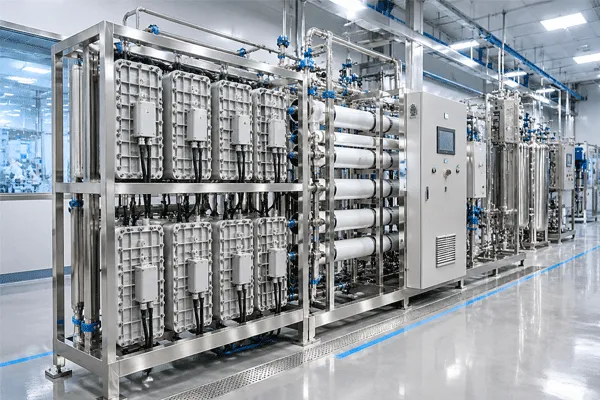
A suitable PLC and SCADA configuration can monitor:
| Monitoring Point |
الغرض |
| الموصلية في العلف |
Tracks incoming ionic loading |
| المقاومة النوعية للمنتج |
Checks final ionic purity |
| تدفق المنتجات |
Monitors water production |
| تدفق المركزات |
Checks concentrate-side operation |
| جهد الوحدة |
Monitors electrical conditions |
| تيار الوحدة |
Tracks electrical loading |
| ضغط التغذية |
Checks hydraulic conditions |
| الضغط التفاضلي |
Helps identify restrictions |
| درجة الحرارة |
Supports accurate performance evaluation |
| مستوى الخزان |
Controls water supply and storage |
When these signals are connected to a PLC/HMI system, operators can monitor equipment status and receive alarms when operating conditions move outside the approved range.
For example, a decline in product resistivity may indicate changes in feed-water quality, excessive ionic loading, or an EDI operating problem.
A rise in pressure difference may suggest fouling or hydraulic obstruction.
Automation does not replace regular maintenance. It makes operation easier to control and helps the site team identify problems before they affect production.
Electrodeionization Water Treatment for Semiconductor Manufacturing: How EDI Supports Ultrapure Water Systems
9. What Engineering and Commissioning Checks Are Important?
A successful EDI project requires more than selecting a suitable module. The complete water treatment system must be engineered, assembled, tested, and commissioned correctly.
Before equipment delivery, EPC contractors and project owners should review the following:
Process engineering
- Raw-water analysis.
- RO permeate specifications.
- Required product-water quality.
- Process flow diagram.
- Equipment capacity calculations.
Mechanical and electrical integration
- ترتيب الوحدات.
- Piping materials and connections.
- Pump and valve selection.
- DC power supply.
- الحماية الكهربائية.
- Instrumentation layout.
الأتمتة
- PLC control logic.
- HMI operating interface.
- Alarm and interlock settings.
- Online water quality monitoring.
- Communication with the plant control system.
Factory testing and delivery
- Equipment assembly inspection.
- Electrical checks.
- معايرة الأجهزة.
- Pressure and leakage checks where applicable.
- Documentation review.
- تغليف الصادرات.
During commissioning, the engineering team should confirm that the EDI unit receives feed water within the manufacturer’s specified limits. Flow, pressure, voltage, current, concentrate discharge, and product quality should be checked against the approved operating requirements.
The commissioning process should also establish baseline operating data for future maintenance.
For semiconductor projects, clear technical documentation and traceable quality records are particularly important because water treatment performance is closely connected to manufacturing reliability.
10. How Can an Integrated Water Treatment Manufacturer Support Your Project?
Selecting the correct EDI equipment is only one part of a successful ultrapure water project.
The upstream pretreatment, RO system, electrical configuration, instrumentation, storage, and distribution network all influence the final result.
في شركة تشينغداو بانوت للتكنولوجيا البيئية المحدودة., we focus on manufacturing and engineering-oriented water and wastewater treatment solutions for industrial and municipal applications.
Our product and system capabilities include:
- أغشية MBR ذات الألياف المجوفة.
- أغشية MBR المسطحة.
- أغشية الترشيح بالألياف المجوفة (UF).
- أغشية التناضح العكسي.
- وحدات EDI.
- Small RO Machines.
- محطات معالجة المياه النقية.
- Ultrapure Water Treatment Systems.
- Integrated Wastewater Treatment Plants.
For semiconductor and electronics manufacturing projects, we can support the integration of RO and EDI technologies with pretreatment, UV oxidation, final polishing, storage, and automated controls.
Our engineering approach focuses on several important areas:
Customized process design: We evaluate source-water conditions, required capacity, and final water specifications before recommending the treatment configuration.
Factory-based manufacturing: Equipment fabrication, module assembly, inspection, and quality control help maintain consistency during production.
Modular system integration: Skid-mounted and customized configurations support different installation spaces and project requirements.
Automation support: PLC/HMI and SCADA-compatible control solutions help operators monitor system performance.
Project documentation and technical support: We support equipment documentation, commissioning preparation, spare parts planning, and long-term technical cooperation.
If you are planning a new semiconductor water treatment project or upgrading an existing purification plant, we can help evaluate the appropriate RO and EDI configuration.
Visit our EDI Electrodeionization Product Page or explore our Ultrapure Water Treatment Solutions to learn more.
الأسئلة الشائعة
What is electrodeionization water treatment used for in semiconductor manufacturing?
Electrodeionization is used to remove residual dissolved ions from highly pretreated water. In semiconductor facilities, it forms part of an ultrapure water system that supplies water for wafer rinsing, equipment cleaning, and other sensitive production processes.
Can an EDI system produce 18.2 MΩ·cm water?
Commercial EDI systems can approach 18.2 MΩ·cm under suitable operating conditions. However, achieving this result depends on feed-water quality, RO performance, temperature, module configuration, and operating parameters. Additional polishing may be required for demanding applications.
Why is reverse osmosis needed before EDI?
RO removes most dissolved salts and reduces the ionic load entering the EDI module. This allows EDI to focus on residual ion removal and supports more stable high-purity water production.
Does EDI completely eliminate chemical use?
EDI eliminates the routine acid-and-caustic regeneration of conventional ion exchange resin. However, the complete water treatment plant may still require chemicals for pretreatment, pH adjustment, cleaning, and sanitization.
Is EDI enough for a complete semiconductor ultrapure water system?
Not always. EDI primarily removes ionized and ionizable impurities. Semiconductor UPW systems may also require UV oxidation, polishing mixed beds, final UF, high-purity storage, and controlled distribution loops.
What information is needed to design an EDI water treatment system?
The main information includes source-water analysis, RO permeate quality, required product flow, target resistivity, silica and TOC requirements, operating hours, installation conditions, and automation requirements. These details help engineers determine the suitable EDI configuration and overall treatment process.
النقاط الرئيسية التي يجب تذكرها
- Electrodeionization is an important polishing technology for semiconductor ultrapure water production.
- EDI combines ion exchange resin, selective membranes, and direct electrical current.
- Reverse osmosis normally comes before EDI to reduce the dissolved ionic load.
- EDI continuously regenerates its internal resin during operation.
- Resistivity is important, but it is not the only measure of ultrapure water quality.
- Silica, TOC, particles, microorganisms, and dissolved gases may require additional treatment.
- UV oxidation, polishing mixed beds, and final UF can provide additional purification.
- EDI capacity should match average and peak water demand.
- PLC and SCADA monitoring help maintain stable operation.
- Proper engineering, commissioning, documentation, and maintenance support long-term system performance.
- An integrated RO and EDI solution is often more effective than selecting individual treatment components without considering the complete process.
Planning a Semiconductor Ultrapure Water Project?
Contact Banott with your source-water analysis, required production capacity, target resistivity, and project specifications. Our engineering team can help evaluate the suitable RO, EDI, and polishing configuration for your application.











 09:31