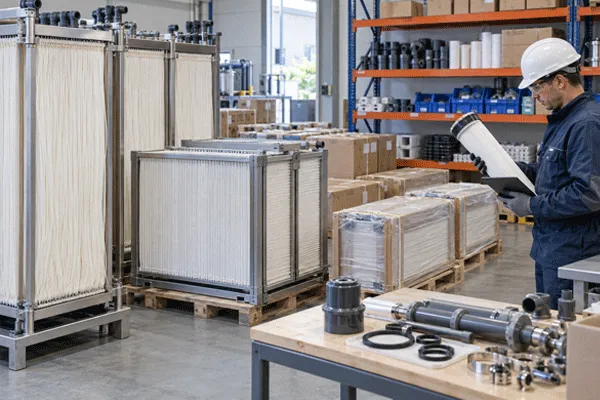
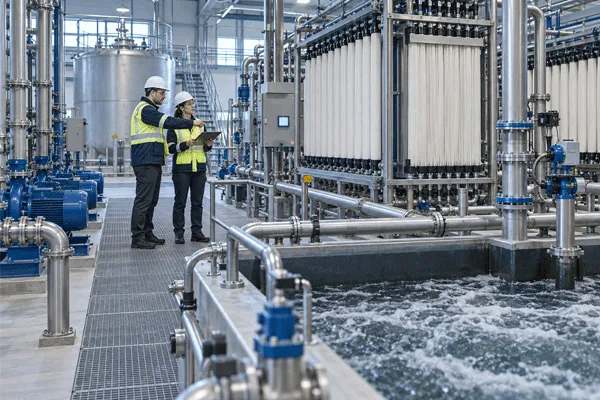
Cloudy water, unstable turbidity, and fine suspended solids can overload downstream equipment and increase chemical use. Without a reliable barrier, these problems may also shorten RO membrane life. A correctly designed UF membrane system provides consistent particle removal in a compact treatment process.
A UF membrane is a porous, semi-permeable filter used to remove suspended solids, colloids, bacteria, and other fine particles from water. Ultrafiltration normally operates under relatively low pressure and uses pores commonly around 0.01–0.05 μm. It improves water clarity but does not remove most dissolved salts, so reverse osmosis may still be required.
O que é uma membrana de ultrafiltração? Explicação sobre a ultrafiltração no tratamento da água
Estrutura do artigo
- What is an ultrafiltration membrane?
- How does ultrafiltration work?
- What can a UF membrane remove?
- What cannot ultrafiltration remove?
- What are the main types of ultrafiltration membranes?
- How do hollow fiber UF modules operate?
- What are the advantages of ultrafiltration?
- Where is ultrafiltration used?
- How do UF and reverse osmosis differ?
- What causes membrane fouling?
- How should buyers choose the right ultrafiltration membrane?
- What should EPC contractors include in a UF system inquiry?
- Perguntas frequentes
- Pontos-chave a reter
What Is an Ultrafiltration Membrane?
An ultrafiltration membrane is a physical separation barrier with very small pores. Water passes through the membrane wall, while particles larger than the effective pore size remain on the feed side of the membrane.
UF belongs to a family of pressure-driven water treatment technologies. It generally sits between microfiltration and nanofiltration in the membrane separation range. Modern water treatment UF products commonly use pore sizes around 0.01–0.05 μm, although the exact value and molecular-weight cut-off vary by membrane design.
The process is often used to separate:
- Fine suspended solids
- Colloidal particles
- Silt and clay
- Algae
- Many bacteria
- Protozoan cysts
- Some large organic molecules
- Precipitated iron and manganese
- Particulate material that causes turbidity
UF is a barrier process. It does not depend on particles settling by gravity, so it can provide more stable filtrate quality when feed-water turbidity changes. However, membrane performance still depends on pretreatment, membrane integrity, operating flux, cleaning, temperature, and feed-water chemistry.
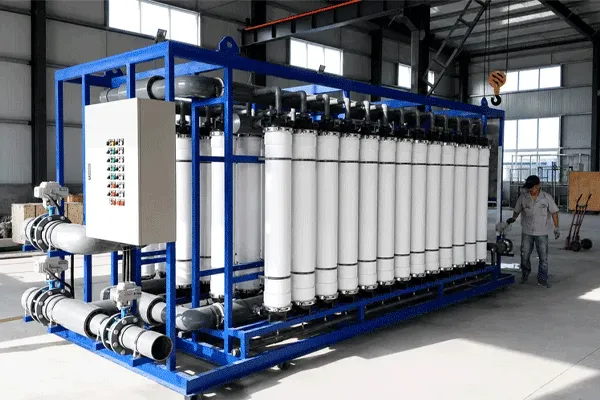
As a manufacturer of hollow fiber UF membranes and integrated membrane filtration systems, we view UF as more than an individual filter. The complete solution normally includes membrane modules, pumps, valves, instruments, backwashing, chemical cleaning, PLC control, tanks, piping, and suitable upstream treatment.
How Does Ultrafiltration Work?
Ultrafiltration uses pressure to move water through a porous membrane. Water and very small dissolved substances pass through the pores, while larger particles remain behind.
The basic ultrafiltration process follows these steps:
- Feed water enters the UF system.
- A pump creates the required transmembrane pressure.
- Water reaches the membrane surface.
- Clean water passes through the membrane wall.
- Retained particles remain on the feed side.
- The system periodically removes accumulated matter through backwashing, flushing, or air scouring.
- Chemical cleaning restores performance when physical cleaning is no longer enough.
A simple flow diagram looks like this:
Feed Water
    ↓
Screen or Prefilter
    ↓
UF Feed Pump
    ↓
Ultrafiltration Membrane Module
    ├──→ UF Filtrate
    └──→ Backwash / Drain Waste
UF is often described as a pressure-driven membrane filtration process based mainly on size exclusion. In simple terms, contaminants too large to enter the membrane pores stay behind. The pore structure, membrane material, surface properties, and integrity determine the actual separation performance.
The pressure difference across the membrane is called transmembrane pressure, or TMP. If contaminants collect on or within the membrane, resistance rises. The plant may then need more pressure to maintain the same membrane flux, or the water production rate may fall at constant pressure.
O que é uma membrana de ultrafiltração? Explicação sobre a ultrafiltração no tratamento da água
What Can a UF Membrane Remove From Water?
A UF membrane is especially effective at removing particulate contamination. This includes material that makes water cloudy as well as microorganisms attached to or larger than the membrane pores.
Typical UF removal targets include:
| Contaminant |
Typical UF Role |
| Sólidos em suspensão |
Strong physical removal |
| Turbulência |
Redução significativa |
| Colloids |
Remoção completa |
| Silt and clay |
Remoção completa |
| Bactérias |
Strong barrier when membrane integrity is maintained |
| Protozoan cysts |
Forte retenção física |
| Algae |
Remoção completa |
| Precipitated metals |
Removable when converted into particles |
| Large organic matter |
Partial removal depending on size and pretreatment |
| Viruses |
Removal varies with pore size, module design, and validated performance |
UF membrane filtration can produce consistently low-turbidity water when the membrane system operates correctly and passes integrity monitoring. The U.S. EPA’s optimization guidance for low-pressure membrane filtration uses very low filtrate turbidity and particle-count goals to help operators identify performance or integrity problems.
One important condition is membrane integrity. A damaged fiber, failed seal, or incorrect assembly can create a bypass route. For drinking water and other sensitive applications, operators may need pressure-decay testing, filtrate turbidity monitoring, particle counting, or another approved integrity method.
UF does not “kill” every microorganism. It physically separates organisms based on the membrane barrier. For that reason, many drinking water and reuse systems still include chlorination, ultraviolet disinfection, ozonation, or another final safety barrier according to local regulations.
What Can Ultrafiltration Not Remove?
UF is excellent for particles, but it does not remove most low-molecular-weight substances dissolved in water.
A standard UF system normally provides limited removal of:
- Sodium and chloride
- General total dissolved solids
- Condutividade
- Dissolved hardness
- Nitrato
- Fluoride
- Many dissolved metals
- Small organic molecules
- Dissolved gases
- Color caused by small dissolved substances
This is the key limit to remember:
UF improves clarity and particle control, but it is not a desalination process.
Dissolved substances are much smaller than the membrane pores and can pass through the membrane with the water. DuPont’s current UF design guidance states that dissolved substances are not removed to a high extent by UF unless they are first converted into particles through processes such as oxidation, coagulation, or adsorption.
For example, dissolved iron may pass through a UF membrane. If the plant oxidizes the iron and forms insoluble particles, the membrane can retain the precipitate. The same principle may apply to manganese and some other contaminants.
When a project must reduce salinity, conductivity, hardness, or dissolved ions, engineers often place reverse osmosis after UF.
What Are the Main Types of Ultrafiltration Membranes?
The main types of ultrafiltration membranes can be classified by shape, membrane material, operating direction, and installation method.
UF Membrane Configurations
| Configuração |
Descrição |
Utilização comum |
| Fibra oca |
Thousands of fine membrane fibers bundled in a module |
Municipal and industrial water treatment |
| Tubular |
Larger flow channels within rigid tubes |
High-solids or viscous liquids |
| Chapa plana |
Membrane sheets installed in plates or cassettes |
Specialized separation and submerged systems |
| Enrolamento em espiral |
Flat membrane layers wrapped around a central tube |
Selected industrial process applications |
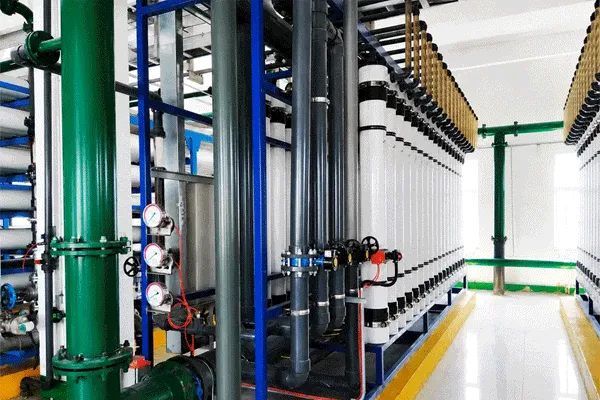
Hollow fiber ultrafiltration is common in municipal and industrial water production because it provides a large membrane area in a compact module.
Common Membrane Materials
UF membrane products may use:
- PVDF: Polyvinylidene fluoride
- PES: Polyethersulfone
- PS: Polysulfone
- PP: Polypropylene
- CA: Cellulose acetate
- Ceramic materials for selected harsh applications
PVDF and PES are widely used polymer materials in water treatment. Engineers compare mechanical strength, chemical tolerance, hydrophilicity, chlorine resistance, pore distribution, temperature limits, and cleanability before selecting a membrane material.
There is no single material that is best for every application. A strong PVDF fiber may suit challenging municipal water or Pré-tratamento por osmose inversa (RO). A different membrane structure may be better for process separation, food production, or a specific chemical environment.
How Do Hollow Fiber UF Membrane Modules Operate?
A hollow fiber membrane resembles a very thin tube. Water passes across the fiber wall, while the membrane pores retain contaminants.
Hollow fiber UF can operate in two main flow directions:
Outside-In Flow
Feed water surrounds the outside of the membrane fibers. Filtrate moves through the membrane wall and enters the hollow center of each fiber.
This configuration can handle water containing more particulate material because the feed flows around the outer fiber surfaces. It can also support air scouring, which helps loosen deposits before or during backwashing.
Inside-Out Flow
Feed water enters the hollow center, or lumen, of each fiber. Water then passes outward through the membrane wall.
This arrangement offers controlled flow within the fibers but may require suitable screening because larger debris can block narrow internal channels.
Both configurations can work well. The correct type of UF depends on feed-water quality, solids loading, cleaning strategy, operating pressure, module construction, and the supplier’s validated design. DuPont’s technical guidance confirms that hollow fiber flow can be inside-out or outside-in and explains the practical differences between them.
A membrane module also contains potting material, housings, seals, feed connections, filtrate outlets, and drain ports. These parts must remain reliable because a fiber break or seal failure may allow untreated water to reach the filtrate side.
What Are the Advantages of Ultrafiltration?
The benefits of ultrafiltration make it useful in both new treatment plants and upgrades to older filtration systems.
Consistent Filtrate Quality
UF creates a defined physical membrane barrier. Unlike a media filter, its separation does not depend only on a changing filter bed. This can produce more stable turbidity and suspended-solids removal.
Compact Equipment Design
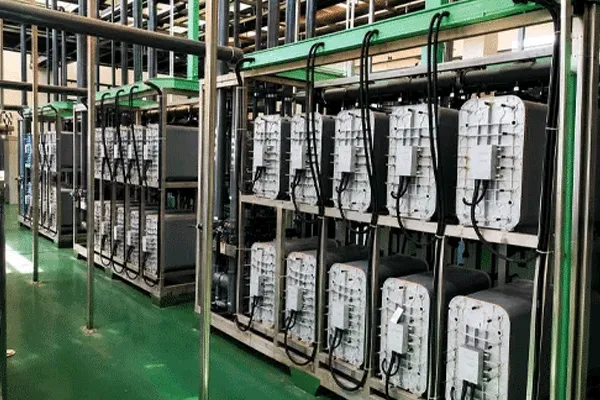
A high membrane area can fit within a relatively small footprint. Skid-mounted or containerized UF systems are therefore practical for factories, hotels, industrial parks, remote projects, and sites with limited space.
Effective Pretreatment for RO Membranes
UF can remove fine particles and colloids before reverse osmosis. This helps reduce particulate fouling potential and provides more stable RO feed water. UF is widely used as pretreatment in integrated UF and RO systems.
Automated Operation
A well-designed ultrafiltration membrane system can automatically control:
- Filtration
- Retrolavagem
- Forward flushing
- Limpeza com ar
- Retrolavagem com reforço químico
- Clean-in-place cycles
- Pressure monitoring
- Flow control
- Alarm management
- Membrane integrity checks
Reduced Dependence on Clarification
UF may replace or supplement conventional clarification and media filtration, depending on the raw-water condition. Coagulation or sedimentation may still be needed when the water contains high solids, algae, natural organic matter, or difficult colloids.
Modular Expansion
A modular membrane system can be expanded by adding racks or modules, provided pumps, piping, tanks, control panels, and civil works have enough reserve capacity.
O que é uma membrana de ultrafiltração? Explicação sobre a ultrafiltração no tratamento da água
What Are the Main Applications of Ultrafiltration Membrane Systems?
The applications of ultrafiltration membrane technology extend across municipal, industrial, commercial, and infrastructure projects.
Municipal Drinking Water
Municipal water treatment plants use UF to reduce turbidity, suspended solids, bacteria, protozoa, algae, and fine particulate matter in surface water or groundwater.
A complete drinking water process may include:
Raw Water
   ↓
Screening
   ↓
Coagulation or Oxidation, if required
   ↓
UF Membrane System
   ↓
Disinfection
   ↓
Drinking Water Storage
The final process must meet the local drinking water regulations. UF alone should not be treated as a universal answer for every chemical and microbial risk.
Reverse Osmosis Pretreatment
UF is often installed before seawater, brackish-water, industrial, or wastewater-reuse RO systems. It helps protect RO membranes from suspended solids and colloidal fouling.
Industrial Process Water
Factories may use UF in process-water production for:
- Unidades de produção de alimentos e bebidas
- Chemical facilities
- Produção farmacêutica
- Electronics factories
- Power plants
- Metal processing
- Textile manufacturing
- Paper production
Wastewater Reuse
UF may polish biologically treated wastewater before RO or disinfection. In some projects, it forms part of a multi-stage water reuse plant.
Membrane Bioreactors
Submerged hollow fiber or flat membrane products are also used in membrane bioreactors. An O MBR combina processos biológicos wastewater treatment with membrane separation. Although MBR and pressurized UF share membrane principles, their operating environment and design conditions differ.
Small and Modular Water Systems
Skid-mounted or containerized systems can support hotels, farms, construction camps, islands, emergency supply, and decentralized municipal projects.
UF vs Reverse Osmosis: What Is the Difference?
UF and reverse osmosis are both membrane technologies, but they remove different contaminants.
| Comparison |
UF |
Ósmosis inversa |
| Membrane structure |
Porous membrane |
Dense semi-permeable membrane |
| Main separation |
Particle size |
Molecular and ionic separation |
| Alvo típico |
Solids, colloids, bacteria, turbidity |
Salts, hardness, ions, small dissolved contaminants |
| Pressão de funcionamento |
Relativamente baixo |
Mais alto |
| TDS removal |
Limitada |
Elevado |
| Recuperação de água |
Often high, application-dependent |
Lower because concentrate is produced |
| Common role |
Pretreatment or particle barrier |
Desalting and purification |
| Main fouling risks |
Particles, organics, biofilm |
Scaling, organics, colloids, biofouling |
UF allows salts and many small dissolved compounds to pass through. RO rejects a large portion of these substances but requires cleaner feed water and higher pressure.
In many projects, the correct question is not “UF or RO?” It is:
Should UF be used before RO?
The answer is often yes when the raw water contains turbidity, colloids, microorganisms, or suspended solids that could foul RO membranes.
A typical integrated system is:
Raw Water
   ↓
Pretreatment
   ↓
UF System
   ↓
Cartridge Filter
   ↓
RO System
   ↓
EDI or Final Polishing, if required
What Causes Membrane Fouling in a UF System?
Membrane fouling occurs when contaminants collect on the membrane surface, enter the pores, or form deposits within the module.
The three basic physical mechanisms include:
- Cake formation: Particles form a layer on the membrane surface.
- Pore blocking: Particles similar in size to the pores obstruct the openings.
- Pore adsorption: Smaller substances attach inside the pores and reduce their effective diameter.
Common types of UF fouling include:
| Fouling Type |
Possível causa |
| Incrustação por partículas |
Silt, clay, suspended solids, colloids |
| Incrustação orgânica |
Natural organic matter, oils, humic substances |
| Incrustação biológica |
Bacteria and biofilm growth |
| Inorganic fouling |
Iron, manganese, calcium, magnesium, silica deposits |
| Fiber plugging |
Large particles, fibers, hair, debris |
Fouling may cause:
- Rising transmembrane pressure
- Falling membrane flux
- Higher cleaning frequency
- Reduced water production
- Higher energy use
- Shorter membrane lifespan
- Unstable filtrate quality
- Earlier membrane replacement
The first defense is good system design. Screens, strainers, coagulation, clarification, oxidation, oil removal, media filtration, or another pretreatment step may be necessary.
How Should a UF Membrane Be Cleaned?
A UF system normally combines routine physical cleaning with periodic chemical cleaning.
Physical Cleaning
Routine physical methods may include:
- Backwashing with UF filtrate
- Forward flushing
- Limpeza com ar
- Drain-down
- Relaxamento
- Feed-side flushing
During backwashing, clean water moves across the membrane in the reverse direction and helps detach material from the membrane surface.
Chemically Enhanced Backwash
A low chemical concentration may be used during selected backwash cycles. Chemicals depend on the foulant and membrane compatibility.
Examples include:
- Sodium hypochlorite for biological or some organic fouling
- Acid for certain mineral deposits
- Alkali for organic contamination
- Approved surfactants for difficult deposits
Clean-in-Place
CIP is a longer and stronger cleaning process used when normal backwashing can no longer restore membrane performance.
Chemical selection must follow the UF membrane supplier’s limits for pH, temperature, concentration, contact time, and cumulative exposure. Using the wrong chemical can cause membrane degradation or permanent damage to the membrane.
The operator should trend normalized permeability, TMP, flux, feed-water temperature, backwash effectiveness, and cleaning recovery. Do not wait for severe fouling before reviewing performance.
How Do You Choose the Right Ultrafiltration Membrane?
To choose the right ultrafiltration membrane, start with feed-water analysis and the required filtrate quality. Do not select a module based only on nominal flow or purchase price.
Review the Feed Water
Important parameters include:
- Turbulência
- Sólidos em suspensão
- Particle-size distribution
- Temperatura
- pH
- Carbonio orgânico total
- Óleo e gordura
- Ferro e manganês
- Dureza
- Algae
- Microbiological activity
- Chemical oxidants
- Peak and average flow
Define the Treatment Goal
Ask what happens after UF:
- Direct municipal water supply?
- Drinking water after disinfection?
- RO pretreatment?
- Industrial process water?
- Wastewater reuse?
- Cooling water?
- EDI feed preparation?
A UF membrane selected for clean groundwater may not perform well on algae-rich surface water or industrial wastewater.
Compare Membrane and Module Properties
Buyers should review:
- Nominal or absolute pore size
- Material da membrana
- Inside-out or outside-in flow
- Fiber strength
- Área efectiva da membrana
- Dimensões do módulo
- Design flux range
- Operating TMP
- Backwash requirements
- Air-scour requirements
- Chemical resistance
- Maximum temperature
- Integrity-testing method
- Connection sizes
- Module replacement procedure
Evaluate the Complete System
The performance of an ultrafiltration system depends on more than the membrane elements. Pumps, valves, air blowers, instruments, chemical tanks, automation, piping, and cleaning logic all influence reliability.
A low-priced UF membrane may become expensive when it requires frequent cleaning, has limited local support, or cannot fit the existing rack.
What Should EPC Contractors Include in a UF System Inquiry?
A complete inquiry helps the engineering team prepare a more accurate process proposal and quotation.
| Required Information |
Exemplo |
| Water source |
River, municipal water, well, seawater, or wastewater |
| Caudal médio |
50 m³/h |
| Fluxo máximo |
65 m³/h |
| Horário de funcionamento |
20 hours per day |
| Feed turbidity |
Laboratory data |
| Sólidos em suspensão |
Laboratory data |
| Temperatura |
Minimum and maximum |
| pH |
Normal and extreme range |
| Óleo e gordura |
Required for industrial wastewater |
| Required filtrate quality |
Turbidity, SDI, microbial or process target |
| Downstream process |
RO, EDI, disinfection, or direct use |
| Instalação |
Indoor, outdoor, skid-mounted, or containerized |
| Automação |
PLC or PLC/SCADA |
| Fonte de alimentação |
Tensão, fase e frequência |
| Destination |
Country and project location |
| Documentação |
PFD, P&ID, GA drawing, manuals, and MTCs |
| Serviços |
Installation guidance, commissioning, and training |
As an engineering-oriented water treatment manufacturer, we supply hollow fiber UF membranes, UF modules, RO membranes, EDI modules, MBR membranes, small RO machines, pure water systems, wastewater treatment plants, and integrated membrane filtration equipment.
Our project support can include:
- Feed-water analysis review
- Process selection
- Customized membrane rack design
- Skid-mounted or containerized construction
- PLC and SCADA automation
- Factory assembly and testing
- Technical drawings and manuals
- International shipping preparation
- Remote or on-site commissioning support
- Spare parts and membrane replacement supply
Illustrative Case Study: UF Pretreatment for an Industrial RO Plant
An industrial plant uses well water as the feed for an RO system. The existing multimedia filters reduce visible turbidity, but the RO cartridge filters still clog quickly. Differential pressure rises, and the plant replaces cartridges more often than expected.
Water analysis shows fine colloidal particles and periodically elevated iron. These particles pass through or break through the existing media filters.
A revised treatment train may include:
- Controlled oxidation of iron
- Reaction or contact time
- Suitable prefiltration
- UF de fibra oca
- UF filtrate tank
- Cartridge filtration
- Osmose inversa
The UF stage removes precipitated iron and fine suspended solids before they reach the RO membranes. The plant gains more stable feed-water quality and a more predictable cleaning schedule.
The lesson is simple:
High-quality ultrafiltration is not just about producing clear water. It is about protecting every treatment step that follows.
The final design would still depend on laboratory results, pilot testing, recovery, chemical consumption, concentrate handling, and the specific RO feed-water limits.
Perguntas frequentes
Is UF water safe to drink?
UF can remove turbidity, suspended solids, bacteria, protozoa, and other particulate contaminants. However, drinking water safety also depends on dissolved chemicals, viruses, membrane integrity, source-water risks, and local regulations. A complete plant may need disinfection and additional treatment.
Does a UF membrane remove salt?
No. Standard UF does not significantly reduce dissolved salt, conductivity, or total dissolved solids. Reverse osmosis, nanofiltration, ion exchange, or another process is required for desalting.
What is the typical UF membrane pore size?
Water treatment UF membranes commonly have pores in the approximate range of 0.01–0.05 μm, although the exact nominal pore size and molecular-weight cut-off depend on the product.
Is UF better than a multimedia filter?
UF generally provides a finer and more defined physical barrier. A multimedia filter may cost less and handle high solids well, but its filtrate quality can vary. Some systems use media filtration before UF rather than choosing only one process.
How long does a UF membrane last?
There is no universal lifespan. Membrane life depends on feed-water quality, operating flux, pressure, chemical exposure, cleaning frequency, temperature, fouling, integrity, and shutdown procedures. Good pretreatment and controlled operation usually extend service life.
How often should UF membranes be cleaned?
Routine backwashing may occur several times per hour or according to the selected cycle, while chemical cleaning happens less often. The correct schedule depends on membrane design, feed water, flux, TMP trend, and supplier instructions.
Pontos-chave a reter
- A UF membrane is a porous physical barrier used in water treatment.
- Ultrafiltration removes suspended solids, colloids, turbidity, bacteria, algae, and many protozoan cysts.
- Typical UF pore size is approximately 0.01–0.05 μm.
- UF does not significantly remove dissolved salts or conductivity.
- Reverse osmosis is required when the project needs desalting.
- Hollow fiber UF can use inside-out or outside-in flow.
- PVDF and PES are common UF membrane materials.
- UF is widely used in drinking water, industrial water production, wastewater reuse, and RO pretreatment.
- Backwashing, air scouring, chemical cleaning, and good pretreatment control membrane fouling.
- The right UF design depends on water analysis, flow, temperature, treatment goals, and downstream equipment.
- Membrane integrity monitoring is important for reliable water quality.
- EPC contractors should provide complete feed-water and project information before requesting a quotation.
- A complete membrane system includes pumps, valves, automation, cleaning equipment, instruments, piping, and technical support—not just membrane modules.
Planning a UF membrane, RO pretreatment, municipal water, or industrial reuse project? Send us your feed-water analysis, design flow, peak flow, required filtrate quality, installation conditions, downstream process, power supply, and destination country. Our engineering team can prepare a customized ultrafiltration membrane system, equipment configuration, and technical proposal.









 11:55
11:55