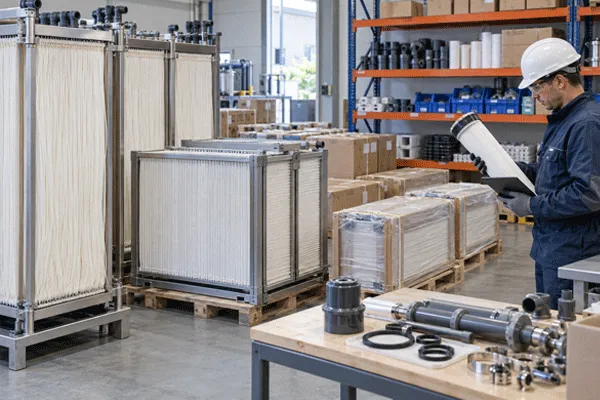
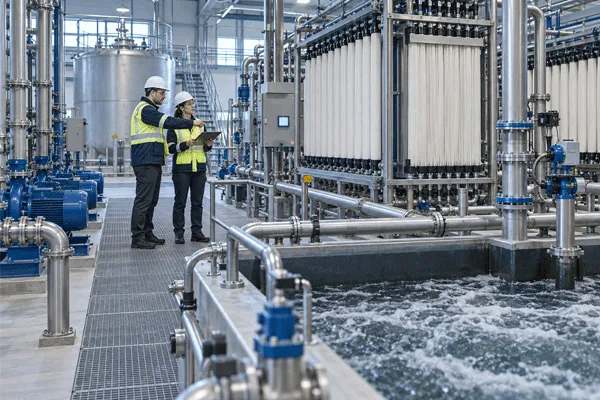
Water treatment projects often face challenges such as limited installation space, complex piping, long construction periods, and unstable commissioning results. These problems can increase project costs and operational risks. A skid-mounted water treatment solution provides a compact, factory-built approach that simplifies installation and improves reliability.
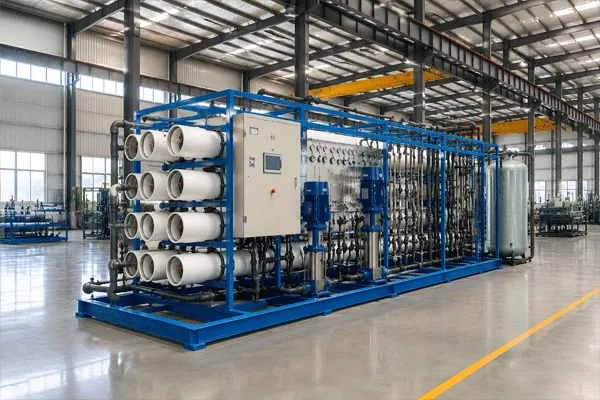
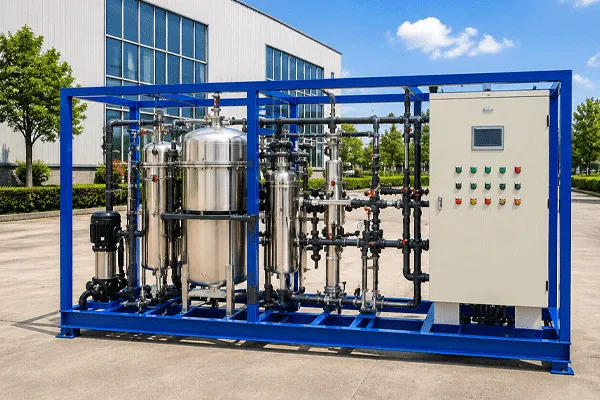
A skid in water treatment is a pre-assembled platform that integrates pumps, pipes, valves, membranes, filtration equipment, instrumentation, and control systems into one complete unit. A water treatment skid helps industries, municipalities, and EPC contractors install reliable treatment systems faster with consistent performance.
Che cos’è uno skid nel trattamento delle acque? Guida completa ai sistemi skid per il trattamento delle acque
Struttura dell'articolo
- What Is a Skid in Water Treatment and How Does It Work?
- Why Are Skid-Mounted Water Treatment Systems Becoming Popular?
- What Equipment Is Included in a Water Treatment Skid?
- How Do You Choose a Skid for Different Water Treatment Requirements?
- What Are the Main Applications of Skid Water Treatment Systems?
- How Do RO Skids and Membrane Filtration Skids Work?
- What Are the Benefits of Modular Skid-Mounted Systems?
- How Does Automation Improve Skid System Performance?
- What Factors Affect Water Treatment Skid Design and Cost?
- Why Choose a Professional Water Treatment Skid Manufacturer?
- What Is a Skid in Water Treatment and How Does It Work?
A skid in water treatment refers to a complete treatment platform where different equipment components are installed on a strong structural base frame. Instead of installing every individual component separately at the project site, engineers assemble the complete unit inside a factory environment.
A typical water treatment skid may include:
| Componente |
Funzione |
| Pump |
Transfers water through the system |
| Pipe system |
Connects treatment stages |
| Valve |
Controls water flow |
| Modulo a membrana |
Removes dissolved substances and contaminants |
| Filtration unit |
Rimuove i solidi in sospensione |
| Strumentazione |
Monitors pressure, flow, and water quality |
| Pannello di controllo |
Manages automatic operation |
The main advantage of a skid system is integration. Manufacturers can test the complete unit before shipment, reducing installation errors and improving startup efficiency.
As a professional manufacturer of water and wastewater treatment systems, we provide customized skid solutions that combine hollow fiber UF membranes, MBR membranes, RO membranes, EDI modules, and complete filtration technologies according to customer project requirements.
Why Are Skid-Mounted Water Treatment Systems Becoming Popular?
Many industrial and municipal projects require faster installation and stable operation. Traditional construction methods often require separate equipment purchasing, complex onsite piping, and longer commissioning periods.
A skid-mounted system solves these challenges by delivering a factory-built treatment package.
For example, an industrial plant requiring process water may need:
- Pretreatment filtration
- RO purification
- Dosaggio di sostanze chimiche
- Pump systems
- Monitoring instruments
Instead of building each section independently, a skid integrates the entire treatment process into one compact structure.
This design is especially useful for:
- Industrial applications
- Municipal water treatment
- Food and beverage production
- Pharmaceutical facilities
- Semiconductor manufacturing
- Wastewater reuse projects
A modular skid can also support facilities with limited installation space because the equipment layout is optimized before delivery.
What Equipment Is Included in a Water Treatment Skid?
A complete treatment skid is not only a frame with equipment. It is an engineered package designed around specific water treatment requirements.
The core components usually include:
Pumps and Piping System
The pump is responsible for moving water through different treatment stages.
Engineers select pumps according to:
- Required pressure
- Portata
- Water characteristics
- Operating conditions
The internal pipe layout is also important. Poor piping design can create pressure loss, unstable operation, or difficult maintenance.
A professional manufacturer designs the skid structure so operators can easily access:
- Pumps
- Valves
- Filters
- Membrane modules
- Electrical components
Filtration and Membrane Systems
Modern water treatment depends heavily on advanced filtration technologies.
A skid may combine:
- Sand filtration
- Cartridge filtration
- UF membrane systems
- MBR membrane systems
- RO systems
- EDI purification
Ad esempio:
A hollow fiber UF membrane skid can remove suspended solids and microorganisms before downstream purification.
A reverse osmosis skid can reduce dissolved salts and produce high-quality water for industrial use.
The correct combination depends on the raw water quality and final application.
Che cos’è uno skid nel trattamento delle acque? Guida completa ai sistemi skid per il trattamento delle acque
How Do You Choose a Skid for Different Water Treatment Requirements?
Choosing the correct skid requires understanding the complete project conditions.
Before designing a skid, engineers normally evaluate:
| Requisito |
Consideration |
| Raw water source |
Municipal water, groundwater, industrial wastewater |
| Water quality target |
Discharge, reuse, pure water production |
| Capacity |
Required daily treatment volume |
| Space |
Available installation area |
| Livello di automazione |
Manual, PLC, SCADA control |
| Future expansion |
Additional treatment capacity |
A common mistake is selecting equipment based only on price.
A lower-cost skid may not provide the required water quality or long-term stability.
Professional suppliers first analyze:
- Water demand
- Treatment objectives
- Ambiente operativo
- Requisiti di manutenzione
Then they design a suitable treatment solution.
What Are the Main Applications of Skid Water Treatment Systems?
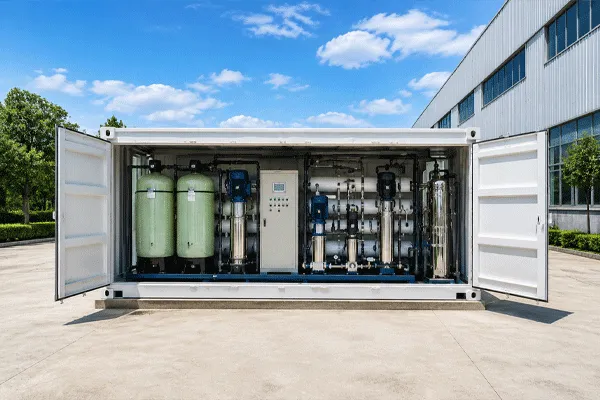
A skid water treatment system is widely used because it can be adapted to many industries and project environments. The compact structure, factory assembly, and flexible configuration make it suitable for both temporary projects and permanent facilities.
For industrial users, a skid can provide stable water quality for production processes. For municipalities, it can support reliable municipal water treatment and wastewater management. For remote locations, containerized and skid-mounted solutions reduce construction difficulties.
Tra le applicazioni più comuni figurano:
| Applicazione |
Typical Treatment Technology |
Finalità |
| Acque reflue industriali |
MBR, UF, chemical dosing |
Meet discharge standards and enable reuse |
| Alimentari e bevande |
RO, UF, softening |
Produce safe process water |
| Farmaceutico |
RO, EDI, ultrapure systems |
High-purity water production |
| Semiconduttori |
RO, EDI, polishing filtration |
Ultra-clean water |
| Municipal projects |
MBR, filtration, disinfection |
Public wastewater treatment |
| Hotels and commercial buildings |
Compact treatment units |
Water recycling |
For example, a food and beverage factory may require a skid that combines pretreatment, UF, RO, and disinfection. A chemical plant may need a stronger wastewater solution with chemical dosing and advanced filtration.
Because every project has different requirements, our engineering team designs each skid based on raw water characteristics, required output quality, capacity, and local regulations.
How Do RO Skids and Membrane Filtration Skids Work?
Membrane technology is one of the most important parts of modern water treatment. Many advanced skid systems use membrane separation because it provides stable performance and a smaller footprint compared with traditional treatment methods.
A typical ro skid uses reverse osmosis membranes to remove dissolved salts, minerals, and other unwanted substances from water.
The RO process normally includes:
- Pretreatment filtration
- High-pressure pump operation
- Reverse osmosis membrane separation
- Product water collection
- Concentrated wastewater discharge
The high-pressure pump pushes water through reverse osmosis membranes, allowing clean water molecules to pass while rejecting dissolved contaminants.
RO technology is widely used for:
- Produzione di acqua pura
- Acqua di processo industriale
- Acqua di alimentazione della caldaia
- Pharmaceutical water systems
- Produzione di componenti elettronici
Membrane filtration skids can also use UF and MBR technologies.
A UF membrane system focuses on removing:
- Solidi sospesi
- Batteri
- Colloidal particles
- Organic materials
An MBR system combines biological treatment with membrane separation, making it highly effective for wastewater treatment projects.
Our company specializes in hollow fiber MBR membranes, hollow fiber UF membranes, flat sheet MBR membranes, RO membranes, and integrated membrane solutions. These technologies help EPC contractors and industrial customers achieve stable effluent quality and reliable operation.
What Are the Benefits of Modular Skid-Mounted Systems?
A major advantage of a skid-mounted design is modular construction.
Traditional treatment projects often require:
- Civil construction
- Separate equipment installation
- Complex onsite piping
- Long commissioning periods
A modular skid reduces these challenges by moving most manufacturing work into a controlled factory environment.
Tra i principali vantaggi figurano:
Faster Installation
Because equipment is already assembled, customers only need to complete:
- Site connection
- Electrical connection
- Water inlet/outlet connection
- Final commissioning
This reduces project schedules and minimizes installation risks.
Better Quality Control
Factory production allows engineers to inspect:
- Welding quality
- Pipe connections
- Electrical wiring
- Strumentazione
- Pump performance
- Membrane installation
Before delivery, the skid can undergo testing to confirm operation.
This helps achieve consistent performance after installation.
Lower Construction Cost
A skid system can reduce costs related to:
- Site labor
- Construction materials
- Installation mistakes
- Project delays
For remote areas or facilities with limited construction resources, this approach is especially valuable.
How Does Automation Improve Skid System Performance?
Modern water treatment projects increasingly require intelligent operation.
A professional skid system can include:
- PLC control
- Touchscreen operation
- Sensors
- Misuratori di portata
- Pressure monitoring
- Automatic valve control
- Remote monitoring
Automation helps operators manage the entire treatment process more efficiently.
For example, sensors can monitor:
- Water pressure
- Portata
- Membrane condition
- Tank levels
- Water quality parameters
If abnormal conditions appear, the control system can provide alarms and support quick maintenance.
Remote monitoring is especially useful for international projects.
Many customers operate facilities far away from the equipment supplier. With remote monitoring and control, engineers can analyze operating data and provide technical support without traveling immediately.
This reduces downtime and improves long-term reliability.
For EPC contractors and global distributors, automation also creates additional value because customers receive a complete engineered package instead of separate equipment.
Che cos’è uno skid nel trattamento delle acque? Guida completa ai sistemi skid per il trattamento delle acque
What Factors Affect Water Treatment Skid Design and Cost?
Every skid project requires customized engineering.
The final cost depends on several factors.
| Fattore |
Impact |
| Water source |
Determines treatment technology |
| Capacity |
Affects equipment size |
| Water quality target |
Influences filtration level |
| Requisiti di automazione |
Changes control system complexity |
| Material selection |
Stainless steel, PVC, special alloys |
| Membrane type |
Affects performance and lifespan |
| Installation conditions |
Influences skid structure |
For example, a small municipal water project may only require basic filtration, while a semiconductor factory may require advanced RO and EDI purification.
The skid designs must match the customer’s actual needs.
Important design considerations include:
Water Characteristics
Engineers analyze:
- pH
- TDS
- Durezza
- Organic content
- Solidi sospesi
- Specific contaminants
This determines the correct treatment process.
Space Limitations
Many industrial facilities have limited installation space.
A compact skid allows equipment to be arranged efficiently while maintaining maintenance access.
Future Expansion
A good design considers future water demand.
Customers may need additional capacity later, so engineers can reserve space for additional filtration units, pumps, or membrane modules.
Why Choose a Professional Water Treatment Skid Manufacturer?
Choosing the right supplier is critical because a skid is not just a collection of equipment.
It is a complete engineering solution.
A professional manufacturer should provide:
- System design
- Equipment manufacturing
- Membrane selection
- Piping integration
- Electrical control
- Factory testing
- Installation guidance
- Commissioning support
- Fornitura di pezzi di ricambio
Our company focuses on customized water treatment solutions for industrial, municipal, and commercial projects.
We provide:
From small RO machines to complex industrial wastewater projects, our engineering team works with EPC contractors, system integrators, and international distributors to design reliable systems.
How Can a Skid Water Treatment Solution Improve Project Reliability?
A successful water treatment project is not only about removing contaminants.
It must also provide:
- Stable water quality
- Low maintenance requirements
- Easy operation
- Lunga durata di vita
- Compliance with regulations
A properly designed skid improves reliability because all components are selected and integrated together.
Ad esempio:
A wastewater treatment skid may combine biological treatment, membrane filtration, chemical dosing, and automation.
A pure water skid may combine pretreatment, RO, EDI, and polishing filtration.
The complete package creates a smoother treatment process.
Environmental regulations continue to become stricter worldwide. Organizations such as the Environmental Protection Agency emphasize the importance of effective wastewater management and pollution control.
Therefore, companies increasingly need efficient water treatment systems that support:
- Water reuse
- Resource conservation
- Reduced wastewater discharge
- Sustainable operation
FAQs About Water Treatment Skids
What is a skid in water treatment?
A skid in water treatment is a factory-assembled platform that combines pumps, pipes, valves, filtration units, membranes, instrumentation, and control systems into one integrated treatment package.
What is the difference between a skid system and traditional water treatment equipment?
A traditional system is usually installed component by component onsite. A skid system is pre-engineered and assembled before delivery, reducing installation time and improving quality control.
What industries use water treatment skids?
Water treatment skids are used in industrial wastewater treatment, municipal projects, food and beverage factories, pharmaceutical plants, electronics manufacturing, hotels, agriculture, and many other applications.
What technologies can be included in a treatment skid?
A treatment skid can integrate filtration, UF, MBR, RO, EDI, softening, chemical dosing, disinfection, pumps, and automation systems depending on project requirements.
How long does it take to install a skid-mounted water treatment system?
Installation time depends on system size and site conditions. Because most components are assembled in the factory, skid-mounted systems usually require less onsite work compared with traditional treatment plants.
Can a skid system be customized for wastewater treatment?
Yes. A professional manufacturer can design customized wastewater treatment skids according to wastewater characteristics, discharge standards, capacity requirements, and reuse targets.











 17:55
17:55