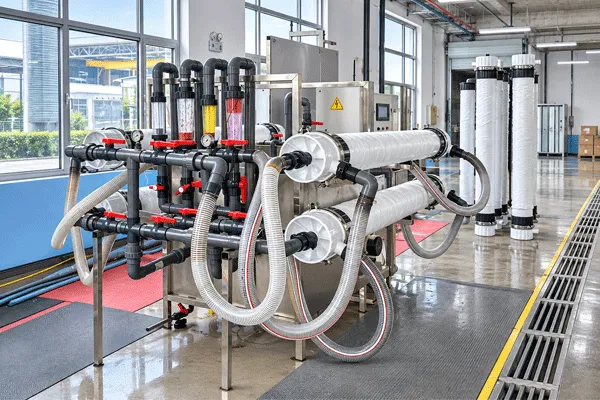
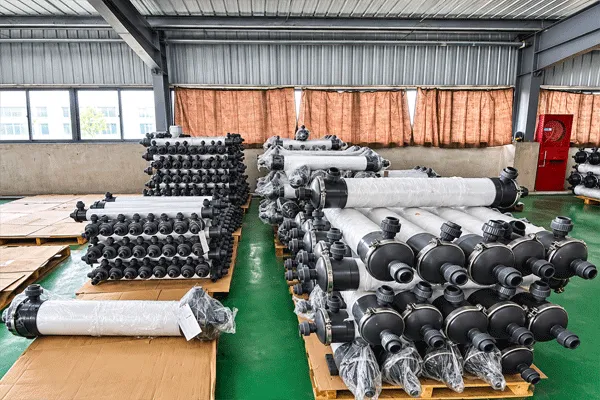
In membrane water treatment systems, reliable operation depends on more than the membrane material itself. The supporting frame, pipe connections, welded joints, and mounting structure all play important roles in equipment installation and long-term maintenance.
En Qingdao Banott Environmental Technology Co., Ltd., we recognize that attention to manufacturing details is an important part of delivering reliable membrane filtration equipment.
This photo update offers a closer look at the membrane frame assembly details, highlighting metal framework connections, pipe fittings, support brackets, and other structural elements involved in water and wastewater treatment equipment manufacturing.
Inside Banott’s Membrane Frame Manufacturing: A Closer Look at Structural and Assembly Details
Membrane Frame Manufacturing: Why Structural Details Matter
A membrane frame provides the supporting structure required to position and integrate membrane components within a treatment system.
In applications such as membrane bioreactor (MBR) wastewater treatment, a properly designed frame helps organize membrane modules, pipework, and related equipment within a limited installation space.
Although these structural components do not perform the membrane separation themselves, their arrangement can influence installation efficiency, access for maintenance, and the overall reliability of the equipment assembly.
For EPC contractors and water treatment engineering companies, frame construction is therefore an important consideration when evaluating a membrane system supplier.
Banott’s membrane-related manufacturing and engineering capabilities support both standard products and project-specific configurations, helping customers coordinate membrane equipment with their overall treatment plant design.
A Closer Look at the Metal Frame Structure and Welded Connections
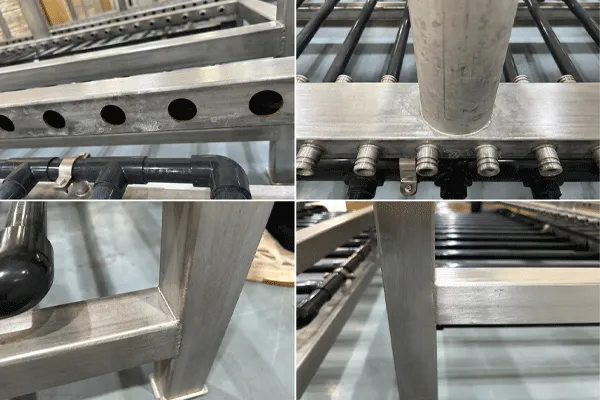
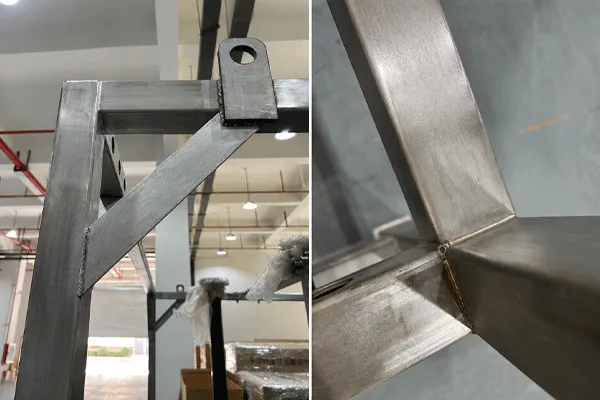
One of the most visible features in these manufacturing photographs is the metal supporting framework.
The images show rectangular metal sections, welded structural joints, reinforcing members, and mounting points that form part of the membrane frame assembly.
These components serve different purposes within the overall structure.
Frame members provide support and establish the basic equipment layout. Welded joints connect structural sections, while reinforcing brackets can help transfer loads between different parts of the assembly.
When manufacturing membrane support frames, important engineering considerations include:
- Structural dimensions and alignment.
- Positioning of welded connections.
- Suitable material selection for the operating environment.
- Strength and stability of supporting members.
- Installation and lifting requirements.
- Space for membrane installation and maintenance.
- Compatibility with the connected piping system.
The suitability of a completed frame must be evaluated against the approved drawings, specified materials, and project inspection requirements.
For industrial wastewater treatment equipment, these details are particularly important because membrane assemblies may operate in humid, corrosive, or continuously submerged environments.
Pipe Connections and Manifold Assembly Details
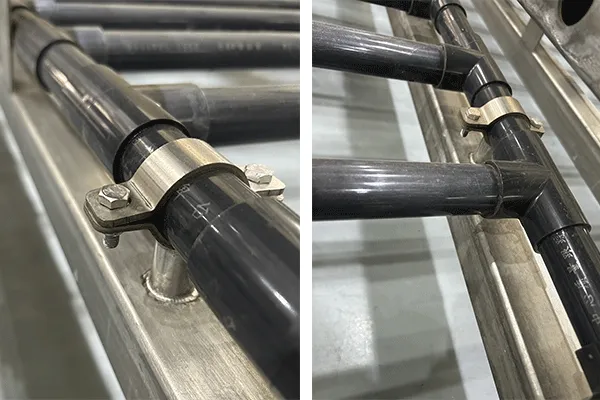
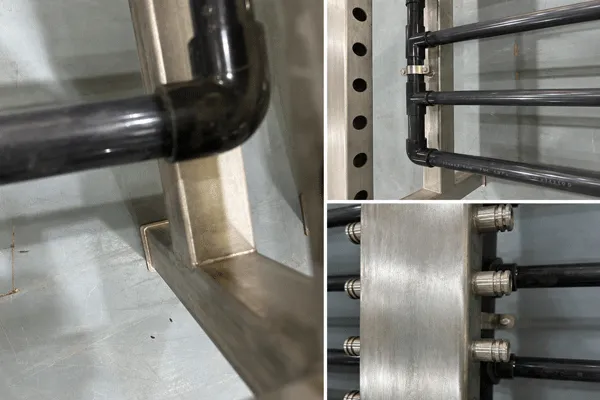
Another key feature shown in the photographs is the arrangement of pipe connections along the metal manifold.
The close-up images show multiple metal connection points, black plastic piping, pipe elbows, and fixed support arrangements.
In membrane filtration equipment, pipework must be arranged according to the specific hydraulic and operating requirements of the system.
Depending on the membrane configuration, the overall assembly may include permeate collection, air distribution, cleaning connections, and other process pipework.
Each pipe connection should match its assigned function and the approved engineering design.
Correct connection positioning can help simplify assembly and reduce difficulties during installation.
For project engineers, important considerations include:
- Pipe diameter and connection type.
- Alignment between connecting components.
- Compatibility of pipe and fitting materials.
- Mechanical support for connected pipes.
- Accessibility for inspection and replacement.
- Allowances for installation and maintenance.
The photographs also show metal clamps used to hold the black piping against the supporting structure.
Inside Banott’s Membrane Frame Manufacturing: A Closer Look at Structural and Assembly Details
Such fixing details are important because connected pipes may be exposed to movement, vibration, and other operating loads.
Proper pipe support can help limit unwanted movement and reduce additional mechanical stress on connected components.
Frame Openings, Mounting Points, and Assembly Accessibility
Small structural features can have an important function in a complete membrane installation.
The supplied images include close-up views of circular openings in a metal frame section, welded support points, and mechanical fixing details.
Depending on the final equipment design, frame openings and mounting features may provide connection points, assembly access, or other structural functions.
Their exact purpose must be established from the relevant engineering drawings.
For equipment manufacturers, these features require attention to positioning, dimensional consistency, and compatibility with adjoining components.
For EPC contractors, they can also affect how easily a membrane frame can be installed, connected, serviced, or incorporated into an existing treatment system.
This is one reason why membrane equipment customization should consider more than the membrane module dimensions alone.
The supporting frame must fit the available installation space and connect properly with the wider treatment system.
Manufacturing Details That Matter to Water Treatment Projects
Membrane frames are often part of a larger engineered system.
In industrial and municipal projects, equipment may need to fit existing tanks, connect with previously installed pipework, or meet specific access and layout requirements.
A frame that is difficult to install or maintain may create additional work for the contractor, even when the membrane modules themselves meet the project specifications.
For this reason, buyers should consider the following points during equipment selection:
| Design Consideration |
Importance for the Project |
| Frame dimensions |
Helps ensure compatibility with the available installation space |
| Structural connections |
Supports the mechanical design of the assembly |
| Pipe arrangement |
Helps coordinate the system’s hydraulic connections |
| Mounting positions |
Supports installation and equipment alignment |
| Material specifications |
Helps assess suitability for the operating environment |
| Maintenance clearance |
Provides access to components that may need servicing |
| Engineering documentation |
Supports installation, inspection, and project coordination |
These considerations are especially relevant for MBR membrane systems, membrane replacement projects, and customized industrial wastewater treatment installations.
They also highlight why membrane frame design and fabrication should be coordinated with the overall engineering package.
Inside Banott’s Membrane Frame Manufacturing: A Closer Look at Structural and Assembly Details
Supporting Customized Membrane Filtration Projects
At Banott, we combine membrane product supply with water and wastewater treatment engineering support.
Our product range includes PVDF Hollow Fiber MBR Membrane Modules, flat sheet MBR membranes, hollow fiber UF membranes, RO membranes, EDI modules, and integrated water treatment systems.
For membrane-related projects, we work with EPC contractors, environmental engineering companies, system integrators, and industrial equipment buyers to review equipment requirements and coordinate suitable system configurations.
Our Engineering & System Integration capabilities support projects involving equipment layout, piping coordination, system design, and integration with associated treatment processes.
Depending on the project scope, customers may require standard membrane equipment or customized support structures to match particular site conditions.
Important information for technical evaluation includes:
- Membrane module type and quantity.
- Tank dimensions and available installation area.
- Required frame dimensions.
- Equipment layout and pipe connection requirements.
- Operating environment and material requirements.
- Installation and maintenance access.
- Engineering drawings and project specifications.
Providing this information during the early design stage helps establish a clearer basis for technical discussions and equipment configuration.
Building Reliable Membrane Systems Starts with the Details
Reliable membrane filtration systems require coordination between membrane selection, equipment construction, hydraulic design, and operating conditions.
The frame details shown in these photographs illustrate how individual components—such as welded joints, pipe connections, fixing clamps, and structural supports—contribute to the complete equipment assembly.
For Banott, these manufacturing details are part of our broader focus on supplying practical membrane filtration products and supporting engineered water treatment projects.
Whether you are developing a new industrial wastewater treatment system, replacing membrane equipment, or planning a customized MBR installation, selecting compatible equipment and establishing clear technical requirements are important steps.
Inside Banott’s Membrane Frame Manufacturing: A Closer Look at Structural and Assembly Details
Looking for membrane modules or customized membrane frame solutions?
Contact Banott with your membrane type, installation dimensions, equipment layout, and project requirements. Our team can discuss suitable membrane products, structural configurations, and engineering support for your water and wastewater treatment project.
Contact Banott for Membrane Equipment and Engineering Support











 17:06