Unstable inlet water can clog equipment, disrupt production, and raise operating costs. Choosing the wrong treatment can leave those problems unsolved. Ultrafiltration helps remove fine particles and many microorganisms, providing a useful barrier when matched to your water source and production needs.
UF, or ultrafiltration, is used to remove suspended solids, colloids, and many microorganisms from water. Common uses include drinking water preparation, industrial pretreatment, wastewater polishing, and protection of reverse osmosis equipment. A UF system uses a porous membrane to separate contaminants, but it does not reliably remove dissolved salts, hardness, or all small organic compounds.
This guide explains what the technology can do, where it fits, and what to check before buying equipment. For plant owners and EPC contractors, those choices affect both daily operation and long-term costs.
¿Para qué se utiliza la ultrafiltración en el tratamiento del agua? Aplicaciones de la ultrafiltración y selección de sistemas
Article outline
- How does the process work?
- Which contaminants can it remove?
- Where is it used?
- How does it support municipal supplies?
- Why install it before RO?
- How does it support wastewater recovery?
- Which industries benefit?
- How should you select equipment?
- What affects maintenance and operating costs?
- Preguntas frecuentes
1. How Does Ultrafiltration Work?
The ultrafiltration process uses pressure to move water through a porous barrier. Water and smaller dissolved substances pass through the membrane, while larger particles remain on the feed side. This is mainly size-based separation. It differs from chemical treatment, which changes substances through reactions or helps particles gather into larger groups.
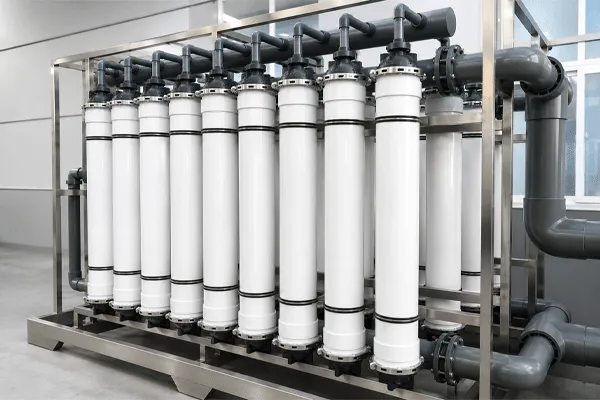
A hollow fiber UF membrane contains many thin, tube-like fibers. Depending on the design, water moves from inside the fibers outward or from outside inward. The treated stream is called filtrate o permeate. Retained material leaves through backwashing, draining, or a concentrate stream.
The membrane pore size affects what the unit can retain. For example, DuPont describes products with openings around 0.02–0.05 micrometers, although specifications vary by manufacturer and model. Pore size alone does not prove whole-system performance; product testing, integrity, and operating conditions also matter.
2. What Can an Ultrafiltration Membrane Remove?
An ultrafiltration membrane can retain suspended solids, fine particles, and colloids—tiny substances that may stay dispersed instead of settling. It can also retain many microorganisms. However, removing particles does not mean removing every contaminant from water. Clear output may still contain dissolved chemicals.
Dissolved salts and hardness generally pass through this barrier. Some larger organic substances may be retained, while smaller dissolved compounds can remain. DuPont’s design guidance also notes that dissolved organic carbon may pass into the filtrate and contribute to fouling.
| Contaminant or property |
Expected role of UF |
Additional consideration |
| Silt and fine particles |
Strong removal potential |
Feed loading affects cleaning needs |
| Bacteria and protozoa |
Retention with a suitable, intact product |
Verify validated performance |
| Virus |
Product-dependent removal |
Require specific supporting evidence |
| Sales disueltas |
Little useful removal |
Consider RO or another desalting process |
| Dureza disuelta |
Generally remains |
Consider softening where needed |
| Small dissolved organics |
Often limited removal |
Assess carbon, oxidation, or other steps |
Avoid a general claim that all products remove viruses from water equally. The EPA’s membrane guidance explains the importance of demonstrated removal and integrity monitoring. A nominal opening size is not a substitute for those checks.
3. What Are the Main Ultrafiltration Applications?
UF is used where fine-particle control supports a larger treatment goal. It may prepare incoming water, polish treated effluent, or protect downstream equipment. The key question is simple: What must the next process receive? That answer helps define the required treatment train.
The technology also appears in specialized separation duties beyond water purification. Those applications may use different modules, materials, and operating methods. Do not assume a standard water-treatment product suits food concentration or demanding chemical streams.
| Aplicación |
Objetivo principal |
Common companion processes |
| Municipal supply |
Reduce particles and validated microbial hazards |
Coagulation where needed, followed by disinfection |
| Pretratamiento por ósmosis inversa |
Lower particulate and colloidal loading |
Screening, dosing, and downstream RO |
| Factory utility supply |
Improve clarity and particle control |
Softening or demineralization when required |
| Treated-effluent polishing |
Capture remaining solids |
Biological treatment and final disinfection |
| Reclaimed cooling supply |
Reduce solids entering the reuse train |
Salt and biological control |
| Remote facilities |
Provide modular treatment capacity |
Source-specific pretreatment and storage |
For engineering comparisons, define both the required outlet and the expected inlet range. A unit designed for stable municipal water may not suit a river intake with heavy seasonal solids.
¿Para qué se utiliza la ultrafiltración en el tratamiento del agua? Aplicaciones de la ultrafiltración y selección de sistemas
4. How Does UF Support Drinking Water Treatment?
In municipal water treatment applications, membrane filtration can provide a physical barrier against particles and selected pathogens. It can help operators maintain a controlled output despite changes in surface water. The EPA identifies microfiltration and ultrafiltration as established options for removing larger pathogens such as Giardia and Cryptosporidium.
However, producing potable water requires assessment of the full source, including dissolved chemicals. A filtration barrier does not provide a disinfectant residual in storage or distribution. Drinking water production therefore needs an appropriate combination of treatment, monitoring, and protection after the equipment.
For municipal water treatment plants, we recommend making the following items explicit in procurement documents:
- Required microbial performance and supporting test evidence.
- Integrity testing and response to a failed test.
- Filtrate monitoring and alarm settings.
- Final disinfection arrangements.
- Storage hygiene and distribution protection.
- Acceptance criteria for commissioning.
These requirements help turn an equipment purchase into a complete operating plan. They also make supplier proposals easier to compare.
5. Why Is UF Often Installed Before an RO System?
An RO system removes dissolved substances but can suffer when particles and colloids reach its feed channels. UF pretreatment can reduce that load. This makes the two technologies complementary: one focuses on fine suspended matter, while the other addresses dissolved salts and other substances.
UF does not eliminate every RO risk. Dissolved minerals can still form scale, and small organic compounds may pass upstream barriers. RO design must therefore consider the full feed analysis, including chemistry, temperature, and the planned recovery. DuPont identifies pretreatment for desalination and RO as established uses of its UF products.
An illustrative water purification process might include:
Screening → UF → required chemical conditioning → RO → application-specific polishing
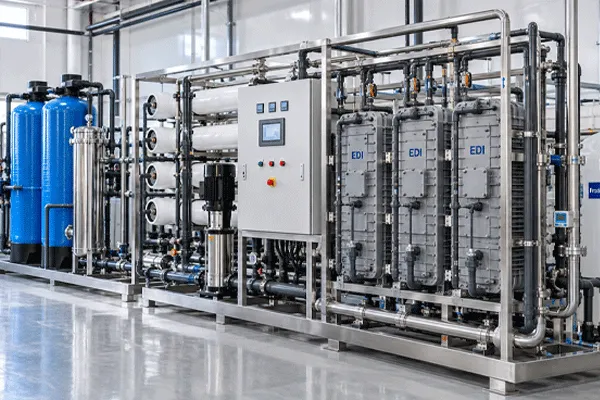
The actual sequence depends on the source. For electronics or other high-purity duties, further stages may include EDI and additional polishing. As a provider of integrated equipment, we recommend agreeing on the quality required at each stage instead of judging the final plant only by rated flow.
6. How Is Ultrafiltration Used in Wastewater Treatment and Recovery?
Ultrafiltration is used to capture remaining solids after upstream treatment. It can support water reuse by preparing effluent for disinfection, RO, or an approved end use. DuPont describes its UF modules as a means of lowering total suspended solids in industrial recovery schemes.
The treatment of aguas residuales still requires attention to dissolved pollutants. A UF unit does not replace biological treatment for biodegradable organic loads. Also, an MBR combines biology with a separation barrier; a standalone polishing skid performs a different role. This distinction matters when comparing quotations.
Consider this illustrative planning example, not a customer case study:
| Planning assumption |
Value |
| Secondary effluent supplied |
100 m³/h |
| Assumed net yield through the polishing stage |
90% |
| Net treated output |
90 m³/h |
| Daily operating time |
20 hours |
| Calculated daily output |
1,800 m³/day |
Actual yield depends on cleaning, solids loading, and operating design. The 1,800 m³/day figure describes volume only; it does not prove suitability for a particular use. Match the outlet specification to the intended destination before estimating freshwater savings.
7. Which Industries Benefit from UF Technology?
Industrial water treatment needs vary widely. A food factory may need stable incoming process water. A textile plant may need particulate removal before a more demanding recovery stage. A pharmaceutical or electronics facility may use UF within a larger purity strategy, while relying on other steps for dissolved-ion control.
We recommend defining the task by production needs rather than industry name alone. Two factories making similar goods can have very different inlet chemistry, cleaning routines, and peak demand. A useful design brief identifies what causes disruption and what the treated supply must achieve.
| User or sector |
Potential role |
Question to resolve |
| Fábricas de alimentos y bebidas |
Prepare incoming utility or ingredient supply |
What quality and hygienic controls apply? |
| Textile and dyeing plants |
Polish solids before further recovery |
Which dissolved colors and salts remain? |
| Plantas químicas |
Separate compatible particulate loads |
Can the materials tolerate the stream? |
| Electronics manufacturers |
Support a multi-stage purity train |
What final ionic and particle limits apply? |
| Hotels and farms |
Treat a suitable local source |
What is the intended end use? |
| Polígonos industriales |
Provide shared pretreatment capacity |
How variable are combined incoming streams? |
These questions help determine whether UF technology is a good fit, where it belongs, and whether testing is needed before full-scale supply.

¿Para qué se utiliza la ultrafiltración en el tratamiento del agua? Aplicaciones de la ultrafiltración y selección de sistemas
8. How Do You Select the Right UF System?
Start with analysis, not equipment size. Your feed water report should cover solids, turbidity, temperature, pH, and relevant organic or chemical loads. Include seasonal extremes where available. A single clear-water sample can hide the conditions that drive module area and cleaning demand.
Next, define net capacity. A UF system rated only by instantaneous flow may deliver less usable water after backwashing and downtime. Also check membrane material, module configuration, permitted cleaning conditions, and replacement access. Difficult or variable streams may justify pilot testing before final sizing.
For a customized water treatment system, we recommend requesting:
- A stated inlet design range and guaranteed outlet conditions.
- Net output at the agreed operating temperature.
- A water balance covering backwash and waste streams.
- Chemical and utility consumption assumptions.
- Duty and standby arrangements.
- PLC controls and any required SCADA interface.
- Installation drawings, manuals, and spare-parts lists.
- Commissioning scope and operator training.
Our manufacturing scope includes hollow fiber UF products, hollow fiber and flat sheet MBR products, RO units, EDI modules, and complete plants. This allows the discussion to cover the full treatment process, including skid-mounted, containerized, and EPC configurations, rather than one component alone.
9. What Affects UF Operating Costs and Membrane Maintenance?
A useful cost comparison includes electricity, cleaning chemicals, waste handling, labor, and replacement parts. Purchase price alone can be misleading. Ask each supplier to use the same inlet conditions, net output, operating hours, and service assumptions.
During operation, retained material can build up on the superficie de la membrana. Backwashing and approved chemical cleaning help control that buildup, but operating limits vary by model. DuPont’s product design manuals describe cleaning and operating requirements for specific product families; these should guide the final maintenance plan.
We suggest tracking the following together:
| Operating measure |
Por qué es importante |
| Net output |
Shows usable production |
| Pressure across the barrier |
Helps reveal growing resistance |
| Temperature-adjusted permeability |
Supports fair performance comparisons |
| Backwash and chemical consumption |
Makes maintenance demand visible |
| Filtrate condition and integrity results |
Checks separation performance |
| Unplanned downtime |
Shows the impact on site operations |
Before requesting a proposal, collect your analysis, required capacity, outlet target, and layout. Send us these details to discuss a suitable configuration, including automation, technical documentation, commissioning support, and spare-parts planning. For an existing plant, operating trends can also help define the upgrade scope.
10. Frequently Asked Questions About UF Membrane Filtration
Does UF remove dissolved salts or reduce TDS?
Usually, it does not reduce total dissolved solids to a useful degree. Most dissolved salts pass through its pores. If low conductivity or desalting is your main goal, consider RO, ion exchange, or another suitable process based on the full analysis.
Can UF alone produce safe drinking water?
Do not assume so. Suitability depends on the source, dissolved contaminants, demonstrated microbial removal, equipment integrity, and downstream protection. Treat it as one part of a source-specific safety plan, with appropriate disinfection and verification.
What is the difference between UF and RO?
UF primarily separates fine suspended matter through a porous barrier. RO targets dissolved salts and many smaller substances using a different separation mechanism and typically higher pressure. The better choice depends on what must be removed; many projects use both.
Does a smaller membrane pore always mean a better system?
No. Selection must balance retention, flow, fouling behavior, cleaning, and validated performance. A smaller nominal opening does not automatically produce lower operating costs or better overall reliability. Compare the complete design against your required duty.
Can UF treat oily or highly polluted effluent directly?
It depends on the oil form, concentration, chemicals, and selected product. Some specialized designs handle demanding streams, while standard modules may foul quickly. Characterize the wastewater and assess upstream oil removal, biological treatment, or pilot trials before choosing equipment.
Can an existing plant be upgraded with a modular unit?
Often, but the available space is only one factor. Check hydraulic conditions, electrical supply, waste capacity, storage, controls, and access for maintenance. A retrofit should include a site-specific integration plan and clearly defined acceptance tests.
Puntos clave
- UF removes fine suspended matter; it is not a general desalting process.
- Common uses include municipal supply, RO pretreatment, factory utilities, and effluent polishing.
- Verify microbial claims through product-specific evidence and integrity checks.
- Size equipment using the inlet range and required net output.
- Compare complete operating costs, including cleaning and waste handling.
- Plan automation, documentation, service access, and support before purchase.
- Share your analysis and project targets to develop a suitable treatment configuration.











 11:12